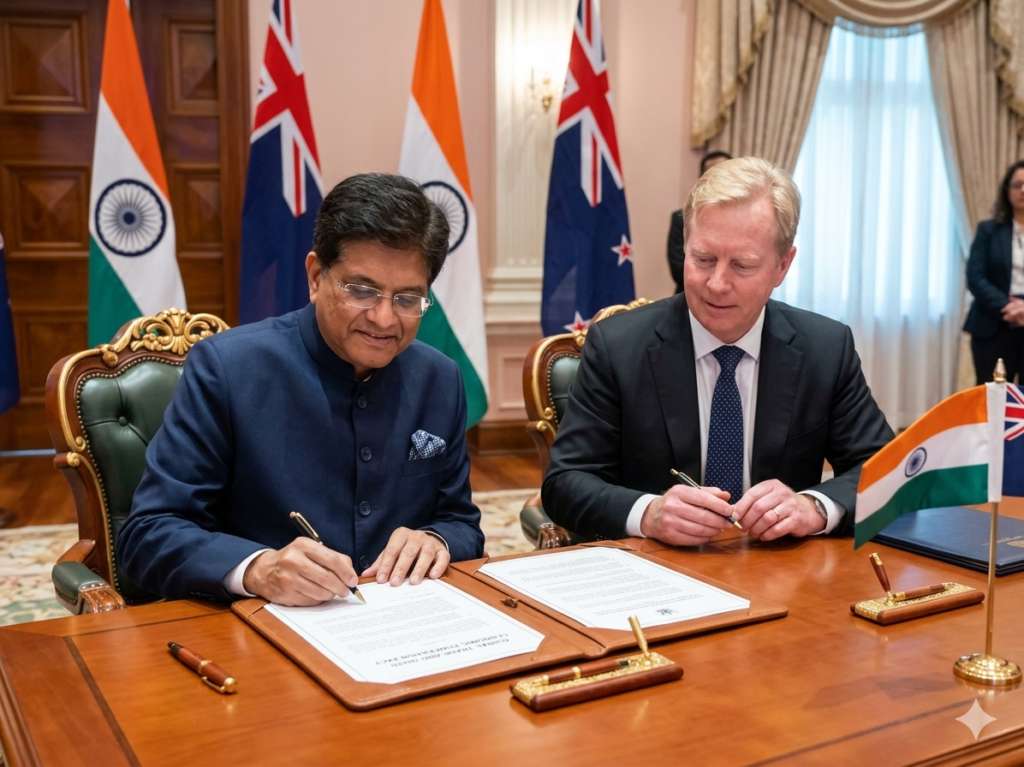
On the surface, the India-New Zealand Free Trade Agreement (FTA) signed on Monday might seem like a footnote. New Zealand’s economy is a mere one-sixteenth the size of India’s, accounting for less than 1% of our total trade. However, to dismiss it based on size is to miss the forest for the trees.
In the high-stakes game of global trade, this agreement is not just about kiwis and wool; it is a critical piece of a larger puzzle designed to insulate India from the volatility of the two “Goliaths”—China and the United States.
1. The ‘Trump-China’ Hedge
The timing of this deal is its true strength. With Donald Trump back in charge of the U.S. (India’s largest export market), the global trade environment has become “mercurial.” At the same time, the “hard task” of weaning India off its 16% import dependency on China remains a national priority.
- Diversification as Defense: By stacking deals with Mauritius, the UAE, Australia, the UK, the EU, and now New Zealand, India is “chipping away” at China’s dominance and creating an insurance policy against potential U.S. tariff frictions.
2. A Masterclass in Negotiation
India’s negotiators deserve credit for a deal that is essentially “all gain, no pain.”
- Immediate Access: In an unprecedented move, New Zealand will remove all goods tariffs immediately upon execution.
- Protecting the Heartlands: Crucially, India has successfully defended its sensitive sectors. Despite immense pressure, Dairy—the backbone of India’s rural economy—remains entirely excluded from the concessions. This is a massive victory for Indian farmers.
3. From Trade to Investment
Like the EFTA pact before it, the New Zealand deal moves beyond the movement of goods into the realm of capital.
- The $20 Billion Commitment: New Zealand has committed to facilitate $20 billion in investments over 15 years.
- The ‘Red Carpet’ Treatment: India’s promise to create a “dedicated desk” for New Zealander investors shows a targeted approach to FDI. This isn’t just about money; it’s about creating jobs and bolstering the capital account to fuel long-term growth.
4. The Scaling Problem
While the FTA provides the “gateway,” the editorial raises a sobering point: domestic manufacturers still struggle to scale up. An FTA can open the door, but Indian industry must be efficient enough to walk through it.
The Bottom Line
The India-New Zealand FTA is a testament to India’s growing “comparative advantage.” It signals that India is no longer a passive participant in global trade but a strategic architect, building a diverse network of partners to ensure that our prosperity is never again dependent on the whims of a single superpower or the stability of a single supply chain.