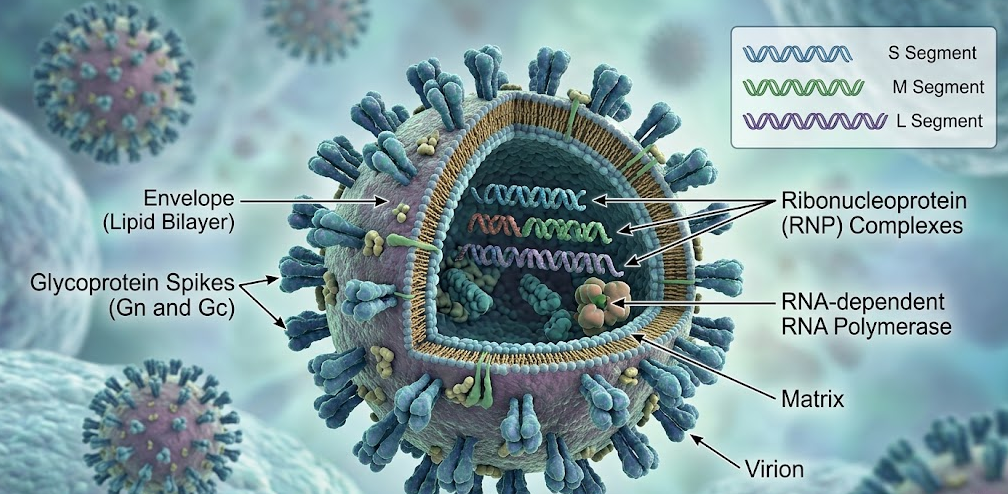
The recent report of a Hantavirus outbreak aboard the cruise ship MV Hondius has triggered a global health alert. The cruise ship MV Hondius reported eight probable cases of Hantavirus, with five confirmed cases and three deaths.
- India’s Involvement: Two Indian nationals on board are currently asymptomatic but remain under observation as per international health protocols.
- Government Action: The Union Health Ministry is coordinating with the World Health Organization (WHO) to monitor the situation and prevent potential domestic spillover.
What is Hantavirus?
Hantaviruses are a family of viruses spread mainly by rodents (rats, mice, and voles). They belong to the Bunyaviridae family.
- Transmission Mechanism:
- Aerosolization: This is the primary mode of transmission. Humans become infected by breathing in air contaminated with the virus through rodent urine, droppings, or saliva.
- Direct Contact: Touching contaminated surfaces and then touching eyes, nose, or mouth.
- Bites: Rarely, the virus can be transmitted through a rodent bite.
- Human-to-Human: Generally, Hantavirus is not transmitted between humans. However, a specific strain called the Andes virus (found in South America) has shown rare instances of person-to-person transmission.
- Classification of Diseases:
- Hantavirus Pulmonary Syndrome (HPS): Common in the Americas. It primarily affects the lungs and heart.
- Hemorrhagic Fever with Renal Syndrome (HFRS): More common in Europe and Asia. It primarily affects the kidneys and causes internal bleeding.
Clinical Profile: Symptoms and Progression
Hantavirus has an incubation period ranging from 1 to 8 weeks. The progression is often divided into two phases:
| Phase | Symptoms |
| Early Symptoms (Prodromal) | Fatigue, high fever, muscle aches (especially in large muscle groups like thighs, hips, and back), headaches, dizziness, and abdominal pain. |
| Late Symptoms (HPS) | Occur 4-10 days after the initial phase. Includes coughing, shortness of breath, and lungs filling with fluid (pulmonary edema). Mortality rate is high (approx. 38%). |
| Late Symptoms (HFRS) | Intense back pain, blurred vision, rash, and eventually kidney failure or shock. |
Why is Hantavirus a Global Concern?
The MV Hondius incident highlights several factors that make Hantavirus a significant public health threat:
- High Fatality Rate: Unlike common respiratory viruses, Hantavirus (specifically HPS) has a high mortality rate, often exceeding 35%.
- Zoonotic Spillover: As human habitats expand into wilderness areas (or expedition cruises enter remote rodent-populated regions), the risk of “spillover” from animals to humans increases.
- International Travel: Ships and aircraft can act as “super-spreaders” for the virus’s vectors (rodents) or infected individuals, turning a localized outbreak into a global concern.
- Lack of Specific Cure: There is currently no specific treatment, cure, or vaccine for hantavirus infection. Care is primarily supportive (intubation, oxygen therapy).
5. WHO’s Role and International Protocols
The WHO operates under the International Health Regulations (IHR, 2005) to manage such outbreaks:
- Surveillance: The WHO Global Outbreak Alert and Response Network (GOARN) monitors the vessel’s movement and ensures data sharing between countries.
- Standard Operating Procedures (SOPs): Implementing strict quarantine and isolation protocols for ships reporting viral outbreaks.
- Vector Control: Guidelines for “deratting” (rodent control) on international vessels are enforced through Ship Sanitation Certificates.
- Technical Support: Providing member states with laboratory diagnostic kits and clinical management guidelines for rare viral infections.
6. Solutions and Preventive Measures
To control the spread of Hantavirus, a multi-pronged approach is required:
A. Public Health Measures (Government Level):
- Screening at Ports: Strengthening health desks at International Cruise Terminals to screen travellers coming from affected regions.
- Integrated Vector Management: Intense rodent control programs in urban and port areas.
- Laboratory Preparedness: Ensuring institutions like the National Institute of Virology (NIV) have the capacity to sequence Hantavirus strains.
B. Individual Level:
- Rodent-Proofing: Sealing holes in homes/workplaces and using traps.
- Safe Cleaning: Do not sweep or vacuum rodent droppings (this kicks up dust). Instead, use disinfectants or a bleach solution to wet the area before cleaning.
- Hygiene: Frequent handwashing after handling materials in areas where rodents might be present.
Practice Questions
Prelims (PT) Related
Q1. Consider the following statements regarding Hantavirus:
- It is a DNA virus primarily transmitted through the bite of a mosquito.
- The virus is usually spread to humans through the aerosolization of rodent excreta.
- Person-to-person transmission is the most common way the virus spreads globally.
Which of the statements given above is/are correct?
(a) 1 and 2 only
(b) 2 only
(c) 2 and 3 only
(d) 1, 2, and 3
Q2. With reference to ‘Hantavirus Pulmonary Syndrome’ (HPS), which of the following is true?
(a) It has a very low mortality rate, similar to the common cold.
(b) It is effectively treated with a widely available vaccine.
(c) It primarily affects the respiratory system and can lead to fluid accumulation in the lungs.
(d) It is caused by consuming contaminated water.
Q3. The ‘International Health Regulations (IHR)’ are an instrument of which international organization?
(a) World Trade Organization (WTO)
(b) World Health Organization (WHO)
(c) World Economic Forum (WEF)
(d) United Nations Environment Programme (UNEP)
Mains Related
Q1. “The increasing frequency of zoonotic outbreaks like Hantavirus and Nipah highlights the vulnerabilities in global health infrastructure.” Discuss the challenges in managing such outbreaks and suggest measures for strengthening India’s public health preparedness. (250 words)
Q2. Explain the mechanism of Hantavirus transmission. Why do enclosed environments like cruise ships pose a unique challenge for the containment of viral infections? (150 words)