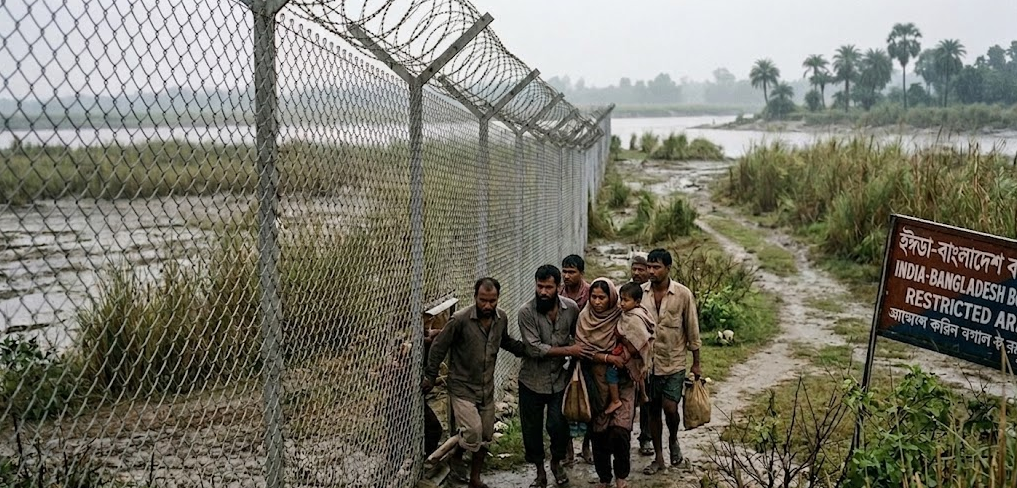
A recent diplomatic document has revealed a significant stalemate between New Delhi and Dhaka regarding the repatriation of suspected illegal immigrants. While India has intensified its diplomatic outreach through Notes Verbale, Bangladesh has expressed concerns over “push-in” allegations following remarks by Indian political leadership.
Key Statistics & Data Points
| Category | Metric |
| Notes Verbale Sent | 1,137 (since September 2020) |
| Consolidated Reminders | 456 |
| Pending Verification Cases | 2,862 cases (some pending for over 5 years) |
| Core Grievance | Lack of “actionable response” from Dhaka for nationality verification. |
Major Points of Contention
- The “Push-in” vs. “Repatriation” Debate:
- India’s Stance: Claims all measures for repatriation are done in adherence to Indian laws and established bilateral arrangements.
- Bangladesh’s Concern: Dhaka protested against remarks suggesting border guards were “pushing in” individuals through unguarded sections, viewing this as a violation of formal protocols.
- Nationality Verification: This is the primary bottleneck. Under bilateral agreements, a person can only be repatriated if their country of origin (Bangladesh) verifies their citizenship. India alleges that Dhaka is not extending the necessary cooperation.
- Domestic Politics: Rhetoric during state elections (Assam and West Bengal) often spills over into bilateral diplomacy, leading to “summons” of envoys and public protests.
Illegal Migration from Bangladesh to India
The Issue: Undocumented Migration
The issue refers to the movement of individuals across the 4,096 km India-Bangladesh border without valid travel documents or legal authorization.
- Geographical Context: The border is the longest India shares with any neighbor, characterized by porous terrains, riverine stretches (char lands), and dense forests, making it difficult to monitor.
- Recent Status: As per recent diplomatic records, there are over 2,862 pending cases for nationality verification, with India sending over 1,100 Notes Verbale since 2020 to facilitate repatriation.
- Causes of Migration
- Migration is driven by a combination of Push and Pull factors:
| Push Factors (From Bangladesh) | Pull Factors (To India) |
| Economic Distress: High poverty levels and lack of employment opportunities in rural areas. | Economic Opportunity: Demand for low-cost labor in India’s construction and domestic sectors. |
| Environmental Vulnerability: Frequent cyclones and flooding in the Ganga-Brahmaputra delta (Climate Refugees). | Cultural Affinity: Shared language (Bengali), ethnicity, and kinship ties in West Bengal and Tripura. |
| Religious/Political Factors: Occasional targeted violence or instability affecting minority communities. | Porous Borders: Ease of crossing due to riverine gaps and incomplete fencing. |
Major Concerns
- National Security: Concerns regarding the infiltration of radicalized elements and the use of porous borders by Insurgent Groups in the Northeast for safe havens.
- Demographic Shift: Significant changes in the demographic profile of border districts in Assam, West Bengal, and Tripura, leading to social friction and “sons of the soil” movements.
- Economic Strain: Increased competition for low-skilled jobs, pressure on public land, and the stretching of state resources (subsidies, healthcare, and education).
- Transnational Crime: Facilitation of human trafficking, cattle smuggling, and the circulation of Fake Indian Currency Notes (FICN).
- Political Sensitivity: The issue often leads to diplomatic “tit-for-tat,” such as the summoning of envoys and protests over “push-in” allegations.
Proposed Solutions
- Comprehensive Integrated Border Management System (CIBMS): Moving from physical fencing to “Smart Fencing” using infrared sensors, cameras, and GPS to plug riverine gaps.
- Diplomatic Streamlining: Establishing a Standard Operating Procedure (SOP) with Dhaka for time-bound nationality verification to avoid the “repatriation stalemate.”
- Biometric Database: Implementation of a robust system to identify and track undocumented individuals to prevent them from obtaining sovereign documents (Aadhaar, Voter ID).
- Economic Cooperation: Investing in Bangladesh’s border districts to reduce “Push” factors. A prosperous Bangladesh is the best guarantee against illegal migration.
- Work Permits: Some experts suggest a “Work Permit” system that allows legal seasonal labor migration without granting citizenship or permanent residency.
Key Terms for UPSC
- Note Verbale: A formal diplomatic communication drafted in the third person and unsigned. It is less formal than a “letter” but more formal than an “aide-mémoire.”
- Repatriation: The process of returning a person—voluntarily or forcibly—to their place of origin or citizenship.
- Nationality Verification: A sovereign process where a state confirms whether a suspected illegal immigrant is indeed its citizen before accepting them back.
Practice Questions
Prelims (PT) Related
Q1. In the context of international diplomacy, the term ‘Note Verbale’ refers to:
(a) A verbal agreement between two heads of state that is not legally binding.
(b) A formal, unsigned diplomatic communication written in the third person.
(c) A secret document shared only between intelligence agencies of two countries.
(d) A public declaration made at the United Nations General Assembly.
Q2. India shares its longest land border with which of the following countries?
(a) China
(b) Pakistan
(c) Bangladesh
(d) Myanmar
Q3. Consider the following statements regarding the repatriation of illegal immigrants:
- Under international law, a country is obligated to accept its citizens being repatriated from another country.
- Nationality verification is a mandatory step in the formal bilateral repatriation process between India and Bangladesh.
Which of the statements given above is/are correct?
(a) 1 only
(b) 2 only
(c) Both 1 and 2
(d) Neither 1 nor 2
Mains Related
Q1. “Illegal migration remains a ‘core issue’ that periodically strains the ‘Neighborhood First’ policy of India with respect to Bangladesh.” Analyze the challenges in the formal repatriation process and suggest measures to resolve this diplomatic stalemate. (250 words)
Q2. Discuss the role of domestic political rhetoric in shaping bilateral relations between neighbouring countries. How can India balance its internal security concerns with its diplomatic commitments to Bangladesh? (150 words)