A recent extensive survey (2021–2023) led by researchers from MIT-World Peace University has highlighted a concerning “alarming gap” in the Odonata (dragonflies and damselflies) population within the Western Ghats. The study suggests that nearly 35% of historically recorded species are currently missing from the region.
Study Overview & Key Data
- Survey Scope: 144 sites across 5 states (Maharashtra, Kerala, Karnataka, Goa, and Gujarat).
- Total Species Recorded: 143 (76 dragonflies and 67 damselflies).
- Endemism: 40 species are endemic (found nowhere else) to the Western Ghats.
- The Gap: Only 65% of historically known species were recovered, indicating potential local extinctions or severe habitat degradation.
| Category | Count | Notable Species |
| Vulnerable (IUCN) | 3 | Elattoneura souteri, Protosticta sanguinostigma, Cyclogomphus ypsilon |
| Data Deficient | 22 | Indicates a massive gap in scientific understanding. |
| Least Concern | 100 | Most common species. |
Odonata as “Indicator Taxa”
Dragonflies and damselflies are considered biological indicators of ecosystem health for several reasons:
- Freshwater Dependence: They require clean, freshwater bodies for reproduction and their larval stage.
- Sensitivity: They are highly sensitive to changes in water quality, temperature, and habitat structure.
- Trophic Level: As both predators (of mosquitoes/flies) and prey (for birds/fish), their absence signals a collapse in the local food web.
Regional Distribution: North vs. South
The study confirmed that Southern Western Ghats (Kerala and Southern Karnataka) exhibit higher species richness and endemism compared to the Northern parts (Maharashtra and Gujarat).
- Reason: Availability of perennial (year-round) streams and stable microhabitats in the South.
- Northern Ghats: Higher seasonality and more fragmented habitats lead to lower Odonata diversity.
Biodiversity in the Western Ghats
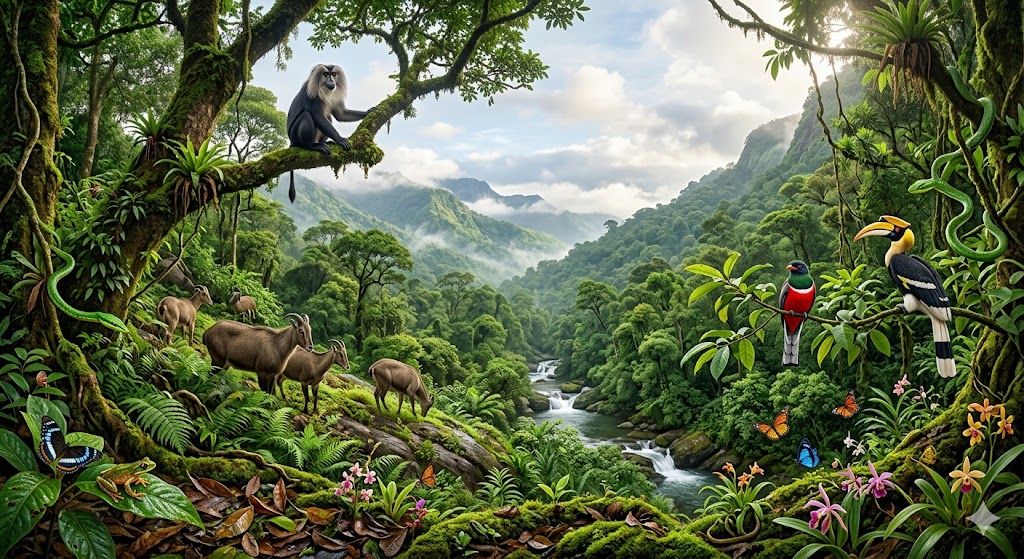
Recognized as a UNESCO World Heritage Site and one of the world’s 36 Global Biodiversity Hotspots, the Western Ghats are a laboratory of evolution.
- High Endemism: Because the Ghats are isolated by the Arabian Sea to the west and dry peninsular plateaus to the east, they act like an “ecological island.”
- Over 50% of India’s amphibian species and 62% of reptile species found here are endemic (found nowhere else on Earth).
- Out of ~5,000 plant species, nearly 30% are endemic.
- Flagship & Endemic Species:
- Mammals: Lion-tailed Macaque (Endangered), Nilgiri Tahr (Endangered), Malabar Large-spotted Civet (Critically Endangered).
- Amphibians: Purple Frog (Mahabali frog).
- Birds: Great Hornbill, Nilgiri Wood Pigeon.
- Insects: High diversity of Odonata (dragonflies/damselflies).
- Ecosystem Diversity: Ranges from tropical wet evergreen forests and moist deciduous forests to high-altitude shola-grassland ecosystems.
Threats to Biodiversity in the Western Ghats
The degradation of the Western Ghats is primarily driven by anthropogenic (human-induced) activities, compounded by climate change.
A. Habitat Loss & Fragmentation (Land-Use Change)
- Monoculture Plantations: Historical and ongoing conversion of native forests into commercial plantations like tea, coffee, rubber, eucalyptus, and teak.
- Linear Infrastructure: Roads, railways, and powerlines carve through dense forests, creating “barriers” that fragment habitats and increase wildlife roadkills.
B. Unregulated Developmental Projects
- Mining: Rampant illegal and legal mining for iron ore, manganese, and bauxite (especially in Goa and Karnataka) destroys the topsoil and pollutes watersheds.
- Hydropower & Dams: The Western Ghats are the origin of major peninsular rivers (Godavari, Krishna, Cauvery). Damming these rivers alters the hydrology, submerges vast forest tracts, and destroys the breeding grounds of freshwater species (like Odonata).
C. Climate Change & Natural Disasters
- Microclimate Alteration: Rising temperatures and erratic monsoons disrupt the life cycles of sensitive flora and fauna.
- Extreme Events: Increased frequency of forest fires during dry spells and devastating landslides during monsoons (exacerbated by deforestation and quarrying).
D. Pollution & Invasive Species
- Agrochemicals: Runoff of pesticides and fertilizers from plantations into streams causes toxicity in the food web.
- Invasive Alien Species (IAS): Weeds like Lantana camara and Senna spectabilis are outcompeting native forage plants, causing food scarcity for herbivores like elephants and deer.
Solutions & Conservation Measures
Conservation in the Western Ghats requires a delicate balance between ecological integrity and the developmental needs of the millions living in and around the range.
A. Implementation of Ecological Expert Committee Reports
- Gadgil Committee (WGEEP – 2011): Recommended designating the entire Western Ghats as an Ecologically Sensitive Area (ESA) with varying degrees of protection (ESZ 1, 2, and 3) and a ban on new mining and large dams.
- Kasturirangan Committee (2013): A diluted version of the Gadgil report, recommending that only 37% of the Western Ghats (approx. 60,000 sq km) be declared as an ESA.
- Solution: The government must finalize and implement the ESA notifications strictly, without succumbing to local political and mining lobbies.
B. Strengthening Protected Area (PA) Networks
- Expanding the footprint of National Parks, Wildlife Sanctuaries, and Biosphere Reserves (e.g., Nilgiri and Agasthyamalai Biosphere Reserves).
- Securing Wildlife Corridors: Identifying and legally protecting elephant and tiger corridors to ensure genetic exchange and reduce human-wildlife conflict.
C. Sustainable Land-Use & Agro-Ecology
- Promoting shade-grown coffee and organic farming to reduce agrochemical runoff.
- Regulating ecotourism by assessing the “carrying capacity” of fragile destinations to prevent over-commercialization.
D. Community-Led Conservation
- Involving indigenous and local communities (e.g., the Todas, Kurumbas) in conservation efforts.
- Recognizing Forest Rights Act (FRA) claims, empowering Gram Sabhas to manage minor forest produce sustainably, and employing locals in anti-poaching and forest fire management squads.
E. Scientific Monitoring & Mitigation
- Undertaking continuous baseline surveys (like the recent MIT-WPU Odonata survey) to move species from “Data Deficient” to actively monitored categories.
- Building “eco-bridges” or underpasses for wildlife across linear infrastructure projects.
Practice Questions
PT (Preliminary Test) Question
Q1. With reference to ‘Odonata’ species mentioned in the news, consider the following statements:
- They are considered “indicator taxa” because their presence reflects the health of freshwater ecosystems.
- The Western Ghats survey found that the Northern part of the region has higher endemism than the Southern part.
- According to the IUCN Red List, the majority of Odonata species in the Western Ghats are classified as ‘Vulnerable’.
Which of the statements given above is/are correct?
A) 1 only
B) 1 and 2 only
C) 2 and 3 only
D) 1, 2, and 3
Answer: A) 1 only. (Statement 2 is incorrect: Endemism is higher in the South. Statement 3 is incorrect: The majority are classified as ‘Least Concern’, though many are ‘Data Deficient’.)
Mains Practice Question
Q2. “The decline of indicator species like the Odonata in biodiversity hotspots is a precursor to deeper ecological stress.” Discuss this statement in the context of the Western Ghats. Suggest measures to bridge the ‘data gap’ and ensure the conservation of freshwater microhabitats. (250 Words)