The Delhi High Court, in a significant ruling on May 8, 2026, protected the “personality rights” of Member of Parliament Shashi Tharoor. Justice Mini Pushkarna restrained the unauthorized use of his likeness, voice, and unique oratorical style, reinforcing the legal boundaries surrounding a public figure’s persona.
What are Personality Rights?
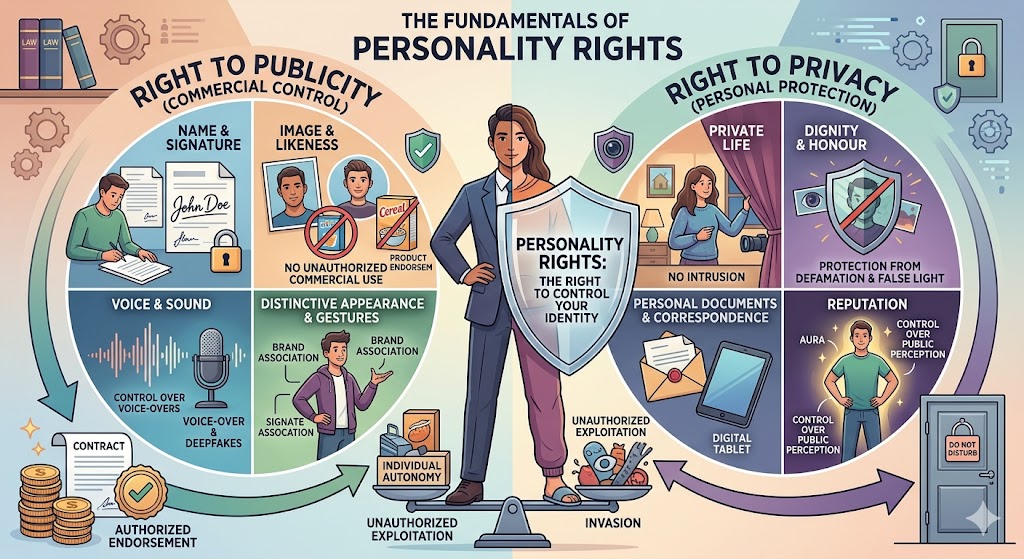
Personality rights, often referred to as Publicity Rights, consist of the right of an individual to control the commercial use of their identity, including their name, image, likeness, or other unequivocal identifiers.
- Right to Privacy: Protected under Article 21 (Right to Life and Liberty), ensuring a person is not portrayed without consent.
- Right to Publicity: The right to keep the commercial value of one’s identity to oneself.
Key Facets Protected in this Ruling:
- Visual likeness and image.
- Distinct voice.
- Signature oratorical cadence (manner of speaking).
- Highly refined vocabulary (unique linguistic style).
Legal Framework in India
Unlike some Western nations, India does not have a specific statute dedicated to personality rights. Instead, they are recognized through a combination of:
| Legal Basis | Description |
| Article 21 | Fundamental Right to Privacy (Justice K.S. Puttaswamy vs. Union of India case). |
| Common Law | Principles of “Passing Off” (preventing someone from representing their goods/services as someone else’s). |
| IPR Laws | Elements of the Copyright Act (1957) and Trademarks Act (1999) apply to signatures and specific performances. |
| Judicial Precedents | Courts have previously protected actors like Amitabh Bachchan, Anil Kapoor, and Jackie Shroff from unauthorized AI-generated content and mimicry for commercial gain. |
Strategic Significance & AI Context
- The “Deepfake” Challenge: The ruling is particularly relevant in the era of Artificial Intelligence. AI can now clone voices and generate photorealistic “deepfake” videos. Protecting a “distinct voice” and “manner of speaking” provides a legal shield against digital misappropriation.
- Commercial vs. Non-Commercial Use: While mimicry for satire or news reporting is often protected under “fair use” (Article 19 – Freedom of Speech), the court intervenes when such attributes are used for commercial exploitation or to mislead the public.
- Recognition of Intellectual Traits: By protecting a “refined vocabulary,” the court has expanded the scope of personality rights from physical appearance to intellectual and behavioral traits.
Practice Questions
PT (Preliminary Test) Question
Q1. With reference to ‘Personality Rights’ in India, consider the following statements:
- Personality rights are explicitly defined under a dedicated central statute in India.
- These rights are an extension of the Right to Privacy under Article 21 of the Constitution.
- Only the visual image and name of a public figure are protected under these rights.
Which of the statements given above is/are correct?
A) 1 and 2 only
B) 2 only
C) 2 and 3 only
D) 1, 2, and 3
Answer: B) 2 only. (Statement 1 is incorrect as there is no specific statute; Statement 3 is incorrect as rights extend to voice, mannerisms, and vocabulary).
Mains Practice Question
Q2. “The digital age, characterized by AI-generated deepfakes and voice cloning, poses a significant threat to the personality rights of public figures.” In light of recent judicial interventions, discuss the need for a specific legislative framework to protect personality rights in India while balancing it with the Right to Freedom of Expression. (250 Words)