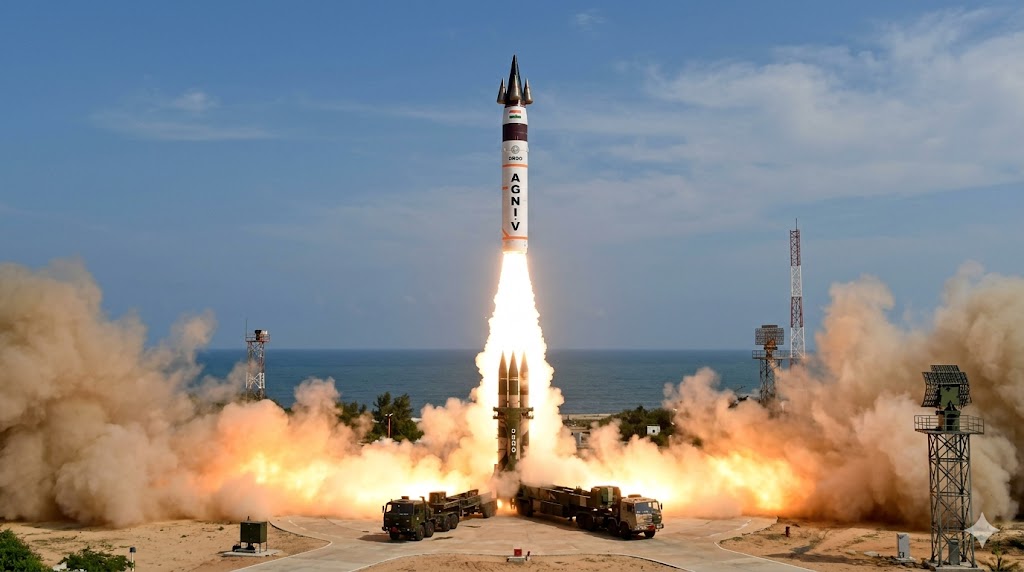
India successfully conducted a fresh flight trial of the Agni-5 ballistic missile equipped with Multiple Independently Targetable Re-entry Vehicle (MIRV) technology on May 8, 2026. This second successful test under Mission Divyastra solidifies India’s position in an elite group of nations possessing advanced strategic strike capabilities.
Mission Highlights: Divyastra (Divine Weapon)
- Launch Site: Dr. APJ Abdul Kalam Island, Odisha.
- Objective: To validate the MIRV technology, allowing a single missile to strike multiple targets spatially distributed over a large area.
- Technical Advancement: The 2026 variant features a lighter carbon composite filament-wound structure for the first stage (replacing maraging steel), improving payload efficiency and reducing overall weight.
Understanding MIRV Technology
A conventional missile carries one warhead for one target. In contrast, a MIRV-equipped missile is a “bus” that carries several warheads.
- Mechanism: After the main missile reaches its trajectory, the “bus” (the re-entry vehicle) detaches. It then maneuvers independently to release different warheads at various speeds and directions.
- Saturating Defenses: MIRVs make interception extremely difficult for enemy Ballistic Missile Defence (BMD) systems because they must track and destroy multiple warheads simultaneously.
- Range: The Agni-5 has an officially declared range of over 5,000 km, putting it in the class of Intercontinental Ballistic Missiles (ICBM).
Strategic Significance for India
- Credible Minimum Deterrence: Aligns with India’s No-First-Use (NFU) policy. If attacked, India can ensure a massive, multi-target retaliatory strike.
- Regional Balance: Enhances deterrence specifically regarding the evolving security architecture in the Indo-Pacific and the Eurasian landmass.
- Elite League: India joins the US, Russia, China, UK, and France as the only nations with proven MIRV capability.
- Technological Sovereignty: The system features indigenous avionics, high-accuracy sensor packages, and a notable contribution from women scientists at the DRDO.
Comparative Analysis: Agni Series
| Missile | Range (Approx.) | Type/Feature |
| Agni-I | 700 – 900 km | Short-Range (SRBM) |
| Agni-II | 2,000 – 2,500 km | Medium-Range (MRBM) |
| Agni-III | 3,000 – 3,500 km | Intermediate-Range (IRBM) |
| Agni-IV | 4,000 km | IRBM (Road Mobile) |
| Agni-V | >5,000 km | ICBM / MIRV-Capable |
Strategic Significance of Agni-5 with MIRV
The integration of Multiple Independently Targetable Re-entry Vehicles (MIRV) on the Agni-5 is not just a technological upgrade; it fundamentally alters India’s strategic posture.
- Defeating Ballistic Missile Defence (BMD) Systems: Modern militaries deploy anti-missile shields. A single warhead can be tracked and intercepted. However, a MIRV releases multiple warheads along with “decoys” (fake warheads). This saturates and overwhelms the enemy’s radar and interceptor missiles, ensuring that the actual payloads hit their targets.
- Cost-Effective Force Multiplication: Instead of building, deploying, and maintaining three separate missiles to hit three different targets, India can now use a single Agni-5 to achieve the same result. This optimizes the defense budget and launch infrastructure.
- Fortifying “No First Use” (NFU): India’s nuclear doctrine is based on NFU, meaning India will only use nuclear weapons in retaliation. Because the enemy gets the “first strike,” India’s surviving arsenal must be highly lethal. MIRVs guarantee that even a retaliatory strike will cause unacceptable damage, thereby strengthening “Credible Minimum Deterrence.”
- Extended Footprint: With a range of over 5,000 km, the Agni-5 brings almost all of Asia, including the northernmost regions of neighboring adversaries, and parts of Europe and Africa within its striking envelope.
Similar Capabilities of Other Countries
Before India, only the “P5” nations (the five permanent members of the UN Security Council) possessed functional MIRV technology.
| Country | Key MIRV-Capable Missiles | Delivery Platform |
| United States | Minuteman III Trident II (D5) | Land-based ICBM (Silos) Submarine-Launched Ballistic Missile (SLBM) |
| Russia | RS-24 Yars, RS-28 Sarmat RSM-56 Bulava | Land-based ICBM (Road-mobile & Silos) SLBM |
| China | DF-5B, DF-41 JL-3 | Land-based ICBM SLBM |
| France | M51 | Submarine-Launched Ballistic Missile (SLBM) |
| United Kingdom | Trident II (D5) | SLBM (Leased/shared technology from the US) |
| Pakistan | Ababeel (Claimed/In Development) | Medium-Range Ballistic Missile (MRBM). Note: Has claimed to test MIRV technology, but global defense analysts debate its operational maturity and true intercontinental capability. |
India’s Stature in Global Missile Technology
The success of Mission Divyastra is a culmination of decades of indigenous research, elevating India from a technology importer to a top-tier missile power.
- Entry into the “Elite 6”: India is definitively the sixth nation to demonstrate operational MIRV capability on an Intercontinental Ballistic Missile (ICBM) class platform.
- The Nuclear Triad is Complete: India is among the few nations that can launch nuclear strikes from land (Agni series), air (Mirage 2000, Rafale), and sea (INS Arihant with K-15/K-4 submarine-launched ballistic missiles).
- Missile Technology Control Regime (MTCR) Member: India’s entry into the MTCR in 2016 legitimized its status as a responsible space and missile power. It allows India to access high-end technology from other countries while maintaining its own sovereign development programs.
- Anti-Satellite (ASAT) Capability: In 2019 (Mission Shakti), India became the fourth country (after the US, Russia, and China) to successfully test an ASAT weapon, proving it can destroy enemy satellites in Low Earth Orbit (LEO).
- Transition to an Arms Exporter: Historically an importer, India is now exporting high-tech missile systems. The sale of the BrahMos supersonic cruise missile (jointly developed with Russia) to the Philippines, and the export of the Akash surface-to-air missile systems to friendly nations, highlights global confidence in Indian missile technology.
- Next-Generation Frontiers: India is currently actively developing Hypersonic Technology Demonstrator Vehicles (HSTDV). Hypersonic glide vehicles travel at over Mach 5 and maneuver unpredictably, making them the next frontier beyond MIRVs.
Practice Questions
PT (Preliminary Test) Question
Q1. Consider the following statements regarding ‘Mission Divyastra’:
- It refers to the flight testing of the Agni-V missile equipped with Multiple Independently Targetable Re-entry Vehicle (MIRV) technology.
- The MIRV technology allows a single missile to hit multiple targets located at different sites.
- With this success, India has become the fourth country in the world to possess MIRV technology.
Which of the statements given above are correct?
A) 1 and 2 only
B) 2 and 3 only
C) 1 and 3 only
D) 1, 2, and 3
Answer: A) 1 and 2 only. (Statement 3 is incorrect: India is part of a “select league” that includes the US, Russia, China, UK, and France, making it the 6th known nation with this tech).
Mains Practice Question
Q2. “The successful testing of MIRV-equipped Agni-5 missiles marks a paradigm shift in India’s strategic deterrence posture.” Discuss the technical advantages of MIRV technology and its implications for the regional security dynamics in the Indo-Pacific. (250 Words)