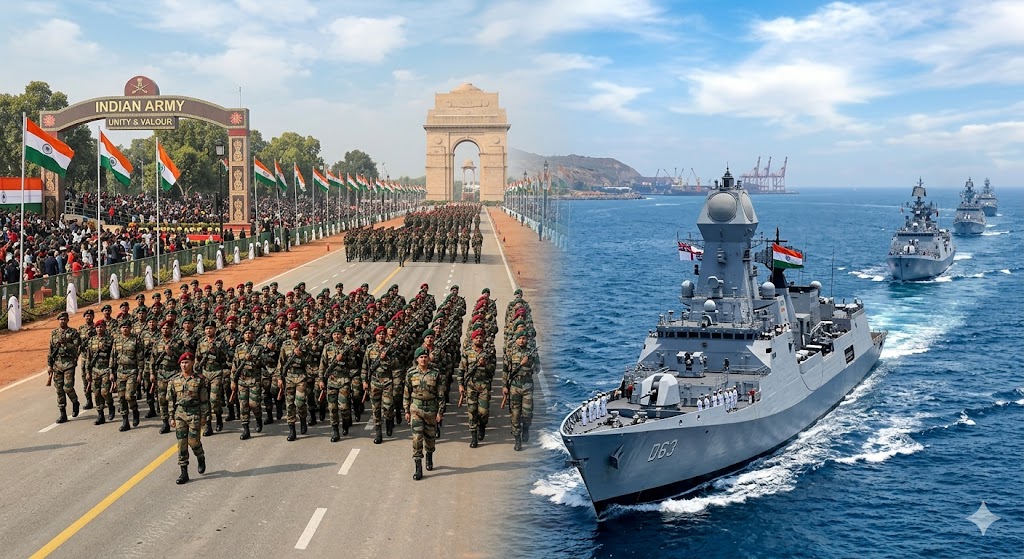
The Union Government has announced a transition in the top military leadership, appointing new heads for the post of Chief of Defence Staff (CDS) and Chief of Naval Staff (CNS). These appointments are critical for India’s ongoing military theaterization and integrated defense strategy.
Chief of Defence Staff (CDS): Lt.-Gen. N.S. Raja Subramani (Retd)
Lt.-Gen. Subramani will succeed General Anil Chauhan on May 30, 2026.
| Feature | Details |
| Dual Role | CDS & Secretary, Department of Military Affairs (DMA). |
| Parent Regiment | 8 Garhwal Rifles (Commissioned Dec 1985). |
| Previous Key Roles | Military Adviser (NSCS), Vice Chief of Army Staff, GOC-in-C Central Command. |
| Operational Experience | Commanded 2 Corps; served in Assam, J&K, and Western Front. |
| Education | NDA, IMA, JSCSC (UK), and National Defence College (New Delhi). |
| Decorations | PVSM, AVSM, SM, VSM. |
Significance of the CDS Role
1. Integration & “Jointness” (The Force Multiplier)
The primary mandate of the CDS is to move the three services (Army, Navy, and Air Force) away from their “silo-based” operations.
- Synergy: By coordinating logistics, transport, and training, the CDS ensures that the military operates as a single, cohesive war-fighting machine rather than three separate entities.
- Theaterization: The CDS is the chief architect of Integrated Theatre Commands. With a target deadline of May 30, 2026, the office is pivotal in transitioning India toward geography-based commands (e.g., Western or Maritime Theatre) where all service assets are under one commander for better operational speed.
2. Single-Point Military Advice
Before the CDS, the government received separate, sometimes conflicting, advice from three different service chiefs.
- Principal Military Adviser: The CDS provides impartial, unified military advice to the Raksha Mantri (Defence Minister) on tri-service matters.
- Nuclear Command Authority (NCA): The CDS serves as the military adviser to the NCA (chaired by the Prime Minister), ensuring the military’s strategic assets are integrated into the nation’s nuclear deterrence posture.
3. Institutional Reform: The Department of Military Affairs (DMA)
The CDS heads the newly created DMA as its Secretary. This is a revolutionary shift in Civil-Military Relations:
- Bureaucratic Integration: It brings uniformed officers into the Ministry of Defence’s decision-making structure, reducing the “red tape” between the civilian bureaucracy and the military.
- Optimized Spending: The CDS is responsible for prioritizing capital acquisitions. By assessing what the nation needs rather than what an individual service wants, the office helps reduce wasteful expenditure and prevents duplication of assets.
4. Modern Warfare & Emerging Domains
The nature of conflict has shifted to non-kinetic and multi-domain environments.
- Specialized Agencies: The CDS exercises command over tri-service organizations like the Defence Cyber Agency, Defence Space Agency, and the Armed Forces Special Operations Division.
- Grey-Zone Warfare: This centralized oversight is crucial for responding to hybrid threats, cyber-attacks, and space-based challenges that do not fall under the exclusive purview of any one service.
5. Promoting ‘Atmanirbharta’ (Self-Reliance)
The CDS plays a key role in the indigenization of defense equipment.
- Indigenization Lists: Through the DMA, the CDS identifies and mandates “Negative Import Lists” (now called Positive Indigenization Lists), ensuring that the services prioritize Indian-made platforms over imports, thereby strengthening the domestic defense industrial base.
Chief of the Naval Staff (CNS): Vice-Admiral Krishna Swaminathan
Vice-Admiral Swaminathan will succeed Admiral Dinesh Kumar Tripathi on May 31, 2026.
- Specialization: Communication and Electronic Warfare.
- Command Profile:
- Commanded frontline warships: INS Mysore and the aircraft carrier INS Vikramaditya.
- Currently serves as Flag Officer Commanding-in-Chief (FOC-in-C) of the Western Naval Command.
- Academic Excellence: Holds multiple postgraduate degrees and a Ph.D. in International Studies.
- Awards: PVSM, AVSM, VSM.
Institutional Context for UPSC
- Department of Military Affairs (DMA): Created in 2019 to ensure better coordination between the civilian bureaucracy and the military. It is headed by the CDS.
- Theaterization: The new leadership will be pivotal in transitioning India from service-specific commands to Integrated Theatre Commands, a move aimed at optimizing resource utilization for modern warfare.
- National Security Council Secretariat (NSCS): The appointment of Lt.-Gen. Subramani from the NSCS highlights the increasing synergy between strategic intelligence and active military command.
Practice Questions
PT (Preliminary Test) Question
Q1. With reference to the Chief of Defence Staff (CDS) in India, consider the following statements:
- The CDS functions as the Secretary of the Department of Military Affairs (DMA) within the Ministry of Defence.
- The CDS exercises direct military command over the three Service Chiefs.
- Lt.-Gen. N.S. Raja Subramani is set to be the third person to hold the office of CDS.
Which of the statements given above is/are correct?
A) 1 and 2 only
B) 1 and 3 only
C) 2 and 3 only
D) 1, 2, and 3
Answer: B) 1 and 3 only. (Statement 2 is incorrect: The CDS is ‘primus inter pares’—first among equals—and does not exercise military command over the Service Chiefs.)
Mains Practice Question
Q2. “The creation of the post of Chief of Defence Staff (CDS) and the Department of Military Affairs (DMA) marks the most significant reform in India’s higher defense management since independence.” Discuss the role of the CDS in achieving ‘jointness’ and the challenges associated with the transition to Integrated Theatre Commands. (250 Words)