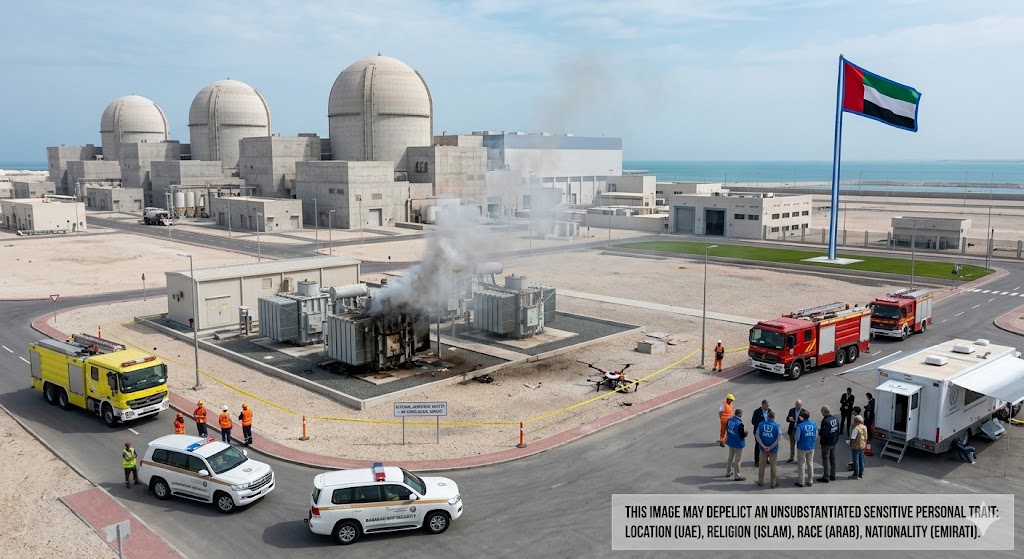
Recently, a drone strike targeted the United Arab Emirates’ (UAE) Barakah Nuclear Power Plant, setting an external electrical generator ablaze on its perimeter. The incident marks a severe escalation in West Asia, heavily straining the tenuous ceasefire in the ongoing regional conflict.
This is the first time the four-reactor Barakah plant—the cornerstone of the UAE’s clean energy grid—has been actively targeted since hostilities erupted.
Key Highlights of the Incident
- The Incursion: The UAE Ministry of Defence reported that three drones entered its airspace from the western border. While two were successfully intercepted, one managed to strike an external generator in the Al Dhafra region.
- Safety and Operational Impact:
- The Abu Dhabi Media Office and the Federal Authority for Nuclear Regulation (FANR) confirmed no injuries and no impact on radiological safety levels.
- The International Atomic Energy Agency (IAEA) noted that while core systems remained safe and units continued operating, one reactor was temporarily powered by emergency diesel generators due to the generator fire.
- Attribution: No group immediately claimed responsibility, and the UAE refrained from directly blaming any specific nation or proxy. However, the region has been caught in a cycle of heavy drone and missile exchanges since the outbreak of the war.
About the Barakah Nuclear Power Plant
- Significance: It holds the historical distinction of being the first and only operational commercial nuclear power facility in the Arab world.
- Capacity: Built in technical collaboration with South Korea at a cost of $20 billion, the four-reactor facility went online in 2020. At full capacity, it provides roughly 25% (a quarter) of the UAE’s entire electricity needs.
- The “123 Agreement” Framework: The UAE’s nuclear program is widely regarded as a model for non-proliferation. Under a strict bilateral pact signed with the United States (the “123 Agreement”), the UAE voluntarily agreed to forego domestic uranium enrichment and the reprocessing of spent fuel. Its uranium supply is imported entirely from abroad to prevent any military diversion.
Wider Geopolitical and Energy Implications
- Threat to Maritime and Regional Truces: The attack threatens to collapse the fragile ceasefire brokered in April. It comes amid an intense U.S. naval blockade on Iranian ports and ongoing friction over the Strait of Hormuz, a vital global energy transit point.
- Compounding the Global Energy Crisis: Energy infrastructure across the Persian Gulf has borne the brunt of retaliatory strikes. With the UAE’s primary gas and petroleum facilities already facing long repair timelines, attacks on civilian nuclear architecture inject severe volatility into global energy markets.
Growing Global Concern: Nuclear Nodes as Military Targets
The strike on Barakah reflects a dangerous, accelerating international trend where civil nuclear infrastructures are pulled into active combat zones:
- Precedents: This modern warfare vulnerability intensified during Russia’s invasion of Ukraine (notably around the Zaporizhzhia plant). In the current West Asian conflict, sporadic threats have also been reported around Iran’s Russian-run Bushehr plant and Israel’s Dimona facility.
- The Regulatory Stand: IAEA Director-General Rafael Mariano Grossi expressed “grave concern,” emphasizing that military actions targeting or operating near sensitive nuclear nodes violate international norms and risk catastrophic regional fallout.
International Law Designed to Protect Civil Nuclear Infrastructure
1. The Geneva Conventions (1977 Additional Protocols)
The most explicit legal protections are found in the 1977 Protocols additional to the Geneva Conventions of 1949. They categorize nuclear plants under a special class of objects called “Works and installations containing dangerous forces.”
- Article 56(1) of Additional Protocol I (International Conflicts): Explicitly states that nuclear electrical generating stations, dams, and dykes shall not be made the object of attack, even if they constitute legitimate military objectives, if such an attack may cause the release of dangerous forces (radioactivity) and consequent severe losses among the civilian population.
- Article 15 of Additional Protocol II (Non-International Conflicts): Mirrors this exact protection for internal wars or conflicts involving non-state actors/proxies, stating that targeting these facilities is absolutely prohibited.
- Protection of Vicinity: Article 56 also prohibits attacking military objectives located in the immediate vicinity of a nuclear plant if the strike could inadvertently trigger a release of dangerous forces.
Classification as a War Crime: Under Article 85(3)(c) of Protocol I, willfully launching an attack against a nuclear facility in the knowledge that it will cause excessive loss of civilian life or severe damage to civilian objects is recognized as a grave breach and is classified as a war crime.
2. Core Principles of International Humanitarian Law (IHL)
Even outside of specific articles, any attack on a nuclear facility must navigate three customary pillars of international law:
- The Principle of Distinction: Belligerents must strictly distinguish between civilian objects and military objectives. A commercial nuclear plant powering civilian homes is fundamentally a civilian object.
- The Principle of Proportionality: An attack is prohibited if the anticipated incidental civilian collateral damage (e.g., nuclear fallout, loss of power to hospitals, radiation sickness) outweighs the concrete and direct military advantage expected from the strike.
- The Principle of Precaution: Combatants must take all feasible precautions in the choice of means and methods of attack to avoid or minimize incidental loss of civilian life.
3. Institutional Mandate of the IAEA
The International Atomic Energy Agency (IAEA) General Conference has passed multiple binding resolutions—notably in 1983, 1984, and 1985—explicitly declaring that any armed attack on or threat against nuclear facilities devoted to peaceful purposes violates the principles of the United Nations Charter, international law, and the IAEA Statute.
When Does Protection Cease?
It is vital to know that the protection granted by the Geneva Conventions is not entirely absolute. Under Article 56(2)(b) of Protocol I, a nuclear power plant loses its special immunity only if:
- It provides electric power in regular, significant, and direct support of military operations.
- An attack is the only feasible way to terminate that military support.
Even if these conditions are met and protection ceases, the attacking party is still legally obligated to take every practical precaution to prevent a radioactive release and safeguard the civilian population.
Why these rules are failing in modern warfare
Despite clear black-letter law, the enforcement of these rules faces severe bottlenecks:
- The “Asymmetric War” Loophole: Non-state proxy groups or covert actors launching drone strikes frequently ignore IHL treaties and exploit plausible deniability.
- The Gray Zone of Auxiliary Infrastructure: As seen in the Barakah incident (and previously at Zaporizhzhia in Ukraine), attackers often target external power grids, generators, or peripheral nodes rather than the reactor core itself. They argue they are targeting conventional military/energy supply lines, though disabling these cooling backups can trigger a catastrophic nuclear meltdown just as easily as a direct hit.
Way Forward
1. Legal and Normative Reforms: Closing the IHL Loopholes
- Amending Article 56 of the Geneva Conventions: The current exception under Article 56—which allows the immunity of a nuclear plant to cease if it provides “direct support to military operations”—is too broad and easily manipulated. International legal bodies must strip away this ambiguity, making the prohibition against targeting civil nuclear nodes absolute and non-derogable under any circumstances.
- Expanding the Definition of Nuclear Targets: Legal protections must explicitly cover a facility’s entire ecosystem. This includes off-site power grids, auxiliary diesel generators, cooling water intake systems, and spent-fuel storage pools. Targeting these peripheral systems can trigger a meltdown just as easily as striking the reactor core itself.
2. Institutional Enforcement: Giving “Teeth” to the IAEA
- Mandating ‘Nuclear Sanctity Zones’: The UN Security Council, in coordination with the IAEA, should establish a mechanism to automatically declare a Demilitarized Exclusion Zone (e.g., a 30-kilometer radius) around any operational civilian nuclear facility during active regional conflicts.
- Rapid Deployment Safety Teams: The IAEA should have a pre-authorized, rapid-deployment peacekeeping force or observer mission that can be stationed permanently at vulnerable nuclear sites in active conflict zones to act as a geopolitical deterrent.
- Triggering Automatic Sanctions: International frameworks should be updated so that any state or documented proxy group that targets a civil nuclear facility faces automatic, severe economic and diplomatic isolation through the UN Security Council, bypassing unilateral vetoes where public safety is at risk.
3. Technological and Operational Hardening
- Advanced Counter-Drone (C-UAS) Integration: Civil nuclear sites must upgrade from passive defense to aggressive active defense. This involves integrating Counter-Unmanned Aircraft Systems (C-UAS), including electronic warfare jamming webs, kinetic interceptors, and directed-energy weapons (lasers) to neutralize rogue drones before they reach the perimeter.
- Redundancy of Power Systems: Facilities should move away from relying on single external power lines or conventional on-site generators. Designing decentralized, micro-modular backup power systems and placing emergency cooling generators in deep underground, reinforced bunkers will insulate reactors from external perimeter fires.
- Cyber-Physical Hardening: As drones and electronic warfare become more sophisticated, isolating the industrial control systems (ICS) of nuclear plants from external digital networks is critical to prevent dual cyber-physical attacks.
4. Diplomatic Accountability in Asymmetric Warfare
- State-Sponsor Liability: Because modern attacks on strategic infrastructure are often executed by non-state proxies to maintain plausible deniability, international law must hold the state sponsors of these groups directly accountable. If a proxy uses a state’s specialized military technology (like long-range kamikaze drones) to target a nuclear facility, the host nation must face the legal consequences of the act.
PRELIMS (PT) PRACTICE QUESTION
Q. Consider the following statements regarding the Barakah Nuclear Power Plant and civil nuclear frameworks:
- Barakah is the first and only operational commercial nuclear power station on the Arabian Peninsula.
- Under the US-UAE “123 Agreement,” the UAE is permitted to conduct low-level domestic uranium enrichment exclusively for commercial power generation.
- The Barakah nuclear facility was constructed in technical collaboration with South Korea.
Which of the statements given above are correct?
(a) 1 and 2 only
(b) 2 and 3 only
(c) 1 and 3 only
(d) 1, 2 and 3
Answer: (c) 1 and 3 only
MAINS PRACTICE QUESTION
Q. “The increasing vulnerability of civil nuclear infrastructure in modern zones of geopolitical conflict exposes a critical gap in global security architectures.” In light of recent developments in West Asia, critically evaluate the safety risks to civil nuclear facilities and suggest measures to strengthen international safeguards. (15 Marks, 250 Words)