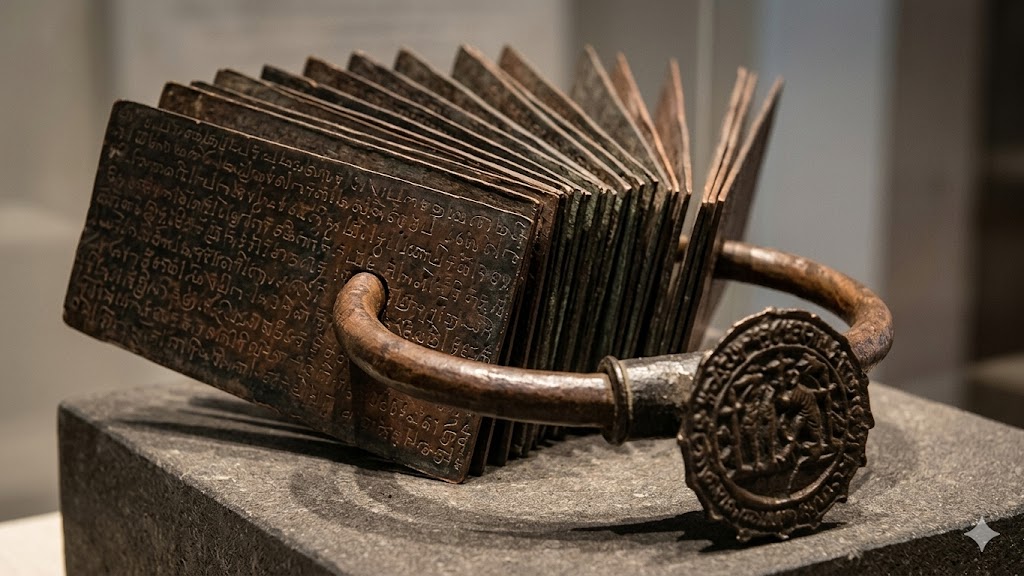
Recently, a landmark event in India’s cultural restitution history occurred at a formal ceremony in The Hague. The Netherlands officially repatriated the 11th-century Anaimangalam Copper Plates Charter (popularly known as the Leiden Copper Plates) to India in the presence of Prime Minister Narendra Modi and Dutch Prime Minister Rob Jetten.
Housed at Leiden University Library since 1862, the return of these imperial charters closes a 14-year diplomatic effort and marks the first time a Chola-era copper plate charter has been successfully brought back to India.
[11th Century] Oral decree by Raja Raja I, etched by Rajendra I ➔ [Late 17th Century] Excavated by Dutch VOC at Nagapattinam ➔ [1862] Donated to Leiden University ➔ [May 2026] Unconditional repatriation to India (ASI)
Historical Context: The Srivijaya Connection & Religious Pluralism
The plates serve as an invaluable documentary archive of the Chola maritime empire, providing key insights into medieval Indian Ocean diplomacy and internal religious harmony:
- The Grant: The inscriptions record the allocation of land revenues from Anaimangalam village (near the port town of Nagapattinam, Tamil Nadu) to maintain a local Buddhist monastery.
- The Vihara: The monastery, named Chulamanivarma Vihara (also known as the Raja Raja Cholan Perumpalli), was constructed by King Sri Mara Vijayotunga Varman of the Srivijaya Empire (centered in modern-day Java/Sumatra, Indonesia) in honor of his father, Sri Chudamani Varman.
- Inter-Faith Patronage: The charter highlights a striking historical precedent of state-sponsored religious coexistence. It records a staunchly Saivite (Hindu) imperial court actively patronizing and safeguarding a Buddhist institution linked to foreign Southeast Asian royalty.
- The Succession Continuum: While Emperor Raja Raja Chola I (regnal years 985–1014 CE) gave the initial oral command recorded on palm leaves, it was his son, Rajendra Chola I (regnal years 1014–1044 CE), who executed the command by having it engraved onto permanent copper sheets.
Epigraphy and Structure of the Leiden Plates
The entire artifact forms a monumental administrative dossier weighing approximately 30 kilograms, structurally divided into two distinct chronological groupings:
| Charter Category | Issuing/Executing Ruler | Script & Language Split | Primary Objective / Content |
| Larger Leiden Plates (21 Plates) | Rajendra Chola I (honoring his father Raja Raja I) | 5 Sanskrit plates & 16 Tamil plates | Traces the divine genealogy of the Chola lineage (Sanskrit) and details the exact revenue boundaries and agrarian exemptions of Anaimangalam village (Tamil). |
| Smaller Leiden Plates (3 Plates) | Kulottunga Chola I (regnal years 1070–1120 CE) | Exclusively Tamil script | Records additional revenue endowments (4,500 kalam of paddy) gifted to the Buddhist Sangha following an appeal by two Javanese emissaries. |
Iconography: The Chola Royal Insignia
The 24 large and small plates are strung together by a massive bronze ring, secured by an intricate molten metal casting of the Chola Royal Seal. The iconography functions as a visual political statement of Chola imperial hegemony across South India:
- The Tiger: Positioned centrally as the primary royal emblem of the Chola dynasty.
- Two Fish: Representing the defeated Pandya dynasty.
- The Bow: Representing the defeated Chera dynasty.
- Subsidiary Symbols: The seal is embellished with a royal parasol (chhatra), two fly-whisks (chamaras), oil lamps, a swastika, and a brief Sanskrit sloka praising the conquests of the Emperor.
Epigraphic Value: Placing the symbols of the Cheras and Pandyas directly alongside or beneath the Chola Tiger visually validated that the contemporary Chola rulers had successfully subjugated their major regional rivals.
5. Way Forward: A Precedent for Contested Heritage
The successful retrieval of the Leiden Plates sets a vital strategic benchmark for India’s cultural diplomacy and heritage reclamation efforts:
- Utilizing Provenance Investigation: The return was accelerated by a 2022 Dutch domestic policy shift on colonial-era restitution. The Independent Colonial Collections Committee concluded that the plates were acquired through “involuntary loss of possession” when the Dutch East India Company (VOC) occupied Nagapattinam in the late 17th century.
- Deterring Colonial Retention: This case strengthens India’s legal and ethical stance at multilateral forums (like the UNESCO Intergovernmental Committee) to demand identical bilateral dialogues for other contested records.
- Targeting Future Repatriations: Historians and the Archaeological Survey of India (ASI) aim to use this momentum to build high-yield restitution claims for other critical Tamil epigraphs abroad, such as the famous Velvikkudi Copper Plates (issued by Pandya ruler Parantaka Nedunchadaiyan), which are currently held in the British Museum, London.
CHOLA DYNASTY: BRIEF OVERVIEW
- Timeline & Core Geography: The Imperial Cholas ruled from the 9th to the 13th century CE, with their power centered in the fertile Kaveri River delta of Tamil Nadu, expanding across South India and parts of Sri Lanka and Southeast Asia.
- The Founder: The revival of the Chola power was led by Vijayalaya Chola (c. 850 CE), who captured Thanjavur from the Muttaraiyar chieftains (vassals of the Pallavas) and made it his capital.
- Key Rulers:
- Raja Raja Chola I (985–1014 CE): Destroyed the Chera navy at Kandalur, conquered northern Sri Lanka, and consolidated a powerful centralized empire. He built the iconic Brihadisvara Temple at Thanjavur.
- Rajendra Chola I (1014–1044 CE): Expanded the empire to its absolute zenith. He led a successful military expedition to the Ganga river, assumed the title “Gangaikondacholan”, built a new capital (Gangaikondacholapuram), and launched a legendary naval raid against the Srivijaya Empire (Southeast Asia) to protect trade routes.
- Unique Administrative Structure: Known for highly evolved local self-government. The Uttaramerur Inscriptions of Parantaka I detail the working of rural assemblies (Ur and Sabha), democratic election systems (Kudavolai), and strict qualification/disqualification criteria for village committee members.
CULTURAL SIGNIFICANCE OF THE CHOLAS
- Peak of Dravidian Architecture: The Chola period marked the transition from rock-cut architecture to grand stone-built structures.
- The Vimana Focus: Unlike later Vijayanagara or Pandya styles where the gateways (Gopurams) became massive, Chola temples are defined by their soaring, multi-tiered Vimanas (towers over the sanctum).
- UNESCO World Heritage Sites: The “Great Living Chola Temples” include the Brihadisvara Temple at Thanjavur, Brihadisvara at Gangaikondacholapuram, and the Airavatesvara Temple at Darasuram.
- Pinnacle of Metallurgy (Chola Bronzes): Using the lost-wax technique (cire perdue), Chola sculptors produced some of the world’s finest metal art.
- The most iconic creation is the Nataraja (Shiva as the Cosmic Dancer), which synthesizes religion, science, and aesthetics, symbolizing the five-fold cosmic cycles of creation, preservation, destruction, illusion, and salvation.
- Golden Age of Tamil Literature: The imperial court heavily patronized scholars and poets, leading to secular and devotional masterpieces:
- Kamban’s Kamba Ramayanam (an epic adaptation of the Ramayana).
- Sekkizhar’s Periya Puranam (documenting the lives of the 63 Nayanars/Saivite saints).
- The formulation of Kalingattu Parani by Jayamkondar (celebrating Rajendra Chola’s victory over Kalinga).
- Maritime Diplomacy & Global Trade: The Cholas turned the Bay of Bengal into a “Chola Lake”. They sent high-level diplomatic and trade embassies to the Tang Dynasty of China, maintained maritime footprints in Sumatra/Java, and dominated the Indian Ocean trade via powerful merchant guilds like the Manigramam and Ayyavole-five hundred.
- Enlightened Religious Pluralism: Despite being devout Saivites, Chola monarchs exhibited deep secular statecraft. They issued extensive land and revenue grants to Vaishnavite temples, Jain shrines (Pallis), and Buddhist monasteries—as exemplified by Raja Raja I and Rajendra I supporting the construction of the Buddhist Chulamanivarma Vihara for the Javanese Srivijaya rulers.
UPSC Preliminary Test (PT) / Multiple Choice Question
Q1. With reference to the recently repatriated 11th-century Anaimangalam Copper Plates Charter (popularly known as the Leiden Copper Plates), consider the following statements:
- The charter records land revenue allocations to the Chulamanivarma Vihara, a Buddhist monastery constructed by the rulers of the Srivijaya Empire.
- The Larger Leiden Plates are written exclusively in the Sanskrit script to preserve the divine genealogy of the Chola lineage.
- The royal insignia on the bronze ring binding the plates includes the symbols of the Cholas, Cheras, and Pandyas, reflecting Chola political hegemony over South India.
Which of the statements given above are correct? (a) 1 and 2 only
(b) 2 and 3 only
(c) 1 and 3 only
(d) 1, 2, and 3
Answer Key & Explanation:
- Correct Answer: (c) 1 and 3 only
UPSC Mains Question
Q2. “The repatriation of the 11th-century Leiden Copper Plates marks a milestone not only for India’s cultural diplomacy but also for its historical historiography.” In light of this statement, analyze how the Leiden plates serve as an invaluable archive of the Chola Empire’s maritime diplomacy, administrative acumen, and religious pluralism. (15 Marks, 250 Words)