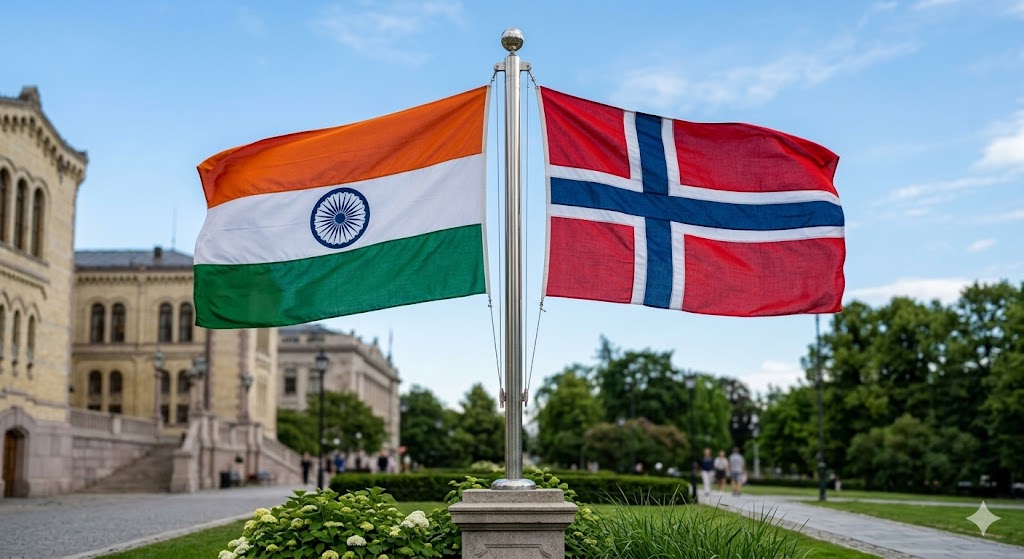
Prime Minister Narendra Modi commenced a historic official visit to Norway, marking the first bilateral visit by an Indian Prime Minister to the country in 43 years (since 1983). PM Modi was conferred with Sweden’s prestigious ‘Royal Order of the Polar Star, Degree Commander Grand Cross’ for his exceptional contributions to pioneering the India-Sweden strategic matrix.
The high-profile visit centers on deepening trade, expanding clean energy pipelines, and participating in the 3rd India-Nordic Summit in Oslo, alongside reviewing institutional progress following the landmark India-EFTA Trade and Economic Partnership Agreement (TEPA).
Key Highlights of India-Norway Bilateral Engagements
- Energy Security & LNG Transition: Energy cooperation topped the agenda. A major consignment of Liquefied Natural Gas (LNG) was recently delivered to India under a 15-year bilateral deal with Norway’s state-backed energy major, Equinor.
- Government-to-Government (G2G) MoUs: India and Norway are set to sign three institutional G2G pacts focusing on:
- Health Cooperation
- Digital Infrastructure
- Space Ties
- Business-to-Business (B2B) Partnerships: At least 18 commercial MoUs are slated for execution, primarily focused on cutting-edge renewable energy technology, green hydrogen, and maritime solutions.
- Harnessing Patient Capital: India is actively pitching for enhanced capital deployment from Norway’s Government Pension Fund Global (GPFG)—the world’s wealthiest sovereign wealth fund—which already maintains investments of close to $28 billion in the Indian capital market.
The 3rd India-Nordic Summit
The visit features the consolidation of the India-Nordic multilateral framework after the cancellation of last year’s summit due to brief regional security frictions (the Pahalgam security incident and the subsequent four-day India-Pakistan conflict).
Strategic Profile of the Nordic Grouping
| Metric | Details |
| Member Nations | The Nordic Five: Norway, Sweden, Finland, Denmark, and Iceland. |
| Current Economic Footprint | Bilateral trade in goods and services stands at $19 billion. |
| Corporate Footprint | Over 700 Nordic firms operate in India, while around 150 Indian entities maintain a presence in the Nordic region. |
| Core Cooperation Pillars | Climate action, green future sustainability, Blue Economy, circular economy, and Arctic research. |
Geopolitical and Economic Backdrop
The summit converges amidst deep global instability, with leaders discussing direct supply chain impacts stemming from:
- The prolonged Russia-Ukraine war.
- The escalating U.S.-Israel war with Iran and its subsequent strain on the Strait of Hormuz.
- The ongoing crisis in Gaza.
- Energy Geopolitics: The meetings coincide with the expiry of U.S. sanctions waivers on Russian oil, putting the spotlight on India’s strategic autonomy regarding energy imports.
Historical Trajectory of Bilateral Relations
The relationship has evolved significantly over the last eight decades, shifting from early post-colonial diplomacy to modern innovation-led industrial integration.
| Phase / Key Era | Key Milestones & Dynamics |
| Early Foundation (1947 – 1960s) | * Sweden recognized India’s independence in 1947; formal diplomatic relations were established in 1949. * In 1957, Jawaharlal Nehru became the first Indian PM to visit Sweden. Legation-level ties were officially upgraded to full Ambassadorial embassies in 1962. |
| Global Multilateralism (1970s – 1980s) | * 1972: PM Indira Gandhi attended the landmark UN Conference on Human Environment in Stockholm, laying the foundation for modern global climate diplomacy. * The two countries jointly led the ‘Six Nation Peace Summit’ in the 1980s, focusing on global nuclear disarmament. |
| The Defense Hiccup (Late 1980s) | * The relationship faced a temporary commercial and political setback following the Bofors scandal (1987), which structurally restricted ties to a rigid buyer-seller paradigm for decades. |
| Institutional Re-alignment (2000s – 2018) | * 2013: India secured Observer Status in the Arctic Council during Sweden’s presidency. * 2018: PM Modi’s visit to Stockholm (the first by an Indian PM in 3 decades) led to the Joint Innovation Partnership and the inaugural India-Nordic Summit. |
| Strategic Transition (2019 – Present) | * Transitioned from a conventional trading arrangement to a Strategic Partnership in 2026, heavily integrated through co-funding, tech co-development, and deep industrial integration. |
The Four Pillars of the Upgraded Partnership (2026–2030)
The newly signed Joint Action Plan structures future engagements across four fundamental pillars:
- Strategic Dialogue for Stability and Security: Focused on expanding defense industrial ties, maritime security, and countering global terrorism.
- Next-Generation Economic Partnership: Leveraging the progress of the India-European Union Free Trade Agreement (FTA) to accelerate labor-intensive Indian exports and Swedish high-tech investments.
- Emerging Technologies and Trusted Connectivity: Spearheaded by the newly launched Sweden-India Technology and Artificial Intelligence Corridor (SITAC) to connect India’s national AI ecosystem with Swedish R&D.
- Shaping Tomorrow Together: Collaborations aimed at people-to-people ties, planetary health, climate resilience, and life sciences.
Major Pillars of Contemporary Cooperation
A. Climate Action and Industrial Transition
- LeadIT Initiative: India and Sweden jointly launched the Leadership Group for Industry Transition (LeadIT) at the UN Climate Action Summit in 2019. At COP28, this was upgraded to LeadIT 2.0, emphasizing low-carbon technology transfers and decarbonizing heavy sectors like steel and cement.
- Green Hydrogen & Circular Economy: Swedish firms are heavily investing in India’s National Green Hydrogen Mission and municipal solid waste-to-wealth technologies.
B. High-Tech, AI, and Innovation
- SITAC (2026): The Sweden-India Technology and Artificial Intelligence Corridor links the IndiaAI Mission with Business Sweden to advance responsible AI implementation in industrial workflows.
- Space Frontier: Sweden is a primary international partner in India’s upcoming Venus Orbiter Mission (Shukrayaan), providing advanced scientific payloads for energetic neutral atom analysis.
C. Defense Co-development
- Beyond Buyer-Seller: Breaking old barriers, Swedish defense major Saab became the first foreign defense entity to establish a 100% foreign-owned production facility in India under the ‘Make in India’ program to manufacture Carl-Gustaf weapon systems locally.
D. Trade and Investment
- Bilateral trade in goods reached $7.75 billion in 2025, with cumulative Swedish FDI crossing $2.8 billion. Over 280 Swedish companies operate in India (e.g., Volvo, Ericsson, IKEA), while over 75 Indian firms are established in Sweden, particularly in the IT sector.
Key Geopolitical Divergences & Challenges
- The Russia Vector: While both share robust democratic credentials, a critical point of divergence is Russia. Post-NATO integration, Stockholm views Russia as an immediate security threat, whereas New Delhi maintains its long-standing strategic autonomy and energy dependencies with Moscow.
- Trade Sub-optimality: Despite a sharp upswing, bilateral trade numbers remain below true structural potential, constrained by legacy regulatory gaps that both sides hope to resolve via the India-EU FTA.
Way Forward
- Capitalizing on EFTA-TEPA: Both sides must leverage the newly operationalized trade pact to dismantle persistent non-tariff barriers and optimize market entry for Indian exports.
- Pioneering a “Green Strategic Partnership”: Merging the sovereign funds of the Nordic bloc with India’s massive infrastructure initiatives (like Sagarmala and PM Gati Shakti) can accelerate India’s domestic transition toward carbon neutrality.
- Collaborative Polar Science: Strengthening scientific ties within the framework of India’s Arctic Policy, utilizing Nordic expertise to track climate variations affecting monsoon predictability.
PRELIMS (PT) PRACTICE QUESTION
Q. Consider the following statements regarding the Nordic countries and India’s bilateral engagements:
- The “Nordic Five” grouping consists of Norway, Sweden, Finland, Poland, and Denmark.
- The Royal Order of the Polar Star is a prestigious civilian honor associated with Norway.
- The EFTA Trade and Economic Partnership Agreement (TEPA) involves India and nations including Norway and Iceland.
Which of the statements given above is/are correct?
(a) 1 and 2 only
(b) 3 only
(c) 2 and 3 only
(d) 1, 2 and 3
Answer: (b) 3 only
MAINS PRACTICE QUESTION
Q. Evaluate the strategic and economic significance of the India-Nordic partnership for India’s clean energy transition and global supply chain resilience in an era of heightened geopolitical fragmentation. (15 Marks, 250 Words)