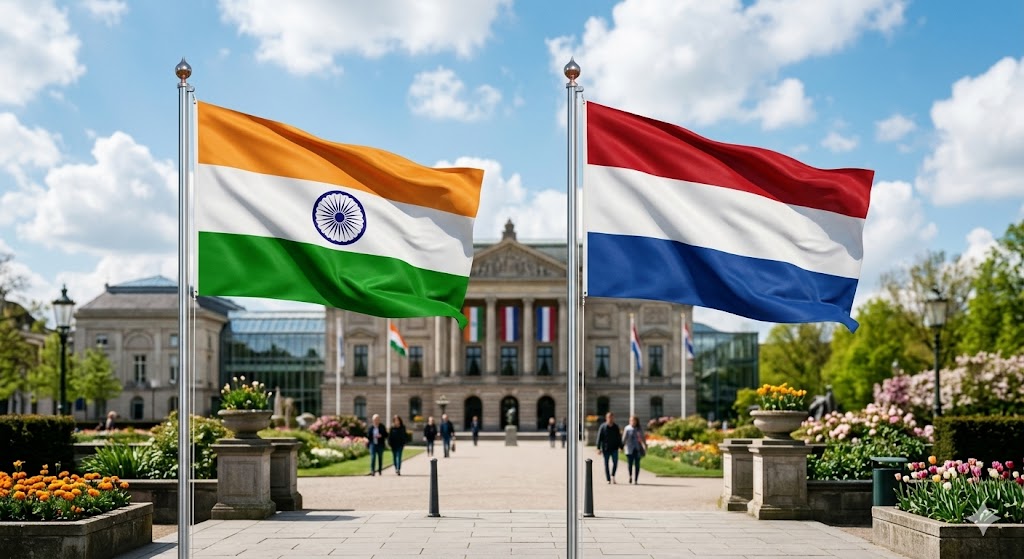
Recently, during Prime Minister Narendra Modi’s official visit to The Hague, India and the Netherlands officially elevated their bilateral ties to a Strategic Partnership.
The leaders adopted an ambitious roadmap to deepen engagement across high-tech manufacturing, climate action, and resource management, concluding 17 agreements and Memoranda of Understanding (MoUs).
Key Pillars of the Upgraded Partnership
The agreements signed during the bilateral visit reflect an intentional shift toward advanced technology, resource security, and ecological sustainability.
| Sector / Pillar | Key Initiative & Structural Impact |
| Semiconductors & High-Tech | * TATA Electronics & ASML Collaboration: A landmark project was established for semiconductor fabrication, linking India’s manufacturing scale with the Dutch giant ASML’s global monopoly in extreme ultraviolet (EUV) lithography machinery. |
| The “WAH” Framework | * Water, Agriculture, and Health: Focuses on upgrading the existing Strategic Partnership on Water to implement large-scale river management projects, climate-resilient farming, and healthcare/digital health research. |
| Energy & Resource Resilience | * Critical Minerals & Renewables: New pathways to secure resilient supply chains for critical minerals required in green transition industries, green hydrogen development, and maritime logistics. |
Diplomatic Divergences and Sensitive Topics
While the economic and technical fronts saw breakthrough alignments, the visit also highlight the strategic complexities and divergences between the two democracies.
Concerns Raised by the Netherlands
The newly elected Dutch Prime Minister, Rob Jetten, utilized the enhanced diplomatic channel to bring forward sensitive domestic and international concerns:
- The Insiya Abduction Case: A long-standing cross-border child custody dispute involving a Dutch-born child allegedly abducted to India by her father in 2016.
- Civil Liberties: Reports from European media outlets noted that the Dutch leadership expressed concerns regarding press freedoms and the protection of minority rights within India.
India’s Institutional Pushback
The Ministry of External Affairs (MEA), represented by Secretary (West) Sibi George, delivered a firm response to counter external criticisms of India’s internal governance:
- On Civil Liberties: The MEA attributed the criticism to a fundamental “lack of understanding” of India’s internal dynamics, pointing out that India successfully governs 1.4 billion people with unprecedented cultural, linguistic, and religious diversity under an institutionalized, peaceful democracy.
- On the Child Custody Case: The MEA acknowledged that the issue was raised but noted the matter remains sub judice within the Indian judicial system, precluding executive interference.
Strategic Geopolitical Alignment
The upgrade in ties aligns with a broader push in Western Europe to diversify supply chains away from single-source dependencies and engage actively with the Global South:
- Indo-Pacific Framework: The Netherlands has increasingly integrated its maritime security strategy with the EU Strategy on the Indo-Pacific, viewing India as a vital anchor for freedom of navigation and maritime logistics.
- Multilateral Trajectory: The visit formed part of an interconnected European tour, serving as a prelude to high-level defense talks in Sweden and the subsequent 3rd India-Nordic Summit in Norway.
INTERNATIONAL RELATIONS
The bilateral relationship between India and the Netherlands is anchored in over 400 years of shared history, evolving from early 17th-century maritime trade into a modern, high-tech Strategic Partnership in 2026. The evolution of this relationship highlights a transition from colonial-era mercantilism to deep economic, environmental, and technological convergence.
Historical Phases of Engagement
A. Pre-Independence & The Early Modern Era (1605–1825)
- The Entry of the VOC: Dutch contact with the Indian subcontinent began in 1605 when merchants of the Dutch East India Company (Vereenigde Oostindische Compagnie – VOC) arrived on the Coromandel Coast (notably Pulicat) seeking textiles to trade for spices in the East Indies.
- Establishment of Directorates: Over the 17th century, the Dutch established key trading posts and directorates across India, including Dutch Surat (1616), Dutch Bengal (1627), and Dutch Malabar (1661).
- The Battle of Colachel (1741): A major historical turning point occurred when the army of King Marthanda Varma of Travancore defeated the VOC at the Battle of Colachel. This marked the first crushing defeat of a European colonial power by an Indian state and signaled the eclipse of Dutch military influence in India.
- Formal Exit (1825): Following the geopolitical reshuffling of the Anglo-Dutch Treaties of 1814 and 1824, the Dutch traded their remaining Indian holdings to the British in exchange for territorial supremacy in Sumatra and Malaya. By mid-1825, formal Dutch presence in India concluded.
B. Post-Independence Era (1947–1990s)
- Establishment of Modern Relations: The Netherlands was among the first European nations to officially recognize Indian independence, establishing formal diplomatic relations in 1947.
- The Surinamese Connection: Historical migrations during the British colonial era saw Indian indentured laborers move to the Dutch colony of Suriname. In the 1970s, a large wave of these “Hindostanis” migrated to the Netherlands, forming the bedrock of Europe’s second-largest Indian diaspora network today.
Shift to an Economic Powerhouse (2000–2020)
At the turn of the century, the relationship pivoted toward intense commercial cooperation, with the Netherlands positioning itself as India’s “Gateway to Europe.”
| Metric / Dimension | Strategic Relevance to India |
| Trade Backbone | The Netherlands grew into India’s 3rd largest export destination in Europe, with bilateral merchandise trade crossing $27 billion. |
| Inward FDI Destination | Positioned consistently as the 4th largest source of Foreign Direct Investment (FDI) into India, with cumulative inflows surpassing $54 billion. |
| Outward ODI Hotspot | Became a primary hub for Indian Overseas Direct Investment (ODI), facilitating major corporate acquisitions like Tata Steel’s takeover of Corus (2007) and Apollo Tyres’ acquisition of Vredestein. |
Institutionalizing the “WAH” Agenda (2021–2025)
During a Virtual Summit in 2021, the leaders introduced a targeted developmental agenda focused on three pillars: Water, Agriculture, and Health (WAH).
- Water Management: As a nation globally pioneered in flood mitigation and delta technology, the Netherlands partnered with India on the Namami Gange project, river delta cleaning, and spatial flood control.
- Agricultural Excellence: Established a joint framework to build 25 Agricultural Centres of Excellence (CoEs) across India to introduce Dutch precision farming, cold-chain logistics, and saline-resistant crop technologies.
- Health and Pandemic Preparedness: Collaborative R&D on antimicrobial resistance (AMR) and vaccine manufacturing partnerships (notably via Serum Institute-owned Bilthoven Biologicals in Utrecht).
The 2026 Strategic Elevation: High-Tech & Green Transit
In May 2026, the relationship underwent a structural upgrade to a comprehensive Strategic Partnership, adopting the India-Netherlands Roadmap (2026–2030).
- The Semiconductor Synergy: Moving beyond traditional trade, the partnership directly connected the Indian Semiconductor Mission with the Dutch Semicon Competence Centre. The headline manifestation of this is the collaborative fabrication project between TATA Electronics and ASML (the global lithography monopoly).
- Green Sea Corridors: A Letter of Intent was institutionalized to launch a Green and Digital Sea Corridor connecting major Indian ports with the Port of Rotterdam, focusing on zero-emission shipping and green hydrogen supply networks.
PRELIMS (PT) PRACTICE QUESTION
Q. With reference to the bilateral relations between India and the Netherlands, consider the following statements:
- The “WAH” framework under the bilateral roadmap specifically targets cooperation in Waste management, Aviation, and Housing.
- The Netherlands is a critical stakeholder in global semiconductor value chains owing to its domestic semiconductor equipment manufacturing monopolies.
- The European Union’s Strategy on the Indo-Pacific emphasizes security and capacity building in partnership with India.
Which of the statements given above are correct?
(a) 1 and 2 only
(b) 2 and 3 only
(c) 1 and 3 only
(d) 1, 2 and 3
Answer: (b) 2 and 3 only
MAINS PRACTICE QUESTION
Q. “The elevation of India-Netherlands relations to a Strategic Partnership reflects a growing convergence on technological and economic frontiers, even as structural divergences on civil liberties highlight the challenges of modern North-South diplomacy.” Critically analyze. (15 Marks, 250 Words)