Table of Contents
NITI Aayog has released a report titled “Roadmap for building India as a leading bioeconomy powerhouse by 2035”. The roadmap outlines an ambitious strategy to transform India into one of the world’s top three biotechnology powers by 2035.
Key Targets Proposed
- Market Expansion: Aims to expand India’s bioeconomy from $195.3 billion in 2025 to $691 billion by 2035 and $2.6 trillion by 2047.
- Employment Generation: Expected to create over 30 million high-value jobs.
- Strategic Shift: Moving beyond the broad framework of the Biotechnology for Economy, Environment and Employment (BioE3) policy toward a mission-mode execution backed by new financing, regulatory reforms, and cross-ministerial governance.
Major Recommendations
1. Financial Interventions
- BioEconomy Growth Fund: A proposed ₹50,000-crore fund (for 2026-35) to bridge the biotechnology sector’s “valley of death” (the gap between proof-of-concept research and commercial-scale manufacturing).
- Funding Mechanism: It will provide blended finance, equity-risk instruments, viability-gap funding, and infrastructure support for advanced therapeutics, synthetic biology, and biomanufacturing.
- PLI Scheme: A dedicated Production-Linked Incentive (PLI) scheme specifically tailored for biomanufacturing.
2. Six National BioMissions (Targets by 2035)
The roadmap recommends setting up six distinct missions with designated lead ministries and measurable outcomes:
- GeneIndia: Focused on developing affordable gene and cell therapies.
- AgriBio 2.0: Directed towards climate-resilient gene-edited crops and biological farm inputs.
- BioX Foundry: Geared toward commercializing innovations in synthetic biology.
- One Health Grid: Designed for integrated surveillance of infectious diseases and antimicrobial resistance.
- Marine Biotechnology: Aimed at expanding seaweed cultivation and marine bio-products.
- BioPharmaNext: Focused on establishing India as a global hub for biologics, biosimilars, and AI-enabled drug discovery.
What is Bioeconomy?
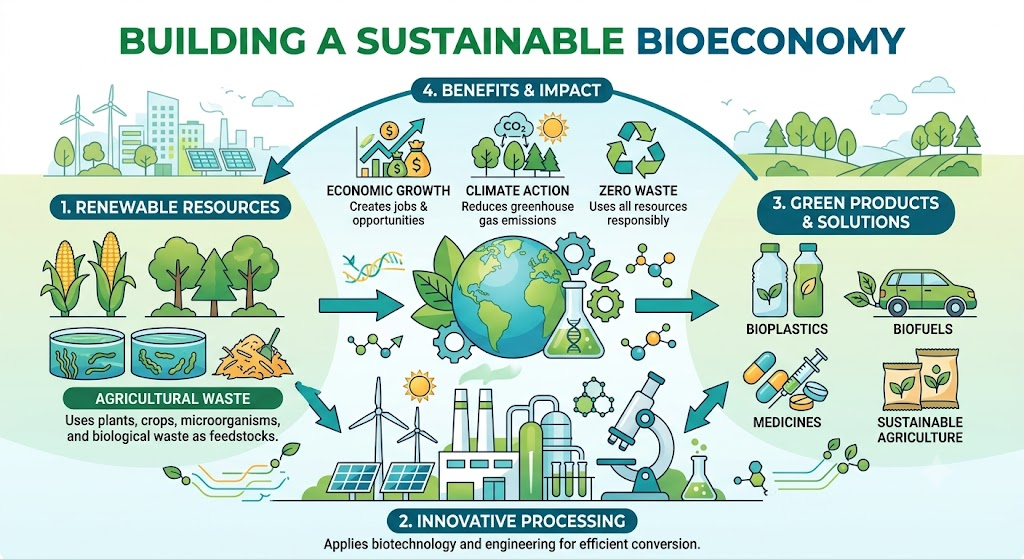
Definition: The bioeconomy encompasses all economic activities driven by research and innovation in the biological sciences. It involves the sustainable production, utilization, and conservation of biological resources (including knowledge, science, technology, and innovation) to provide information, products, processes, and services across all economic sectors.
Core Components:
- Bio-Pharma: Vaccines, therapeutics, diagnostics, and regenerative medicine.
- Bio-Agriculture: Genetically modified crops, bio-fertilizers, bio-pesticides, and climate-resilient seeds.
- Bio-Industrial: Biofuels, bio-plastics, enzymes, and bio-chemicals.
- Bio-IT & Bio-Services: Bioinformatics, clinical trials, and contract research and manufacturing services (CRAMS).
Key Principles: It signifies a shift away from a fossil-fuel-based economy toward a circular and sustainable economy, focusing on renewable biological resources to solve challenges in food, health, environmental protection, and energy.
Bioeconomy and the Indian Economy
The biotechnology sector is emerging as a critical growth engine for the Indian economy, shifting from a niche sector to a mainstream economic driver.
Current Landscape & Economic Potential:
- Rapid Expansion: The Indian bioeconomy has grown exponentially over the last decade. With new strategic targets, it aims to scale from approximately $195 billion (projected 2025) to $691 billion by 2035, fundamentally altering India’s GDP composition.
- Global Positioning: India is currently among the top 12 destinations for biotechnology globally and ranks 3rd in the Asia-Pacific region.
Multi-Sectoral Impact on the Indian Economy:
- Agriculture and Rural Economy:
- Income Enhancement: Bio-agriculture innovations (high-yield, drought-resistant crops) directly impact agricultural productivity, aiding in the stabilization of farmer incomes.
- Sustainability: Reducing dependency on chemical fertilizers through bio-inputs helps manage the agricultural subsidy burden and improves soil health.
- Healthcare and Biopharma:
- Global Pharmacy Hub: India supplies over 50% of the global demand for various vaccines. Advancing to biosimilars and cell therapies will capture higher-value segments of the global pharmaceutical market.
- Out-of-Pocket Expenditure (OOPE): Indigenous development of advanced therapeutics can drastically reduce domestic healthcare costs.
- Energy Security and Import Substitution:
- Biofuels: The push for ethanol blending and biodiesel directly reduces India’s crude oil import bill, conserving foreign exchange reserves and providing an alternative revenue stream for the sugar and agriculture sectors.
- Employment Generation:
- The transition to a bio-based economy is projected to create millions of high-skilled, high-value jobs in research, bio-manufacturing, and supply chain logistics, helping to harness India’s demographic dividend.
- Climate Commitments:
- Bio-manufacturing processes generally have a lower carbon footprint, assisting India in meeting its net-zero targets by 2070 (Panchamrit commitments).
Way Forward
To transform into a leading bioeconomy powerhouse, India must address structural bottlenecks and adopt a mission-mode approach.
- Bridging the ‘Valley of Death’:
- There is a critical gap between successful laboratory research and commercial-scale manufacturing. Establishing dedicated venture capital or growth funds (like the proposed ₹50,000-crore BioEconomy Growth Fund) is essential to provide viability-gap funding and equity support to biotech startups.
- Strengthening Bio-Manufacturing Infrastructure:
- Moving beyond research to establish large-scale bio-foundries and bio-manufacturing hubs. Utilizing Production-Linked Incentive (PLI) schemes specifically for bio-chemicals, bio-plastics, and enzymes will incentivize domestic manufacturing.
- Regulatory Streamlining:
- Biotechnology involves complex ethical, environmental, and health regulations. Creating a predictable, agile, and single-window regulatory framework for genetic engineering, synthetic biology, and clinical trials is necessary to attract global investment.
- Fostering Industry-Academia Linkages:
- Transforming academic research into commercial products requires institutionalized collaboration. Universities need to be incentivized to patent and commercialize their intellectual property in partnership with private enterprises.
- Skilling for the Future:
- Updating academic curricula to include advanced fields like synthetic biology, bioinformatics, and AI-enabled drug discovery to ensure a steady pipeline of specialized talent.
- Mission-Mode Execution:
- Implementing targeted national missions (e.g., for Marine Biotech, One Health, or Gene Therapies) with clear, measurable outcomes and cross-ministerial coordination (Science & Tech, Health, Agriculture, and Commerce).
Prelims Question
Consider the following statements regarding the recently released NITI Aayog Roadmap for Bioeconomy:
- It targets expanding India’s bioeconomy to $691 billion by 2035.
- It proposes a ₹50,000-crore BioEconomy Growth Fund to bridge the gap between proof-of-concept research and commercialization.
- The roadmap introduces six National BioMissions, including ‘GeneIndia’ and ‘BioPharmaNext’.
Which of the statements given above are correct? (a) 1 and 2 only (b) 2 and 3 only (c) 1 and 3 only (d) 1, 2 and 3
Mains Practice Question
Q. Discuss the significance of the recently proposed NITI Aayog roadmap in transforming India into a global biotechnology powerhouse by 2035. What major structural and financial bottlenecks does it aim to address? (15 Marks, 250 Words)