Subject: Science-Technology and Environment (General Studies Paper-III)
Table of Contents
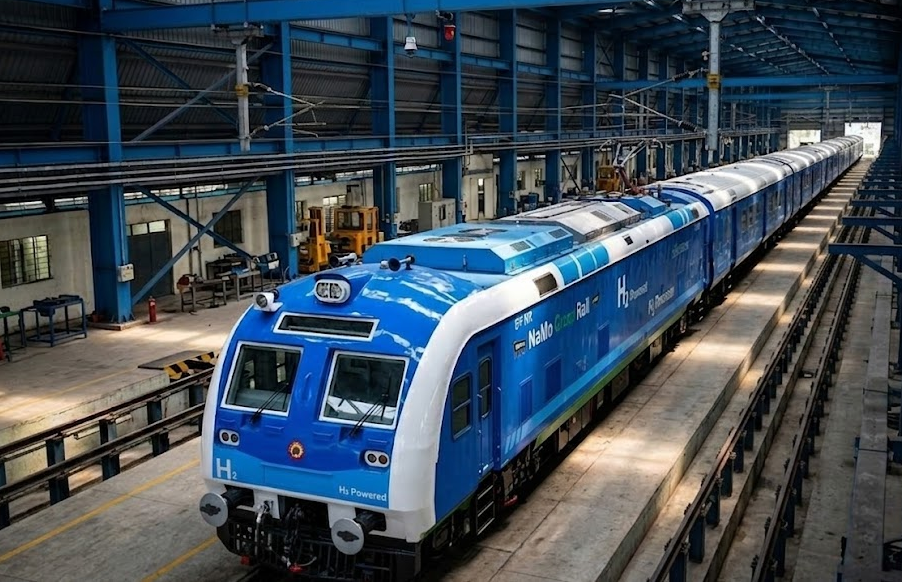
Recently, in a major leap toward sustainable transport and enhanced connectivity, Prime Minister Narendra Modi flagged off India’s first ‘hydrogen-powered fuel cell train’ in Jind, Haryana.
Key Highlights
- Indigenous Design and Integration: This 10-coach train has been completely designed and integrated indigenously.
- Power and Capacity: Powered by a 3,200 horsepower (HP) propulsion system, it is among the world’s longest and most powerful hydrogen-fueled passenger trainsets.
Working Mechanism of Hydrogen Fuel Cell Technology
- Onboard Power Generation: Unlike conventional trains reliant on diesel or electric power grids, this train generates its electricity onboard.
- Chemical Reaction: Electricity is produced inside a ‘fuel cell’ through a chemical reaction between hydrogen gas and atmospheric oxygen.
- Zero Emissions: The only by-product emitted during this entire process is water vapor, making it 100% eco-friendly.
Hydrogen as a Transport Fuel
- High Energy Density: Hydrogen has an exceptionally high gravimetric energy density (energy per unit mass). $1\text{ kg}$ of hydrogen contains approximately $142\text{ MJ}$ of energy—nearly three times more than conventional diesel or gasoline.
- Zero Tailpipe Emissions: Because the chemical reaction inside the fuel cell releases only water vapor and heat, it holds immense potential to completely decarbonize the transportation sector.
- Rapid Refueling and Extended Range: Unlike Battery Electric Vehicles (BEVs), Fuel Cell Electric Vehicles (FCEVs) can refuel in just a few minutes (similar to conventional fossil fuels) and offer extended ranges suitable for heavy-duty transport (trains, trucks, ships).
- Energy Security and Self-Reliance: India currently imports nearly 85% of its crude oil needs. Domestic hydrogen production will significantly lower reliance on imported fossil fuels.
Types of Hydrogen Fuel and Their Production
Hydrogen is classified into different “colors” based on its production source and environmental footprint:
| Type of Hydrogen | Production Method | Environmental Impact / Carbon Footprint |
| Green Hydrogen | Water electrolysis using renewable energy (solar/wind). | Zero carbon emissions (cleanest and most sustainable type). |
| Grey Hydrogen | Steam Methane Reforming (SMR) of fossil fuels, mainly natural gas. | High carbon emissions (currently accounts for the majority of global production). |
| Blue Hydrogen | Produced from natural gas (like Grey Hydrogen), but utilizes Carbon Capture and Storage (CCS). | Low carbon emissions (emitted carbon is captured before entering the atmosphere). |
| Brown / Black Hydrogen | Coal gasification process. | Extremely high carbon emissions (most damaging to the environment). |
Challenges of Hydrogen as a Transport Fuel
- High Production Costs: Green hydrogen remains expensive due to high electrolyser prices and input costs of renewable power.
- Storage and Transport: As the lightest element, hydrogen has a low volumetric energy density. Storing it requires compression under extreme pressure or cryogenic temperatures, making handling complex and hazardous.
- Infrastructure Deficit: India lacks a widespread network of Hydrogen Refueling Stations (HRS), dedicated pipelines, and safe storage facilities.
- Safety Concerns: Hydrogen is highly flammable, and its invisible flame makes leak detection difficult.
- Efficiency Losses: Energy is lost during the two-stage round-trip process (converting electricity to hydrogen via electrolysis, and converting hydrogen back to electricity via the fuel cell).
Future Strategy
- Effective Execution of National Green Hydrogen Mission: Provide financial incentives (e.g., the SIGHT program) to boost domestic electrolyser manufacturing and lower production costs to competitive levels.
- Scaling Up Pilot Projects: Replicate the Jind hydrogen train initiative across other heavy-transport sectors, such as long-haul buses and freight trucks.
- Building Safe Infrastructure: Develop dedicated green hydrogen corridors and refueling networks under strict safety standards.
- Investment in R&D: Foster academic-industry partnerships to develop advanced storage media (e.g., solid-state metal hydrides) and indigenous fuel cell technology.
- Policy Mandates: Progressively implement Green Hydrogen Purchase Obligations across commercial transport and heavy industries.
Practice Question for Prelims
Q. With reference to recent developments, consider the following statements:
- India’s first hydrogen-powered fuel cell passenger train was launched from Jind, Haryana.
- In hydrogen fuel cell technology, electricity is generated through a chemical reaction between hydrogen and atmospheric oxygen, with water vapor as the sole by-product.
- The foundation stone of a state-of-the-art museum dedicated to the heritage of Sikh Gurus was recently laid in Amritsar, Punjab.
Which of the statements given above is/are correct?
(a) Only 1 and 2
(b) Only 2 and 3
(c) Only 1 and 3
(d) 1, 2, and 3
Answer: (a) Only 1 and 2
Explanation: Statements 1 and 2 are correct. Statement 3 is incorrect because the foundation stone of the state-of-the-art Sikh museum was laid in Kurukshetra (Haryana), not in Amritsar.
Practice Question for Mains
Q. “Hydrogen Fuel Cell Technology can prove to be a game-changer in decarbonizing India’s public transport sector and achieving sustainable energy goals.” In light of the launch of India’s first hydrogen train, evaluate the benefits of this technology and the potential challenges in its implementation. (250 words)
Approach for Mains Answer:
- Introduction: Begin by highlighting the launch of India’s first indigenous hydrogen train in Jind (Haryana) as a major step toward clean transport.
- Body Section 1 (Mechanism & Benefits): Explain how fuel cells operate (Hydrogen + Oxygen $\rightarrow$ Electricity + Water Vapor). Discuss key advantages: zero tailpipe emissions, high energy density, decreased reliance on crude oil imports, and alignment with climate goals.
- Body Section 2 (Challenges): Detail key hurdles including high green hydrogen production costs, storage/transport complexities, infrastructure gaps, and efficiency losses.
- Conclusion: Conclude on a forward-looking note emphasizing India’s National Green Hydrogen Mission and the path toward a zero-emission transport ecosystem.