
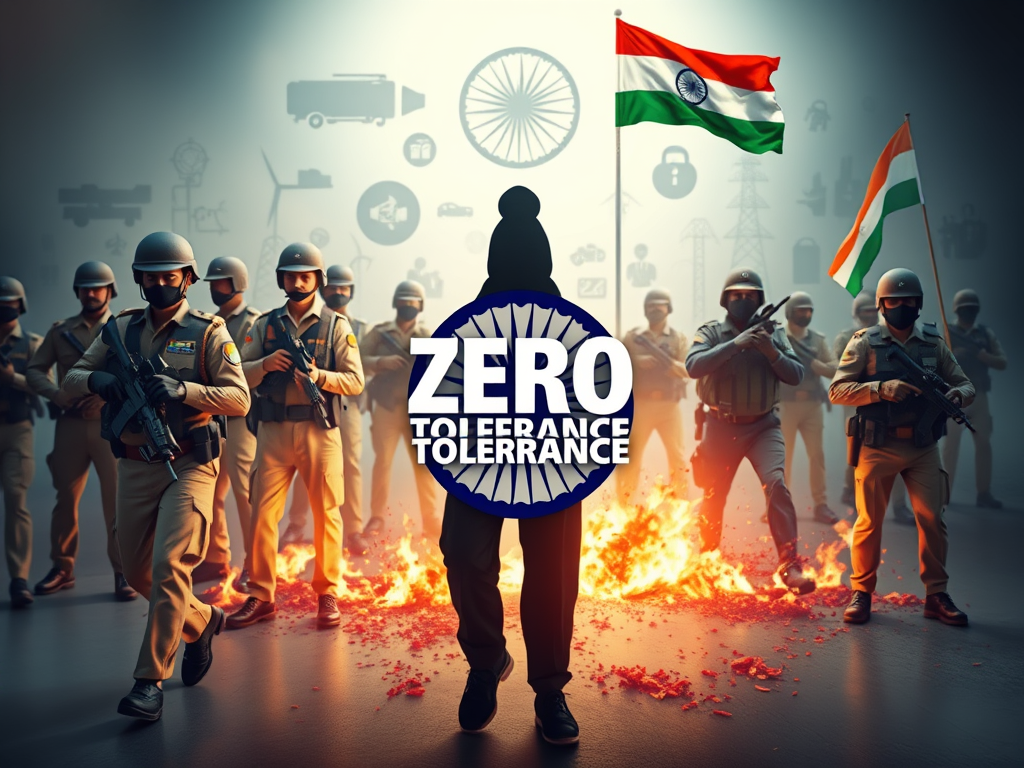
The Union Ministry of Home Affairs (MHA) has unveiled ‘PRAHAAR,’ India’s first-ever comprehensive National Counter-Terrorism Policy and Strategy. It marks a shift toward a proactive, unified, and technology-driven approach to tackling evolving security threats.
1. Core Philosophy and Scope
The policy is built on the principle of “Zero Tolerance” toward terrorism. Crucially, it clarifies India’s global stance:
- Decoupling Identity: India does not link terrorism to any specific religion, ethnicity, nationality, or civilization.
- Comprehensive Threat Perception: It recognizes that threats are no longer localized but span across land, water, air, and the digital frontier (Cyber-attacks).
2. Key Pillars of the PRAHAAR Policy
The policy aims to dismantle the entire ecosystem of terrorism through four primary objectives:
- Criminalization: Ensuring every act of terror is met with a robust legal framework.
- Financial Choking: Denying terrorists, financiers, and supporters access to any form of funding (e.g., via crypto-wallets or informal channels).
- Logistical Denial: Restricting access to weapons, ammunition, and safe havens.
- Critical Infrastructure Protection: Developing specialized capacities to protect vital sectors like Atomic Energy, Space, Power, Railways, and Aviation from both state and non-state actors.
3. Emerging Threats and Challenges
The policy identifies a “New Age” of warfare that moves beyond conventional infiltration:
A. The Cyber-Kinetic Link
- Nation-State Actors: Targeted attacks by foreign governments and criminal hackers on India’s digital economy.
- Dark Web & Encryption: Use of the dark web and encrypted messaging for anonymous communication and propaganda.
B. Technological Asymmetry
- Drones and Robotics: The use of Unmanned Aerial Vehicles (UAVs) for smuggling weapons and drugs (especially in Punjab and J&K) and for launching lethal attacks.
- CBRNED Threats: The challenge of intercepting Chemical, Biological, Radiological, Nuclear, Explosive, and Digital (CBRNED) materials.
C. The Terror-Crime Nexus
- The policy highlights an increasing reliance by terror groups on organized criminal networks for logistics, recruitment, and terrain knowledge.
4. Institutional and Structural Reforms
To ensure a “Whole-of-Government” approach, PRAHAAR proposes:
- Uniform Anti-Terror Structure: Standardizing processes and procedures across all Indian States to ensure a synergistic response.
- Legal Integration: Involving legal experts at every stage of the investigation to build “watertight” cases, ensuring higher conviction rates.
- Intelligence Synergy: Strengthening the role of the National Investigation Agency (NIA) and intelligence agencies in pre-empting attacks like the 2025 Pahalgam incident.
5. The Social Dimension: De-radicalization
Recognizing that security is not just a police matter, the policy emphasizes:
- Community Engagement: Involving moderate religious leaders and NGOs to spread awareness against extremist ideologies.
- Youth Outreach: Actively working to prevent the recruitment of Indian youth by global groups like al-Qaeda and ISIS.
6. International Cooperation
The policy acknowledges that terrorism is a transnational challenge. It calls for:
- Regional cooperation to deny “safe havens” in neighboring countries.
- Aligning national actions with international counter-terrorism protocols to track global terror financing.
7. Critical Analysis (UPSC Perspective)
While PRAHAAR provides a much-needed roadmap, its success will depend on two factors:
- Federal Cooperation: Since ‘Police’ is a State subject, the “Uniform Anti-Terror Structure” will require deep political consensus between the Centre and States.
- Technological Upgradation: As terrorists move toward crypto and the dark web, India’s “Digital Police” must evolve faster than the threat actors.
Conclusion: PRAHAAR is a landmark shift from a reactive security posture to a pre-emptive and holistic strategy. By addressing the “ecosystem” of terror—including finance, technology, and ideology—India is positioning itself to handle the complexities of 21st-century asymmetric warfare.