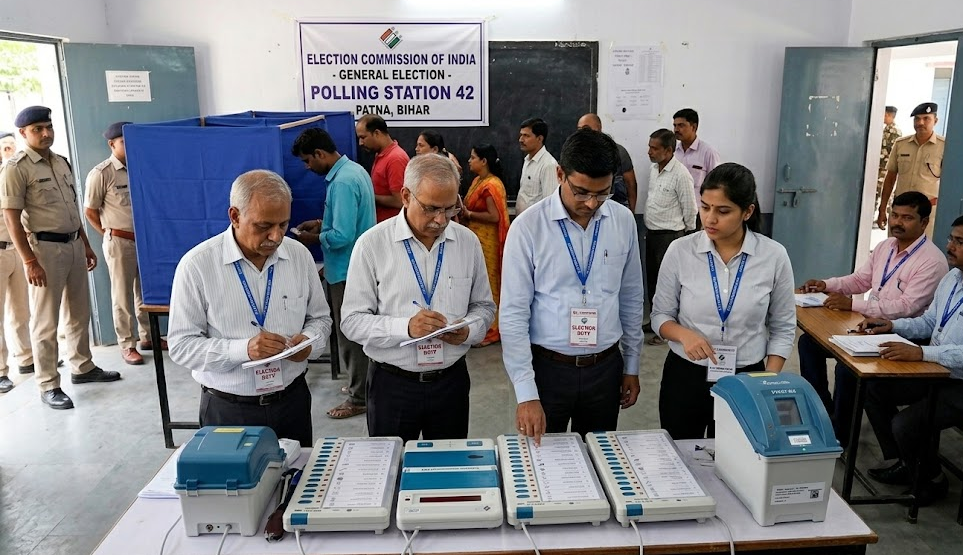
On May 2, 2026—just 48 hours before the scheduled counting of votes in West Bengal—the Supreme Court dismissed a petition by the Trinamool Congress (TMC). The court rejected the claim that Central government employees are biased toward the party at the Center, affirming the Election Commission’s (EC) supreme authority over all poll personnel.
Key Points
- The “Allegiance Fallacy”: The Supreme Court termed it a “fallacy” to assume that State employees are loyal to the state’s ruling party or that Central employees are controlled by the party at the Center.
- EC’s Total Control: Justice Joymalya Bagchi clarified that once any officer (State or Central) is deployed for poll duties, they legally belong to the Election Commission. They are under the EC’s exclusive “superintendence, direction, and control.”
- The April 13 Circular: The dispute centered on a directive requiring at least one counting supervisor and assistant at each table to be a Central government or Central PSU employee. The EC defended this as a measure to address “apprehensions of irregularities.”
- TMC’s Argument: Represented by Kapil Sibal, the party argued that Central employees are “susceptible” to BJP influence, creating an “apparent risk of bias” during the counting process.
- Article 324 Limits: While the TMC argued that the EC’s powers under Article 324 cannot be a “wild horse” (acting without data-backed apprehensions), the Court noted that the EC’s “subjective satisfaction” on the ground is paramount for maintaining a level playing field.
- The Randomization Process: The EC confirmed that selection is done through a randomized module (ECINet), and the Returning Officer (usually a State service officer) retains the overarching power to manage these selections.
Article 324: The “Reservoir of Power”
Article 324 is not just a procedural provision; the Supreme Court has described it as a “reservoir of power” for the Election Commission of India (ECI).
Key Clauses
- Article 324(1): Vests the “superintendence, direction, and control” of elections in the ECI.
- The Mohinder Singh Gill Principle (1978): The SC ruled that where the law (Representation of the People Act) is silent, Article 324 acts as a plenary power. The ECI can issue any order necessary to ensure a “free and fair” poll, provided it doesn’t violate existing laws.
- Article 324(2) & (5): Composition and Tenure
- The Commission consists of a Chief Election Commissioner (CEC) and other ECs as fixed by the President.
- The S.S. Dhanoa Case (1991): The SC clarified that the CEC has a higher constitutional status than other ECs because the CEC cannot be removed except through impeachment (like an SC Judge), whereas ECs can be removed by the President on the recommendation of the CEC.
Why it Matters for Civil Servants
Under Article 324(6), the President or Governor must provide the ECI with the staff necessary to conduct elections. Crucially:
- Once deployed, these officers are on deemed deputation to the ECI.
- The ECI gains disciplinary control over them, overriding the State/Central government’s authority for that period.
Neutrality and Anonymity of Civil Services
These two concepts form the “Weberian” backbone of the Indian bureaucracy, ensuring stability amidst political changes.
A. Political Neutrality
Neutrality does not mean a civil servant should have no opinions; it means they must provide objective, data-driven advice to the government of the day, regardless of their political leanings.
- Neutrality vs. Commitment: UPSC often asks if officers should be “committed.” The answer is: They should be committed to the Constitution and the Rule of Law, but neutral toward political parties.
- Second ARC Recommendation: The 2nd Administrative Reforms Commission emphasized that neutrality is essential to maintain public trust. It suggested a Civil Services Authority to oversee transfers and protect officers from political “witch-hunts.”
B. The Principle of Anonymity
Anonymity is the shield that allows neutrality to function. It is governed by the Maxwell Fyfe Doctrine (UK, 1954), which India follows:
- Ministerial Responsibility: The Minister represents the department in Parliament and takes the credit or blame for its actions.
- The “Alter Ego” Concept: Civil servants work behind the scenes as the “alter ego” of the Minister. They should not be praised or criticized in Parliament by name.
- Rationale: If an officer’s name is dragged into political debate, they lose their ability to serve the next government impartially.
The Convergence: The 2026 West Bengal Context
The Supreme Court’s recent dismissal of the “Allegiance Fallacy” (the idea that Central employees are BJP-loyal and State employees are TMC-loyal) reinforces these constitutional principles:
| Concept | Judicial Observation (May 2026) |
| Institutional Identity | An officer does not “belong” to the party in power; they belong to the Institution of the Civil Service. |
| Electoral Duty | During polls, the “State” or “Central” label disappears; they are exclusively ECI officials. |
| Randomization | Use of technology (like the ECINet module) is the modern safeguard to ensure that neither “allegiance” nor “bias” can influence the counting process. |
Sardar Patel’s Vision (1947):
“A civil servant cannot afford to, and must not, take part in politics… [If you take that steel frame out], the fabric will collapse.”
By maintaining Anonymity (staying out of the limelight) and Neutrality (serving the Constitution), the Civil Service ensures that while governments change, the State remains permanent and functional.
UPSC Practice Questions
1. Prelims (PT) Question
Q. With reference to the conduct of elections in India, consider the following statements:
- Once government employees are deployed for election duty, they are considered to be on deputation to the Election Commission.
- The Election Commission has the power to discipline state government employees for lapses in election duty under Article 324.
- The Returning Officer of a constituency is always an official appointed by the Central Government.
Which of the statements given above are correct?
A) 1 and 2 only
B) 2 and 3 only
C) 1 and 3 only
D) 1, 2, and 3
Answer: A) 1 and 2 only
Explanation: Statement 3 is incorrect. The Returning Officer is usually a State government officer (like a District Magistrate or Sub-Divisional Officer) designated by the EC in consultation with the State Government.
2. Mains Question
Q. “The independence of the Election Commission is not merely a statutory requirement but a constitutional imperative to ensure the ‘purity’ of the electoral process.” In the light of recent judicial observations, discuss the challenges to the perceived neutrality of poll personnel in a federal setup. (250 words)