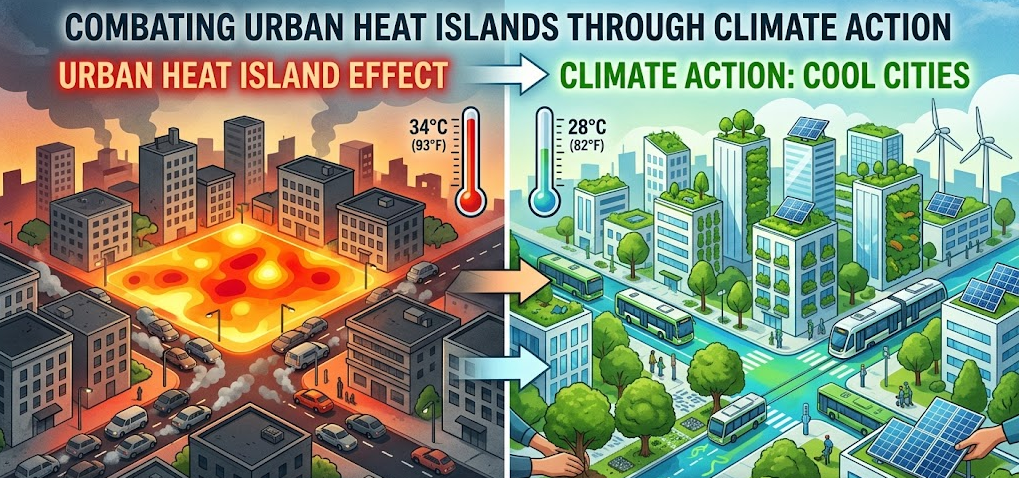
As Nation grapples with summer temperatures hitting 35 °C, the commercial hub of several cities has emerged as a critical “Urban Heat Island” (UHI). Experts are calling for localized climate action plans that move away from “top-down” approaches toward integrated district-level resilience.
Key Points from the News
- The Cooling Paradox: Textile and jewelry showrooms in T. Nagar of Chennai often “blast” cold air onto streets. While cooling interiors, the external heat exhaust significantly contributes to the Urban Heat Island (UHI) effect.
- Localized Solutions: Mitigation in dense areas like T. Nagar requires passive cooling, mechanical ventilation (fans), and setting ACs to 24-26 °C to reduce energy load and external heating.
- Chennai’s Third Master Plan: Led by the CMDA, this plan integrates heat mitigation by identifying vulnerable spots based on surface temperature and building density.
- State-Level Success Stories:
- Tamil Nadu: Established the Tamil Nadu Green Climate Company (TNGCC) as a nodal agency.
- Odisha: Implemented Climate Budgets to track spending.
- Maharashtra (Ratnagiri): Integrated climate resilience directly into the District Development Plan rather than having a separate document.
- Policy Shift: The 16th Finance Commission has recommended making heatwaves a nationally notified disaster, which would unlock significant federal funding for city-level resilience.
What is an Urban Heat Island (UHI)?
An Urban Heat Island is a metropolitan area that is significantly warmer than its surrounding rural areas due to human activities and the built environment.
Causes of UHI
- Concrete & Asphalt: These materials have high thermal mass; they absorb and retain heat during the day and release it slowly at night.
- Lack of Vegetation: Fewer trees mean less evapotranspiration (the process by which plants release water vapor, cooling the air).
- Waste Heat: Heat exhausted by air conditioners, vehicles, and industrial processes.
- Urban Geometry: Tall buildings close together (urban canyons) trap heat and block wind flow that would otherwise clear hot air.
Effects of UHI
- Health: Increased risk of heatstroke, respiratory issues, and exhaustion, especially in vulnerable populations.
- Energy Demand: Spikes in electricity consumption for cooling, leading to higher carbon emissions (a feedback loop).
- Water Quality: Hotter pavement transfers heat to rainwater, which then enters sewers and raises the temperature of local water bodies, harming aquatic life.
India’s Policy Framework for Heat & Climate
1. State Action Plan on Climate Change (SAPCC)
Originally criticized as “top-down,” the SAPCC 2.0 versions are now more granular. States like Kerala and Tamil Nadu are integrating these into legislative processes.
2. Heat Action Plans (HAPs)
First pioneered by Ahmedabad in 2013, HAPs provide a framework for:
- Preparedness: Early warning systems and color-coded alerts (Yellow/Orange/Red).
- Response: Training healthcare workers and providing “cool roofs” or public cooling centers.
- Long-term Mitigation: Increasing green cover and urban planning changes.
3. Strategic Dashboards
- India Climate and Energy Dashboard (ICED): Developed by NITI Aayog to provide a holistic picture of national energy and climate trajectories.
- PM Surya Ghar Portal: Tracks the adoption of rooftop solar, which reduces grid dependency and “waste heat” from traditional power plants.
UPSC Practice Questions
Prelims (PT) Question
Q. With reference to ‘Urban Heat Islands’ (UHI), consider the following statements:
- The ‘Albedo’ of urban surfaces like asphalt is generally higher than that of rural green cover.
- The UHI effect is primarily a daytime phenomenon and disappears completely at night.
- High building density contributes to the UHI effect by creating “urban canyons” that trap heat.
Which of the statements given above is/are correct?
A) 3 only
B) 1 and 3 only
C) 2 and 3 only
D) 1, 2, and 3
Answer: A) 3 only
Explanation: Statement 1 is wrong; asphalt has low albedo (absorbs more heat). Statement 2 is wrong; UHI is often most noticeable at night when concrete releases stored heat.
Mains Question
Q. “Climate adaptation is not a separate document but a lens through which all developmental and infrastructure plans must be viewed.” Discuss this statement in the context of India’s emerging localized Heat Action Plans (HAPs). (250 words)