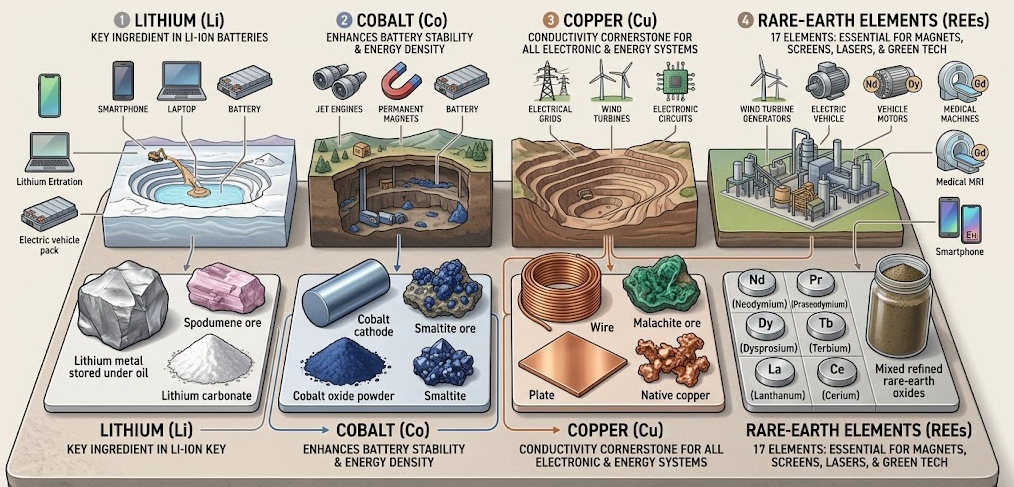
As the world accelerates toward a net-zero future by 2050, a central irony has emerged: the “green” transition is currently one of the largest drivers of global mining. Building a single electric vehicle (EV) requires six times the mineral inputs of a conventional car, creating a massive tension between global climate goals and localized ecological protection.
The Three Frameworks of Sustainability in Mining
To address the inherent contradiction of “sustainable mining,” global policy-makers use three distinct conceptual lenses:
- Weak Sustainability: This “Capital Exchange” model (supported by the UN and IEA) suggests that mining is acceptable if the Natural Capital extracted is converted into Human Capital. For example, using mining royalties to build permanent schools, hospitals, and renewable energy grids that outlast the mine.
- Sustainable Mining: This focuses on the Circular Economy. Since minerals are finite, “sustainability” is achieved by keeping them in use indefinitely. However, the current global recycling rate for critical minerals like lithium is less than 5%, meaning we are still in a “linear” extraction phase.
- Responsible Mining: This focuses on the Operational Footprint. It involves using Green Hydrogen for trucks, powering sites with wind/solar, and securing the Social License to Operate—ensuring local communities give consent and share in the profits.
Critical Minerals: The “New Oil”
The energy transition has shifted the world’s strategic focus from fossil fuels to specific “critical minerals.”
| Technology | Key Mineral Requirements | Why it’s needed? |
| EV Batteries | Lithium, Cobalt, Nickel | High energy density and storage. |
| Wind Turbines | Rare Earths (Neodymium) | Powerful permanent magnets. |
| Solar Panels | Copper, Silicon, Silver | Conductivity and photon absorption. |
| Power Grids | Copper, Aluminium | Expanding the global electrical backbone. |
The Ethical & Ecological Dilemma
- The Sacrifice Zone: Areas like the “Lithium Triangle” in South America or Cobalt mines in the DRC often face water depletion and human rights issues to provide “clean” energy for the developed world.
- Irreversibility: No amount of “Human Capital” (money or education) can restore a destroyed rainforest or an extinct species lost to open-pit mining.
- The Recycling Gap: Until recycling technologies for lithium-ion batteries mature, the world remains dependent on primary extraction (mining the earth).
UPSC Perspective: Governance & Environment
1. Important Concepts for GS Paper 3
- Natural Capital Accounting: Measuring the economic value provided by ecosystem services (like clean air/water) before deciding to mine an area.
- District Mineral Foundation (DMF): An Indian statutory body (under the MMDR Act) that embodies “Weak Sustainability” by using mining funds for the welfare of affected people.
- Critical Minerals Mission: India’s recent policy initiative to secure supply chains for minerals like Lithium (found in J&K) and Vanadium.
UPSC Practice Questions
Prelims (PT) Question
Q. Which of the following frameworks suggests that mining can be considered ‘sustainable’ if the wealth generated is invested in education and infrastructure?
A) Strong Sustainability
B) Weak Sustainability
C) Circular Economy
D) Responsible Mining
Answer: B) Weak Sustainability
Mains Question
Q. “The path to a low-carbon economy is paved with intensive mineral extraction.” Critically analyze the ecological and ethical challenges associated with ‘Green Mining’ and suggest measures to move toward a circular mineral economy. (250 words)