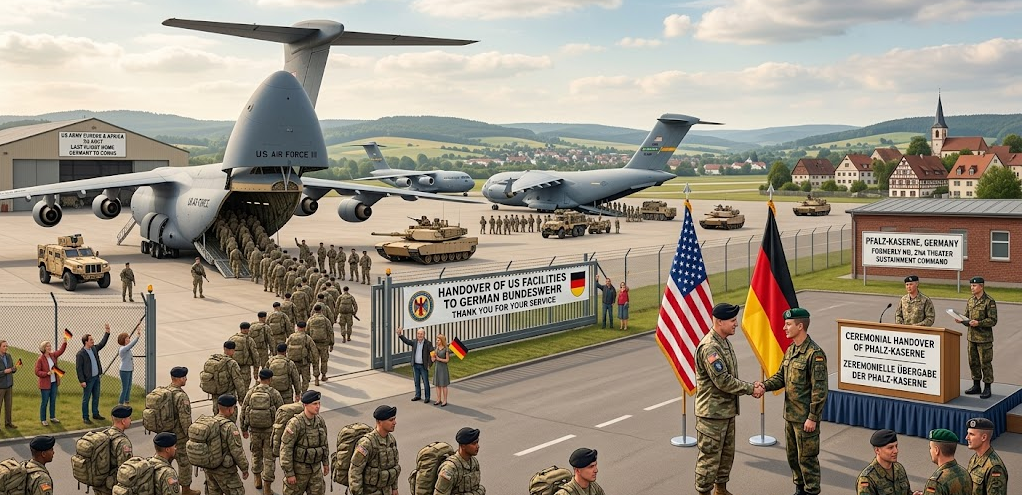
As of May 4, 2026, the relationship between the United States and Germany has entered a period of severe friction following President Donald Trump’s announcement of significant troop withdrawals. This move has escalated a public dispute between Trump and German Chancellor Friedrich Merz, who took office on May 6, 2025.
The Dispute: Trump vs. Merz
The tension centers on differing strategic views regarding NATO and regional conflicts, specifically the ongoing U.S.-Israel military operations against Iran.
- The “Humiliation” Comment: Earlier in the week, Chancellor Merz publicly stated that the U.S. was being “humiliated” by the Iranian leadership and criticized Washington’s lack of a clear strategy.
- Trump’s Response: President Trump reacted sharply, suggesting Merz “doesn’t know what he’s talking about.” Shortly after, Trump moved to weaponize the U.S. military presence in Germany—a long-standing point of contention for him regarding European “burden-sharing.”
The Troop Withdrawal Details
- The Initial Plan: On Friday, May 1, the Pentagon announced a formal plan to withdraw roughly 5,000 troops (about 14% of the 36,000 U.S. service members in Germany) over the next 6 to 12 months.
- Trump’s Escalation: On Saturday, Trump indicated that the 5,000-troop figure is just a starting point, stating, “We’re cutting a lot further than 5,000.” He has not provided a specific final number, but his comments signal a potential fundamental shift in America’s European security posture.
- Strategic Implications: Germany currently hosts major U.S. hubs, including Ramstein Air Base, the Landstuhl Regional Medical Center, and the headquarters for both U.S. European Command (EUCOM) and Africa Command (AFRICOM).
Germany’s Reaction and Strategic Pivot
Chancellor Merz’s government has sought to maintain a calm public front, with Defense Minister Boris Pistorius describing the move as “anticipated.” However, the withdrawal has accelerated a massive shift in German defense policy:
- Increased Spending: Under Merz, Germany has pledged to increase defense spending to 5% of GDP, a historic high aimed at making the Bundeswehr the “strongest conventional army in Europe.”
- European Autonomy: Merz has increasingly called for Europe to achieve “strategic sovereignty,” reducing its reliance on U.S. security guarantees as the war in Ukraine enters its fifth year.
Bipartisan Backlash in Washington
The move has faced significant resistance within the U.S. Congress. Critics from both parties argue that a unilateral withdrawal weakens NATO’s eastern flank and provides a strategic advantage to Russian President Vladimir Putin. Senator Jack Reed (D-RI) described the action as “reckless,” warning of irreversible consequences for transatlantic alliances.
UPSC Practice Question
Q. Discuss the implications of the “America First” foreign policy on the collective security architecture of NATO in the context of the 2026 U.S.-Germany rift. How should India recalibrate its strategic partnerships in a world of shifting Western alliances? (250 words)