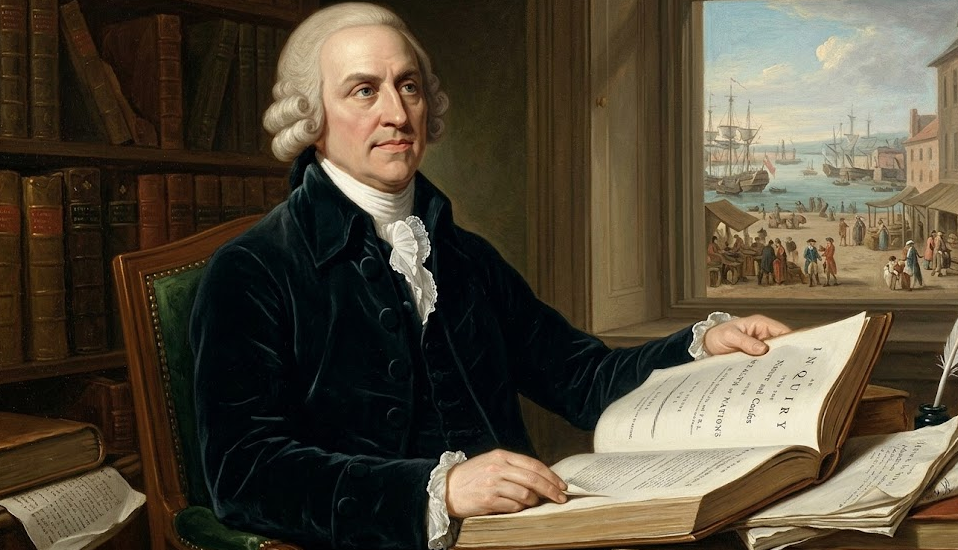
March 9, 2026, marks the 250th anniversary of The Wealth of Nations, the foundational text of modern economic science. The milestone has reignited interest in “Das Adam Smith Problem,” the historical debate over the perceived conflict between Smith’s focus on “self-interest” and his earlier emphasis on “sympathy.”
The Spectrum of Adam Smith: Key Analysis
- Theory of Moral Sentiments (1759): Focuses on Sympathy and the “Impartial Spectator.” It explores how humans are naturally inclined to care for the well-being of others, forming an inward-focused moral compass.
- The Wealth of Nations (1776): Focuses on Self-interest and the “Invisible Hand.” It explores how individual pursuit of gain, within a structured market, leads to collective prosperity.
- The “Problem”: 19th-century German economists argued Smith had “changed his mind” from altruism to egoism. Modern scholars reject this, noting that Smith viewed self-interest as a motivation that only functions effectively within an ethical framework.
- The Unified View: Empathy is the common thread. In WON, it is “applied empathy” (understanding what others want to trade), while in TMS, it is “pure empathy” (understanding what others feel).
Economic Ethics
Economic ethics focuses on the moral principles that govern financial and commercial activity. In Smithian terms, this is the “internal” check on human behavior.
- Empathy as a Market Utility: Contrary to the “selfish” caricature of capitalism, Smith argued that market exchange requires “applied empathy.” To trade effectively, one must understand and respect the needs and feelings of the other party.
- Trust and Transaction Costs: A functional economy relies on trust. When ethical behavior is high, transaction costs (legal fees, policing, insurance) are low. A breakdown in economic ethics leads to market failures like the 2008 financial crisis.
- The “Impartial Spectator”: This concept from Smith’s Theory of Moral Sentiments acts as an internal moral judge. It suggests that individuals should evaluate their economic actions from the perspective of a neutral third party to ensure fairness.
- Ethical Motivation vs. Self-Interest: While self-interest drives the desire to trade, ethics provides the rules of engagement. Without a moral compass, self-interest devolves into greed, which eventually destroys the market’s social license.
Governance
Governance refers to the external frameworks—laws, institutions, and state policies—that direct economic activity toward the common good.
- Institutional Integrity: Governance is responsible for creating the “institutions” Smith spoke of. This includes property rights, an independent judiciary, and regulatory bodies that prevent monopolies and ensure a “level playing field.”
- The “Visible Hand” of the State: While the “Invisible Hand” manages prices and supply, the state provides Public Goods (education, healthcare, infrastructure). Smith recognized that certain social needs cannot be met by the market alone.
- Inclusive Growth: In a modern context, governance must ensure that the “Wealth of a Nation” is not concentrated in the hands of a few. Policies like Progressive Taxation and Direct Benefit Transfers (DBT) reflect the moral obligation of the state to redistribute wealth fairly.
- Regulatory Balance: Governance must be strong enough to prevent corporate malpractice but flexible enough to encourage innovation. The goal is to create a “moral market” where competition thrives alongside social welfare.
UPSC Checkpoint: Integrated Analysis
GS Paper 4 (Ethics): The Moral Capital
In Ethics, “Moral Capital” refers to the trust, goodwill, and legitimacy a company earns by adhering to ethical standards. When a firm maximizes “Wealth” (profits) at the expense of “Moral Sentiments” (human values), it depletes its moral capital, leading to systemic failure.
Example: The Satyam Computers Scandal (2009)
- The Focus on “Wealth”: The leadership focused solely on inflating balance sheets and stock prices to project a false image of growth and wealth.
- Ignoring “Moral Sentiments”: The ethical obligation toward transparency, shareholder trust, and fiduciary duty was discarded.
- Crisis of Legitimacy: Once the fraud was revealed, the company didn’t just lose money; it lost its “Social License to Operate.” It faced a total collapse of legitimacy, proving Smith’s point that markets cannot survive without an underlying moral framework of honesty.
Example: Fast Fashion & Environmental Impact
- The Dualism: Modern companies using “sweatshops” prioritize the “Invisible Hand” (cheap production) but ignore the “Impartial Spectator” (the moral awareness of exploitation).
- The Result: Global boycotts and ESG (Environmental, Social, and Governance) regulations now force these companies to reintegrate “Moral Sentiments” into their business models to remain viable.
GS Paper 2 & 3 (Governance & Economy): Social Justice
In Governance and Economy, Smith’s reconciliation justifies the Welfare State. If the market (Wealth of Nations) creates inequality, the state must act as the moral arbiter (Moral Sentiments) to ensure equity.
Example: Direct Benefit Transfer (DBT) and PDS in India
- The “Wealth” Aspect: India’s high GDP growth rate represents the successful “Wealth of Nations” side—efficient production and market activity.
- The “Moral Necessity”: However, growth alone doesn’t reach the “Antyodaya” (the last person). The state intervenes through the National Food Security Act (NFSA) and DBT.
- Substantiation: This intervention is not a “hindrance” to the economy. By ensuring nutrition and financial inclusion, the state builds Human Capital, which in turn makes the market more robust and sustainable. This is Smith’s “applied empathy” at a policy level.
Example: The Mahatma Gandhi National Rural Employment Guarantee Act (MGNREGA)
- The Conflict: Critics often call it a “drain” on the exchequer (purely an economic view).
- The Reconciliation: From a Smithian perspective, MGNREGA provides a “Social Safety Net.” By providing a floor for wages and livelihood security, it prevents the social unrest that would otherwise destroy the market’s stability. It turns “Moral Sentiment” into a “Governance Tool” for social justice.
UPSC Practice Questions
Preliminary (PT) Question
Q. Which of the following best describes ‘Das Adam Smith Problem’ in the context of economic history? A) The difficulty in calculating the exact Gross Domestic Product of a nation. B) The perceived contradiction between Smith’s focus on ‘sympathy’ in one book and ‘self-interest’ in another. C) The failure of the ‘Invisible Hand’ to prevent the Great Depression. D) The ethical dilemma of using child labor in the early industrial era.
Answer: B
Mains Question
Q. “Economics without ethics is a hollow science.” Discuss this statement in the light of Adam Smith’s dual legacy of The Wealth of Nations and The Theory of Moral Sentiments. How is this reconciliation relevant to the socio-economic challenges of 21st-century India? (250 Words)