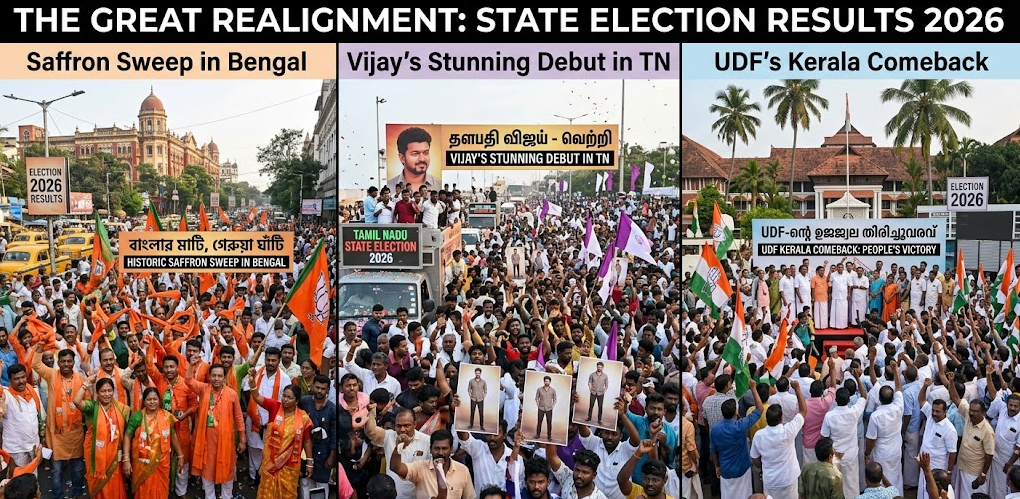
The May 2026 Assembly election results across Tamil Nadu, West Bengal, Kerala, Assam, and Puducherry have signaled a fundamental realignment in India’s federal landscape. This verdict underscores a shift from ideological duopolies toward personality-centric regionalism and a clear demand for administrative “re-boots.”
1. Tamil Nadu: The Rise of the “Third Pole”
In a result that has stunned political pundits, C. Joseph Vijay’s Tamilaga Vettri Kazhagam (TVK) has emerged as the single largest party, dismantling the 50-year-old DMK-AIADMK duopoly.
- The Numbers: TVK won 107 seats, just 11 short of a majority.
- The Giant Killers: Chief Minister M.K. Stalin and 14 of his Cabinet ministers were defeated. The DMK was relegated to 59 seats.
- Historical Context: This is the first hung Assembly in Tamil Nadu since 1952. Vijay’s ascent mirrors the 1983 “NTR wave” in Andhra Pradesh, marking a successful transition from the silver screen to the Secretariat.
- The Vote Share: TVK secured a massive 35%, indicating a total consolidation of the “change” vote.
2. West Bengal: A Saffron Milestone
For the first time in history, the Bharatiya Janata Party (BJP) is set to form the government in West Bengal, ending 15 years of Trinamool Congress (TMC) rule.
- The Landslide: The BJP swept 206 seats (over two-thirds majority), while the TMC plummeted to 80 seats.
- The Bhabanipur Shock: In a repeat of the Nandigram narrative, Mamata Banerjee lost her Bhabanipur seat to Suvendu Adhikari by over 15,000 votes.
- The “Myth-Breaker”: The result suggests a significant religious polarization, with the BJP securing nearly 46% of the vote. The minority vote, traditionally a TMC fortress, was split among the Left-ISF, Congress, and AJUP.
3. Kerala: The End of the “Double Term” Experiment
Kerala has returned to its “revolving door” tradition, decisively ousting the LDF after a ten-year stint.
- The Winner: The Congress-led UDF secured a massive 102 seats, leaving the LDF with just 35.
- BJP’s “Third Bloc”: The BJP won 3 seats (Nemom, Kazhakoottam, and Chathannoor), fundamentally realigning the state’s traditionally bipolar politics.
- Key Drivers: Anti-incumbency, the “Sabarimala gold scandal,” and effective consolidation of minority votes by the UDF.
4. Assam & Puducherry: The NDA Strongholds
While the South and East saw disruption, the Northeast and the Union Territory of Puducherry provided a narrative of continuity for the NDA.
Assam: The Sarma Hat-trick
- Record Win: The NDA bagged 102 of 126 seats. The BJP alone won 82, well past the majority mark of 64.
- Stature of Himanta Biswa Sarma: Securing a third term and playing a key role in the Bengal victory, Sarma has cemented his position as the BJP’s most powerful regional leader.
- Opposition Collapse: The Congress was reduced to its lowest-ever tally of 19 seats.
Puducherry: Stability for AINRC
- The Result: The AINRC-led NDA retained power with 18 out of 30 seats.
- Personal Victory: CM N. Rangasamy won both seats he contested, while the TVK made a small but significant debut with 2 seats in the UT.
Summary Table: 2026 Assembly Results
| State/UT | Leading Party/Alliance | Total Seats | Seats Won | Status |
| Tamil Nadu | TVK (Vijay) | 234 | 107 | Hung Assembly (TVK Largest) |
| West Bengal | BJP | 294 | 206 | Clear Majority (First BJP Govt) |
| Kerala | UDF (Congress) | 140 | 102 | Clear Majority |
| Assam | NDA (BJP+) | 126 | 102 | Hat-trick (Clear Majority) |
| Puducherry | NDA (AINRC+) | 30 | 18 | Retained Power |
Recent Trends in Indian Polity (Based on 2026 Verdicts)
The 2026 elections offer a masterclass in evolving voter behavior and institutional shifts. For UPSC aspirants, these results provide rich fodder for GS Paper 2 (Polity and Governance).
1. The Decline of Bipolarity and the “Third Pole” Phenomenon
- The Tamil Nadu Shift: For nearly 50 years, Tamil Nadu was the textbook example of a stable bipolar system (DMK vs. AIADMK). The rise of C. Joseph Vijay’s TVK as the single largest party (107 seats) suggests that voters are increasingly willing to look beyond legacy Dravidian ideologies if a credible “personality-driven” alternative emerges.
- Kerala’s New Bloc: While the UDF won a landslide, the BJP winning 3 seats and becoming a “third bloc” in the Kerala Assembly fundamentally realigns the State’s traditionally exclusive LDF-UDF “revolving door” politics.
2. The Penetration of National Parties into “Ideological Fortresses”
- West Bengal: The BJP’s win with a two-thirds majority (206 seats) marks the fall of the last major regional fortress that had resisted the “Saffron Wave.” This trend shows that national narratives can eventually overcome deeply embedded regional sub-nationalism if coupled with strong anti-incumbency (15 years of TMC rule).
- Assam’s Continuity: The BJP-led NDA’s third straight term in Assam (102 seats) highlights the success of combining “developmentalism” with the “protection of indigenous identity,” creating a sustainable electoral model in the Northeast.
3. The “Personality over Party” Surge
- The NTR Parallel: Vijay’s success in Tamil Nadu, without a prior political grounding, mirrors N.T. Rama Rao’s 1983 ascent. It highlights that in the age of social media, “Mass Charisma” can bypass traditional grassroots party building, provided the candidate has a pre-existing, decade-long “fan-to-voter” pipeline.
- The Sarma Factor: In Assam, Himanta Biswa Sarma has emerged as a “Regional Sub-national Icon” within a national party, proving that strong regional leadership is now the most bankable asset for national parties.
4. Fragility of Minority Vote Consolidation
- West Bengal Analysis: The split of Muslim votes among the TMC, Left-ISF, and AJUP shows that minority blocks are no longer monolithic. Strategic fragmentation in minority-heavy seats often benefits the primary challenger (BJP), a trend that was decisive in 2026.
- Kerala Analysis: Conversely, the UDF’s victory was built on the “successful corralling” of anti-BJP Muslim and Christian votes, showing that where a clear alternative to the BJP exists, minority consolidation remains a potent defensive electoral tool.
5. The “Cabinet Wipeout” and Administrative Accountability
- In West Bengal, Tamil Nadu, and Kerala, a significant number of sitting Cabinet Ministers were defeated. This reflects a high level of “performance-based voting,” where voters distinguish between the party’s top leadership and the individual performance of ministers on the ground.
Constitutional & Legal Angles
- Governor’s Discretion (Article 164)
- Under Article 164, the Governor holds the pivotal responsibility of appointing a Chief Minister during a hung Assembly.
- In the current Tamil Nadu scenario, the Governor must exercise discretionary power to ensure a stable government.
- Legal Precedents for Appointments
- Following the Sarkaria Commission and S.R. Bommai case, the single largest party should be invited first.
- The leader of the TVK must then be given a clear opportunity to prove their majority on the floor of the House.
- Electoral Integrity (Article 324)
- Article 324 grants the Election Commission the supreme authority to manage, direct, and control the electoral rolls.
- This constitutional mandate ensures the purity of the election process by maintaining accurate and valid voter data.
- Special Intensive Revision (SIR)
- The Special Intensive Revision in West Bengal led to the deletion of 90 lakh electors to update the rolls.
- Such large-scale revisions underscore the Commission’s vital role in preventing discrepancies during the polling cycle.
UPSC Practice
Preliminary (PT) Style Questions
Q1. In the context of a ‘Hung Assembly’, consider the following statements regarding the Governor’s powers:
- The Governor’s power to appoint a Chief Minister when no party has a clear majority is a form of ‘Constitutional Discretion’.
- According to the Sarkaria Commission, the Governor should first invite an alliance of parties that was formed prior to the elections.
- The Supreme Court in the S.R. Bommai case (1994) held that the majority of a government must be tested on the floor of the House and not in the Raj Bhavan.
Which of the statements given above are correct?
A) 1 and 2 only
B) 2 and 3 only
C) 1 and 3 only
D) 1, 2, and 3
Answer: B. (Statement 1 is incorrect; it is ‘Situational Discretion’, as it arises from political circumstances rather than explicit constitutional text).
Q2. With reference to the ‘Special Intensive Revision’ (SIR) of electoral rolls, consider the following statements:
- SIR is a reactive process where the Election Commission relies on citizens to voluntarily file claims for inclusion.
- The Election Commission derives its authority for SIR from Article 324 of the Constitution and the Representation of the People Act, 1950.
- The primary objective of SIR is to eliminate ‘ghost voters’ through house-to-house enumeration.
Which of the statements given above is/are correct?
A) 3 only
B) 1 and 2 only
C) 2 and 3 only
D) 1, 2, and 3
Answer: C. (Statement 1 is incorrect; SIR is a proactive, door-to-door verification process, unlike the Summary Revision).
Mains Style Questions
GS Paper 2: Indian Polity (Governor’s Role)
Q. “The Governor’s situational discretion in a hung assembly is often a subject of constitutional silence and political controversy.” In the light of the 2026 Tamil Nadu election results, critically examine the guidelines provided by the Sarkaria and Punchhi Commissions regarding the appointment of a Chief Minister. (250 Words)
GS Paper 2: Election Commission (Article 324)
Q. “Article 324 acts as a reservoir of power for the Election Commission of India, but these powers are not absolute.” Discuss this statement in the context of recent ‘EVM vandalism’ reports and the Commission’s power to order a total constituency repoll. (150 Words)
GS Paper 2: Federalism & Electoral Reforms
Q. The Special Intensive Revision (SIR) 2026 resulted in the deletion of nearly 90 lakh electors in West Bengal. Analyze the tension between the need for ‘purifying’ electoral rolls and the right to universal adult suffrage. What safeguards are necessary to prevent the accidental disenfranchisement of genuine voters? (250 Words)