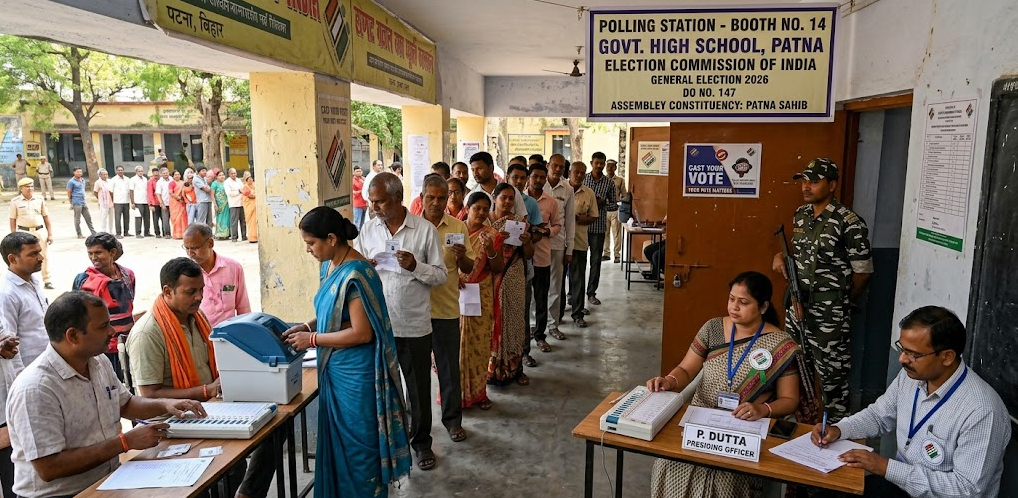
As of May 2026, the Election Commission of India (ECI) faces significant scrutiny over the enforcement of the Model Code of Conduct (MCC) following Prime Minister Narendra Modi’s April 18 national broadcast. While the MCC is a set of non-statutory guidelines, a writ petition in the Supreme Court (Diary No. 24600 of 2026) now seeks to link such broadcasts to “corrupt practices” under the Representation of the People Act, 1951.
What is the Model Code of Conduct (MCC)?
The MCC is a consensus-based document. Unlike many other election rules, it is not a law enacted by Parliament. Instead, it evolved from a 1960 Kerala experiment where political parties voluntarily agreed to follow certain ethical rules.
- Origin: First drafted in Kerala (1960); adopted by the ECI nationally in 1968.
- Purpose: To ensure that the “Party in Power” (at the Center or State) does not use its official position to further its election prospects.
- Scope: It covers eight key areas, including general conduct, meetings, processions, polling day behavior, and the conduct of the party in power.
UPSC Checkpoint: Legal and Statutory Framework
- Evolution and Constitutional Power
The MCC evolved from a 1960 Kerala draft into a national standard, later enforced with unprecedented rigour by T.N. Seshan starting in 1991.
In Mohinder Singh Gill (1978), the Supreme Court ruled that Article 324 acts as a “reservoir of power” allowing the EC to intervene where law is silent.
- Temporal Scope and Part VII Restrictions
The Code comes into effect the moment election dates are announced, as established by the Punjab and Haryana High Court in 1997.
Part VII specifically prohibits the “party in power” from misusing government machinery, official visits, or publicly funded media for partisan electoral gains.
- Statutory Limits of Section 123(3)
Section 123(3) of the RP Act defines “corrupt practices” as appeals based on the religion, race, caste, community, or language of candidates or voters.
The Abhiram Singh (2017) judgment expanded “his” to include the voter’s identity, yet it remains limited to these five specific identity-based categories.
- The Workforce Clause (Section 123(7))
A 2026 petition argues that using Doordarshan and PMO personnel for partisan broadcasts violates Section 123(7) regarding the assistance of government servants.
This shift focuses on who was used to deliver the message (the workforce) rather than the specific identity-based grounds of the appeal itself.
How is it Implemented in India?
The implementation of the MCC is unique because it relies more on moral suasion and Article 324 of the Constitution (which gives the ECI plenary powers) than on a specific statute.
- Timeline: It kicks in the moment the ECI announces the election schedule and remains in force until the results are declared.
- Enforcement Mechanism:
- Observers: The ECI appoints thousands of senior civil servants as “Election Observers” to monitor ground-level violations.
- C-Vigil App: A digital tool that allows citizens to report violations in real-time with photo/video evidence.
- Notices and Censure: The ECI can issue “Show Cause” notices. If the response is unsatisfactory, it can censure the candidate, ban them from campaigning for a few days, or even suspend their party’s recognition.
- The “Reservoir of Power”: Under the Mohinder Singh Gill (1978) case, the SC ruled that where the law is silent, the ECI has the power to act independently to ensure fair polls.
Key Issues Related to Implementation
The 2026 elections have highlighted several “hard tests” for the MCC:
| Issue | Description |
| Lack of Statutory Backing | Since MCC is not a law, the ECI cannot send anyone to jail for a violation. It must file separate FIRs under the IPC or RP Act, which are slow. |
| The “Digital Gap” | MCC was written for a physical world. It struggles with social media, deepfakes, and “partisan broadcasts” (like the April 18 incident) that reach millions instantly. |
| Delayed Action | Critics often argue the ECI is “too slow” to act against top leaders, making the punishment (like a 48-hour ban) irrelevant if the damage is already done. |
| Open Texture vs. Rigid Law | As seen in the recent Section 123(7) debate, the law (RP Act) is rigid, but the MCC is “open-textured.” This leads to inconsistent interpretations by different Commissions. |
Proposed Solutions & Way Forward
- Statutory Backing (The Debate): Some argue for making the MCC a part of the Representation of the People Act, 1951. However, the ECI opposes this because it would subject every decision to judicial review, potentially delaying elections indefinitely.
- Fast-Track Courts: For “Corrupt Practices” under Section 123 of the RP Act, dedicated fast-track courts should resolve cases within 6 months.
- Social Media Regulation: Formalizing the “Voluntary Code of Ethics” signed by social media platforms into a mandatory regulatory framework during the election period.
- Independent ECI Appointments: Ensuring the appointment of Election Commissioners is done through a bipartisan committee (as recently debated) to ensure the ECI remains neutral when dealing with the “party in power.”
- Clarifying Part VII: Providing a “closed list” of what constitutes “misuse of public resources” to avoid the kind of doctrinal difficulties seen in national broadcasts during campaign periods.
UPSC Practice Questions
Prelims (PT) Question
Q. With reference to the Model Code of Conduct (MCC), consider the following statements:
- The MCC is a statutory document enacted by the Parliament under the Representation of the People Act, 1951.
- Part VII of the MCC, which deals with the “party in power,” was added to the code in 1979.
- The MCC comes into operation only from the date of notification of the election by the President.
Which of the statements given above is/are correct?
A) 2 only
B) 1 and 2 only
C) 2 and 3 only
D) 1, 2, and 3
Answer: A) 2 only
Explanation: Statement 1 is incorrect as the MCC is non-statutory. Statement 3 is incorrect because the MCC applies from the announcement of the schedule by the EC, not the notification.
Mains Question
Q. “The Model Code of Conduct (MCC) provides an ‘open-textured’ framework that goes beyond the strict categories of the Representation of the People Act, 1951.” In light of recent controversies regarding the use of public media by incumbents, discuss the need for providing statutory backing to the MCC. (250 words)