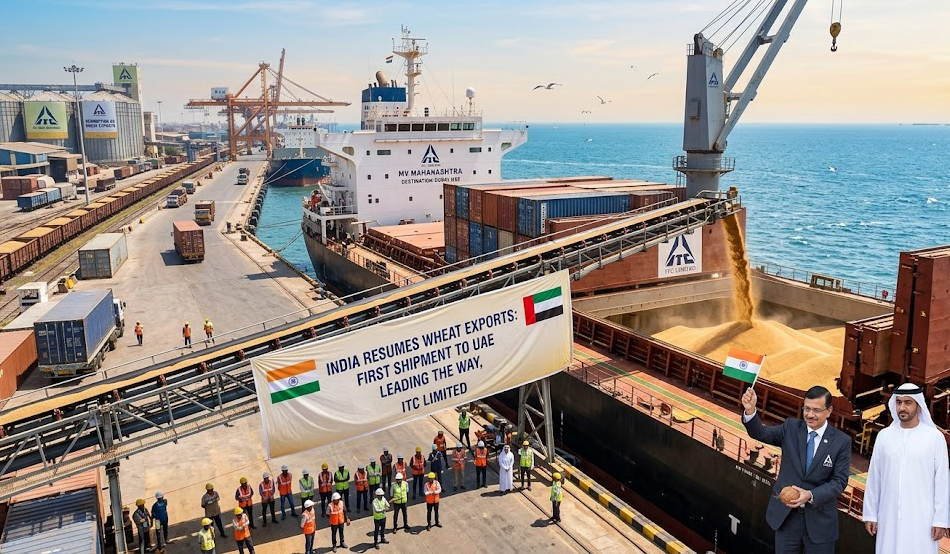
As of May 2026, Indian traders have resumed wheat exports after a four-year hiatus. Driven by record domestic stocks and a spike in global wheat prices, major conglomerates like ITC have commenced shipments from the Kandla port to destinations in the Middle East, such as the UAE. This move signals a significant shift in India’s agricultural trade policy and its role in global food security.
Factors Driving the Export Resumption
The reopening of the “export window” is the result of a specific set of economic and logistical conditions:
- Ample Domestic Buffer: Consecutive years of bumper harvests have left India with wheat stocks far exceeding the mandatory buffer norms required for the Public Distribution System (PDS).
- Global Price Surge: Geopolitical tensions and crop failures in other major exporting regions (like the Black Sea or North America) have pushed global prices high enough to make Indian wheat competitive despite high domestic support prices.
- Freight Rate Dynamics: While global freight rates are firmer, the geographical proximity of Indian ports to West Asia (Middle East) and Southeast Asia gives Indian traders a logistics advantage over distant competitors in Europe or the Americas.
- Private Sector Participation: The entry of organized players like ITC indicates that the quality and supply chain logistics for Indian wheat are meeting international standards.
Economic and Strategic Implications
- Foreign Exchange Earnings: Resuming exports helps improve India’s trade balance and brings in valuable foreign exchange.
- Farmer Income: Increased demand from private exporters often pushes open-market prices above the Minimum Support Price (MSP), directly benefiting farmers in wheat-surplus states like Punjab, Haryana, and Madhya Pradesh.
- Global Food Security: As a major producer, India’s re-entry acts as a stabilizing force in the global market, helping to cool down soaring food inflation in import-dependent nations in Asia and the Middle East.
UPSC Perspective: Agriculture and Trade Policy
1. Key Concepts for GS Paper 3
- Buffer Stock Norms: The minimum food grain stocks the government (via Food Corporation of India) must maintain for food security and PDS.
- Open Market Sale Scheme (OMSS): The mechanism through which the government sells surplus food grains to private traders to regulate domestic prices.
- SPS Measures: “Sanitary and Phytosanitary” measures are international quality standards that Indian wheat must meet to avoid being rejected by importing nations.
Economic Survey 2025-26 Data
Foodgrain Production (Agricultural Year 2024–25)
India achieved a record-breaking foodgrain output of 3,577.3 lakh metric tonnes (LMT) or 357.73 million metric tonnes (MMT), marking an increase of 254.3 LMT over the previous year.
- Rice: Production reached 150.18 MMT.
- Wheat: Production stood at 117.94 MMT.
- Pulses: Output was recorded at 25.68 MMT.
- Millets (Shree Anna): Production reached 18.59 MMT.
Horticulture and Commercial Crops
The horticulture sector has emerged as a “bright spot,” contributing approximately 33% of agricultural Gross Value Added (GVA).
- Total Horticulture Production: Reached 362.08 MT in 2024-25, surpassing total foodgrain production.
- Fruits and Vegetables: Production included 114.51 MT of fruits and 219.67 MT of vegetables.
- Cotton: Estimated at approximately 5.05 million tonnes.
- Tea: Output reached 1.203 million tonnes between April and December 2024-25.
Key Initiatives
Umbrella and Strategic Missions
- Krishonnati Yojana (KY): This serves as an umbrella framework comprising eight specialized schemes, including the Mission for Integrated Development of Horticulture (MIDH), the National Food Security and Nutrition Mission (NFSNM), and the Digital Agriculture Mission (DAM). It aims for holistic, science-based development to improve farm value realization.
- PM Dhan Dhaanya Krishi Yojana (PM-DDKY): Approved in July 2025 for a six-year period (commencing FY26), this scheme targets 100 Aspirational Agricultural Districts. It focuses on districts with low productivity and credit disbursement to improve irrigation, storage, and crop diversification.
- Mission for Atmanirbharta in Pulses: Approved on October 1, 2025, this initiative specifically targets self-sufficiency in pulse production to reduce import dependency.
Digital Public Infrastructure
- Digital Agriculture Mission (DAM): Approved in September 2024, it envisages the creation of AgriStack and a Krishi Decision Support System to provide farmers with timely, data-driven information.
- Kisan Rin Portal (KRP): Launched in 2023, this portal integrates multiple banks to streamline Kisan Credit Card (KCC) claims and identify duplicate or excess claims, ensuring financial discipline.
Seed and Soil Health
- National Mission on High-Yielding Seeds: Announced in the Union Budget 2025-26, this mission strengthens the research ecosystem to develop and propagate climate-resilient seed varieties.
- National Mission on Natural Farming (NMNF): A scaled-up version of previous organic initiatives, it has a budget of ₹2,481 crore and has already enrolled over 15 lakh farmers into natural farming clusters.
UPSC Practice Questions
Prelims (PT) Question Q. With reference to the ‘Kandla Port’ mentioned in the news, consider the following statements:
- It is a major port located on the Gulf of Kutch in Gujarat.
- It was the first Special Economic Zone (SEZ) to be established in India.
- It is primarily known for handling bulk commodities like petroleum and food grains.
Which of the statements given above are correct?
A) 1 and 2 only
B) 2 and 3 only
C) 1 and 3 only
D) 1, 2, and 3
Answer: D) 1, 2, and 3 (Note: Kandla was the first Export Processing Zone/SEZ in Asia, established in 1965).
Mains Question Q. “India’s shift from a food-deficit nation to a consistent food exporter requires a delicate balance between domestic food security and international trade commitments.” Discuss in the context of the recent resumption of wheat exports. (250 words)