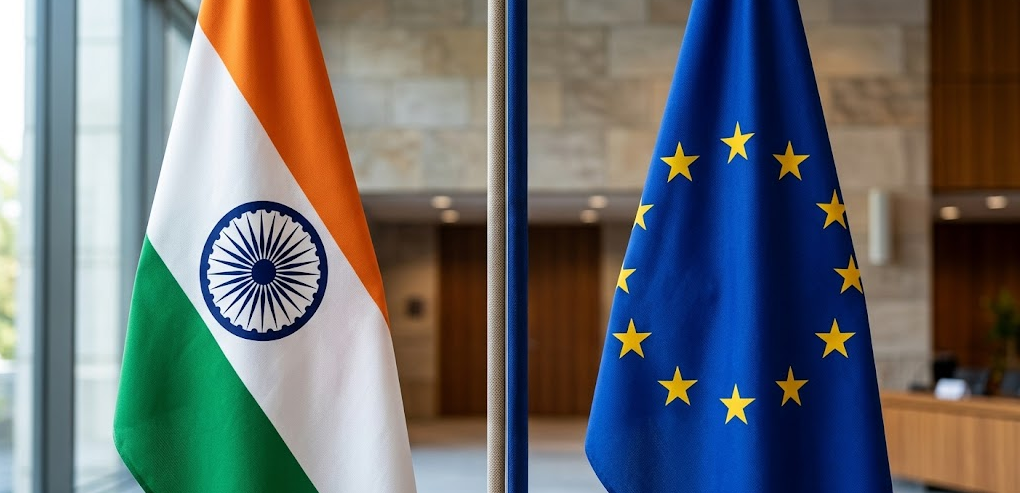
The India-EU FTA, recently concluded in January 2026, represents a landmark shift in bilateral economic relations. Described by EU Ambassador Hervé Delphin as the “mother of all deals,” the agreement aims to integrate two of the world’s largest economies into a singular, high-capacity market.
Key Highlights & Scale
- Market Reach: The FTA creates a free trade zone covering nearly two billion people.
- Economic Magnitude: Combined, the joint market accounts for one-quarter (25%) of global GDP.
- Timeline: Expected implementation is slated for early 2027, a timeline corroborated by both EU and Indian government sources.
- Strategic Nature: This is the largest FTA ever signed by either the EU or India, reflecting a shift toward “friend-shoring” and resilient supply chains.
Significance of the Agreement
- Deep Integration into Global Value Chains (GVCs): Beyond simple exports, the deal allows Indian manufacturers—particularly in the textile, footwear, and chemical sectors—to integrate directly into European supply chains with zero-duty access for 97% of tariff lines.
- Radical Shift in Automotive and Spirits: The agreement marks a historic concession from India, with tariffs on European cars dropping from 110% to 10% and wine tariffs eventually plummeting from 150% to 20%. This is expected to diversify the Indian luxury and machinery markets significantly.
- Critical Minerals Security: A strategic convergence has emerged regarding rare-earth elements and critical minerals (like gallium and germanium). The FTA facilitates technology transfer and joint extraction projects to ensure a stable supply for the green energy transition, reducing reliance on single-source suppliers.
- Labor-Intensive Sector Boost: For regions specializing in leather and gems & jewelry, the removal of duties on the first day of implementation provides an immediate competitive edge over other Asian exporters.
Challenges & “Unfinished Business”
- Despite the optimism, Ambassador Delphin highlighted several critical hurdles that could limit the FTA’s actual impact:
| Challenge Category | Specific Concern |
| Regulatory Barriers | Burdensome customs procedures and conformity requirements may act as “hidden” trade barriers. |
| Cost of Compliance | If administrative hurdles are too high, businesses may find the cost of compliance outweighs the benefits of lower tariffs. |
| Investment Gaps | Lack of a specific chapter on investment liberalization in non-services sectors, leading to lower predictability for investors. |
| Operational Mindset | The need for a “pro-FTA approach” across all levels of government to ensure implementation in “good faith.” |
Critical Gaps: Beyond the FTA
- The “Carbon Border” Hurdle (CBAM): While the FTA cuts tariffs, the EU’s Carbon Border Adjustment Mechanism (CBAM) remains a major “non-tariff” cost. Indian exporters of steel, aluminium, and cement will still face carbon taxes at the border unless their production methods align with EU environmental standards.
- Digital Trade and E-commerce: There is a notable lack of granular, enforceable rules on cross-border data flows and platform accountability. As digital trade grows, the absence of a comprehensive digital chapter could lead to fragmented regulations for tech firms and startups.
- Regulatory Conformity and QCOs: While tariffs are disappearing, Quality Control Orders (QCOs) and technical barriers to trade (TBT) are emerging as the new friction points. Aligning these standards remains “unfinished business” that could lead to shipment rejections at customs.
- Non-Services Investment Gap: As Ambassador Delphin noted, the lack of a dedicated chapter for investment liberalization in manufacturing leaves investors without the same level of legal predictability enjoyed by the services sector.
The Way Forward
- Parallel Agreements (IPA & GI): The two sides are working to conclude a separate Investment Protection Agreement (IPA) and a Geographical Indications (GI) Agreement. These are essential to protect brands like Darjeeling Tea or Champagne and to provide a legal safety net for multi-billion dollar factory investments.
- EU-India Platform for Climate Action: To help Indian industry bridge the “sustainability gap,” the EU has envisaged €500 million in support and the launch of a joint platform in early 2026 to help MSMEs adopt cleaner technologies and meet EU verification standards.
- The “Towards 2030” Strategic Agenda: This roadmap expands the partnership into maritime security, cybersecurity, and counter-terrorism, ensuring the economic deal is backed by a robust geopolitical framework.
- Customs Modernization: Between now and the 2027 rollout, the focus will shift to technical capacity building—training customs officials and simplifying documentation processes—to ensure that the administrative cost of using the FTA does not negate the 0% tariff benefit.
Question for Practice
Part 1: Preliminary Test (PT) / Objective Questions
Q1. With reference to the India-European Union (EU) Free Trade Agreement (FTA), consider the following statements:
- Once implemented, it will create a joint market comprising nearly 50% of the global Gross Domestic Product (GDP).
- The agreement is expected to be fully implemented by early 2027.
- The current FTA framework includes a comprehensive chapter on investment liberalization in non-services sectors.
Which of the statements given above is/are correct?
(a) 1 and 2 only
(b) 2 only
(c) 2 and 3 only
(d) 1, 2, and 3
Answer: (b) 2 only
- Explanation: Statement 1 is incorrect because the joint market accounts for one-quarter (25%) of global GDP, not 50%. Statement 2 is correct as both EU and Indian sources confirm an early 2027 timeline. Statement 3 is incorrect; the EU Ambassador specifically noted the absence of an investment liberalization chapter for non-services sectors as “unfinished business.”
Q2. The term “Mother of all deals,” recently seen in the news, is used in the context of:
(a) The India-Middle East-Europe Economic Corridor (IMEC).
(b) The Comprehensive Economic Partnership Agreement (CEPA) between India and UAE.
(c) The Free Trade Agreement (FTA) between India and the European Union.
(d) The Regional Comprehensive Economic Partnership (RCEP).
Answer: (c) The Free Trade Agreement (FTA) between India and the European Union.
- Explanation: EU Ambassador Hervé Delphin referred to the India-EU FTA as the “mother of all deals” due to its scale, covering nearly two billion people and a quarter of the global economy.
Part 2: Mains Examination / Subjective Questions
Q1. “While tariff reductions are the cornerstone of Free Trade Agreements, administrative and regulatory hurdles often act as invisible barriers to trade.” In the light of the India-EU FTA, analyze how regulatory compliance costs can impact the effectiveness of such trade deals. (150 Words, 10 Marks)
Key points for the answer:
- Introduction: Mention the conclusion of the India-EU FTA negotiations and its aim to create a massive joint market.
- Body:
- Explain the concept of “Cost of Compliance”: If administrative procedures (customs, conformity certificates) are too burdensome, the financial benefit of “zero tariffs” is neutralized.
- Discuss the SME perspective: Small and medium enterprises often lack the legal/administrative resources to navigate complex EU regulations.
- Mention Non-Tariff Barriers (NTBs): Standards related to health, safety, and environment (like the Carbon Border Adjustment Mechanism) can act as hurdles.
- Conclusion: Suggest that a “pro-FTA mindset” and administrative streamlining are essential for the deal to move beyond a “missed opportunity.”
Q2. Discuss the strategic and economic significance of the India-EU Free Trade Agreement for India’s ‘Atmanirbhar Bharat’ vision. Also, identify the gaps in the current agreement regarding investment protection. (250 Words, 15 Marks)
Key points for the answer:
- Introduction: Define the scale of the India-EU FTA (2 billion people, 25% of global GDP) and its status as the largest FTA for both sides.
- Economic Significance:
- Market access for Indian labor-intensive sectors (Textiles, Leather, Agriculture).
- Integration into Global Value Chains (GVCs).
- Cheaper access to high-tech EU machinery and green technology.
- Strategic Significance:
- Diversification of supply chains (de-risking from China).
- Strengthening the India-EU Strategic Partnership.
- The “Unfinished Business” (Gaps):
- Absence of investment liberalization in non-services sectors (Manufacturing, Mining, etc.).
- Need for a robust Investment Protection Agreement (IPA) to provide predictability and legal recourse for foreign investors.
- Conclusion: Emphasize that while the FTA is a major milestone, its long-term success depends on resolving the “beyond FTA” issues and ensuring ease of doing business across borders.