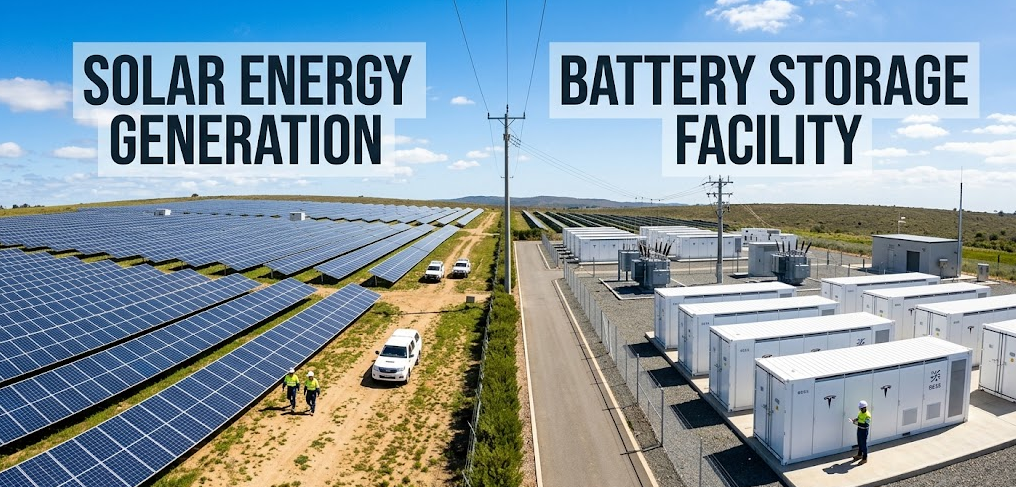
On April 25, 2026, India hit a record peak electricity demand of 256.1 GW. While solar plants contributed significantly during the afternoon, the 24-hour ledger highlighted a critical “yawning gap” between installed capacity and actual generation, primarily due to the lack of Battery Energy Storage Systems (BESS).
Current Status of Solar in India (2026)
- Peak Performance: Solar supplied 21.5% of the afternoon load on peak day.
- Generation Gap: Despite the peak performance, solar contributed only 10.8% to the total daily generation and a negligible 0.1% during evening peak hours (after sunset).
- Installed Capacity vs. Generation:
- Solar now accounts for nearly 28% of India’s installed capacity (up from 15% in 2022).
- However, its contribution to generation on peak days has only risen from 5.6% (2022) to 10.8% (2026).
Key Challenges: The “Half-Built Bridge”
- Grid Instability & Curtailment: Without storage, excess solar power during the day can destabilize the grid. In 2025, India curtailed 2.3 TWh of solar generation (18% of average monthly output) to maintain grid balance.
- Financial Burden: Power Purchase Agreements (PPAs) often require states to compensate producers for curtailed power, leading to a loss for the public exchequer for energy never delivered.
- The Evening Peak: Solar remains ineffective during evening hours when demand often spikes, forcing continued reliance on thermal power.
- Climatic Pressures: The IMD has forecast a below-normal monsoon (92% of Long Period Average). A drier, hotter summer increases daytime cooling demand, making efficient solar utilization vital.
Economics and Execution of Storage
- Falling Costs: Standalone two-hour battery storage tariffs dropped from ₹2.21 lakh per MW/month (early 2025) to ₹1.48 lakh (late 2025).
- Operational Lag: By end-2025, only 0.7 GWh of battery storage was operational, with a target of 2 GWh by December 2026.
Way Forward
- Mandatory Co-location: Future solar auctions should mandate co-located storage to ensure “firm and despatchable” renewable energy.
- Shift in Focus: Moving from “tendering” (announcing projects) to “commissioning” (making them operational).
- Addressing the “Financing Wall”: Resolving financial hurdles for low-tariff projects to ensure they reach the construction phase.
PRACTICE QUESTIONS
Q1. With reference to India’s solar energy sector, consider the following statements:
- Solar energy currently accounts for more than 50% of India’s total installed electricity capacity.
- “Curtailment” in the solar sector refers to the intentional reduction in electricity output to balance the grid.
- The “Long Period Average” (LPA) of rainfall is the average rainfall recorded over a particular region for a 10-year period.
Which of the statements given above is/are correct? A) 1 and 2 only
B) 2 only
C) 2 and 3 only
D) 1, 2, and 3
Q2. In the context of the Indian power sector, the term “Duck Curve” is most closely associated with:
A) The migration pattern of birds near hydro-power reservoirs. B) The fluctuating demand-supply gap caused by solar power generation during the day. C) The trajectory of falling tariffs in battery storage auctions. D) The thermal efficiency of coal-based power plants during monsoons.
ANSWERS AND EXPLANATIONS
Ans 1: B (2 only)
- Statement 1 is incorrect: While solar capacity has grown to nearly 28%, it is not yet above 50% of total installed capacity.
- Statement 2 is correct: Curtailment is a grid management tool used when supply exceeds demand or grid capacity.
- Statement 3 is incorrect: The LPA is usually calculated based on a 50-year period (currently 1971–2020), not 10 years.
Ans 2: B
- Explanation: The Duck Curve illustrates the timing imbalance between peak demand and renewable energy (solar) production. During the day, solar creates a “belly” of low net demand, followed by a sharp “neck” as solar drops off and evening demand surges.
MAINS PRACTICE QUESTION
“Solar capacity without storage is a half-built bridge.” In light of India’s recent peak demand records and the challenges of grid stability, critically analyze the role of Battery Energy Storage Systems (BESS) in achieving India’s renewable energy targets. (250 words)