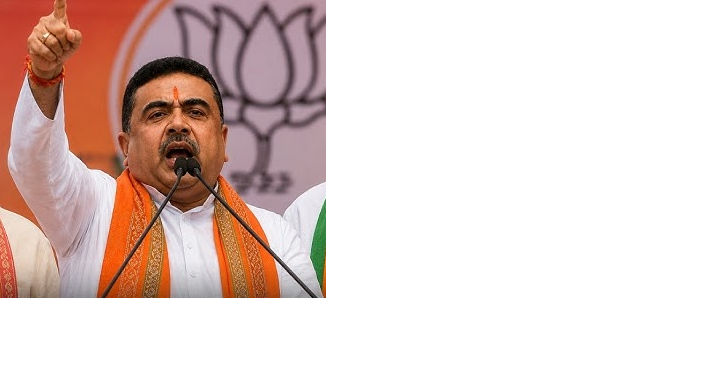
Following a decisive mandate in the West Bengal Assembly Elections, the Bharatiya Janata Party (BJP) has elected Suvendu Adhikari as the leader of its Legislature Party. With 207 seats in the 294-member Assembly, the BJP has crossed the majority mark (148), leading to the formal staking of claim to form the government.
Key Constitutional & Procedural Aspects
- Appointment of the Chief Minister (Article 164): The Governor (R.N. Ravi) appoints the Chief Minister, usually the leader of the party/coalition commanding a majority in the Legislative Assembly.
- Staking Claim: The process involves the leader of the majority party submitting a formal letter of support from the elected MLAs to the Governor at the Raj Bhavan (or Lok Bhavan in this specific context).
- Oath of Office: Administered by the Governor. It includes an oath of allegiance to the Constitution and an oath of secrecy.
- Collective Responsibility: The Council of Ministers, headed by the CM, is collectively responsible to the State Legislative Assembly.
Profile: Suvendu Adhikari (CM-Designate)
| Aspect | Details |
| Political Origin | Rose to prominence during the 2007 Nandigram movement against forcible land acquisition. |
| Career Trajectory | Former Cabinet Minister (2016–2020); Leader of the Opposition (2021–2026). |
| Electoral Performance | Won from both Nandigram and Bhabanipur. Defeated the outgoing CM in Bhabanipur by 15,115 votes. |
| Ideological Focus | Emphasis on security, nationalism, and restoring West Bengal’s status as a “cultural capital.” |
Governance Roadmap & Commitments
The incoming administration has outlined several “first-day” priorities:
- Anti-Corruption Drive: Establishment of a commission headed by a retired judge to investigate allegations of corruption in the previous regime.
- Social Security: Focus on the “security of women” and probing past atrocities via dedicated commissions.
- Implementation of “Modi Guarantees”: Fulfilling central-aligned election promises.
- Electoral Target: Aiming to increase the vote share from 46% to 60% for future political consolidation.
Practice Questions
Prelims Related (PT)
Q1. Consider the following statements regarding the appointment of a Chief Minister in India:
- The Constitution requires that a person must prove their majority on the floor of the Legislative Assembly before being appointed as the Chief Minister.
- A person who is not a member of the State Legislature can be appointed as Chief Minister for a maximum period of six months.
- The Governor’s discretion in appointing a Chief Minister is absolute and cannot be challenged in any court.
Which of the statements given above is/are correct?
(a) 2 only
(b) 1 and 2 only
(c) 2 and 3 only
(d) 1, 2, and 3
Q2. With reference to the West Bengal Legislative Assembly, consider the following:
- The total strength of the Assembly is 294 seats.
- The Leader of the Opposition is a statutory post.
- A party must secure at least 1/10th of the total seats to claim the post of Leader of the Opposition.
Which of the statements given above are correct?
(a) 1 and 2 only
(b) 2 and 3 only
(c) 1 and 3 only
(d) 1, 2, and 3
Mains Related
Q1. “The role of the Governor becomes crucial during the transition of power in a state.” Discuss the discretionary powers of the Governor in the context of government formation and the constitutional safeguards against the misuse of such powers. (150 words)
Q2. Analyze the impact of ‘Land Acquisition Movements’ on the shifting political landscape of regional politics in India, with special reference to West Bengal. (250 words)