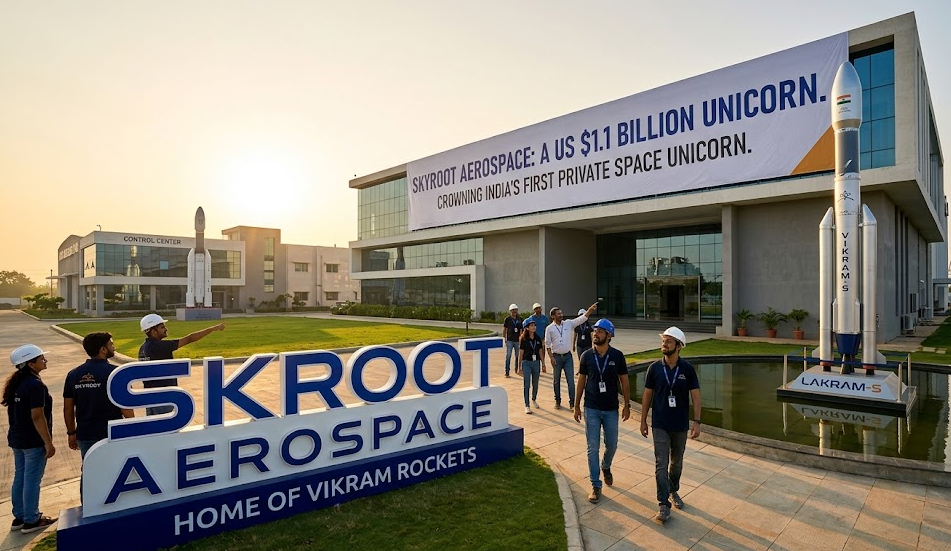
Skyroot Aerospace, a leading Indian private space-tech startup, recently raised $60 million in a funding round, pushing its pre-money valuation to $1.1 billion. With this, Skyroot has officially entered the “Unicorn club” (privately held startups valued at over $1 billion).
Key Highlights of the Development
- Global Backing: The funding round was co-led by international investors like Sherpalo Ventures and GIC (Singapore’s sovereign wealth fund).
- Strategic Leadership: Ram Shriram, a renowned tech investor and Alphabet Inc. board member, will join Skyroot’s board, bringing global tech-scaling expertise to the Indian space sector.
- A Milestone for Indian Space-Tech: Skyroot is now positioned as a flagship entity in India’s rapidly privatizing space economy, demonstrating immense global investor confidence in indigenous capabilities.
Background: Skyroot Aerospace & Indian Space Privatization
- Mission Prarambh: In November 2022, Skyroot made history by launching India’s first privately developed rocket, Vikram-S, from ISRO’s Sriharikota spaceport.
- Focus Area: The company specializes in building small satellite launch vehicles (SSLVs) to meet the growing global demand for deploying commercial satellites into Low Earth Orbit (LEO).
Significance of this Milestone
- Validation of Space Reforms: The $1.1 billion valuation is a direct validation of the Indian government’s decision to open the space sector to private players through the establishment of IN-SPACe (Indian National Space Promotion and Authorization Centre).
- Boost to FDI in Space: In early 2024, the government amended the FDI policy to allow up to 100% FDI in the space sector. This funding round demonstrates the successful attraction of global capital.
- Commercial Viability: It proves that Indian space startups can move beyond R&D and achieve commercial viability, competing with global players like SpaceX or Rocket Lab in the small-payload market.
- Atmanirbhar Bharat: Enhances domestic manufacturing and reduces reliance on foreign launch vehicles for small satellite deployment.
Challenges for Private Space-Tech Startups in India
| Challenge | Description |
| Capital Intensity | Space technology requires massive upfront capital with long gestation periods before generating revenue. |
| High Risk of Failure | Launch vehicle technology is inherently risky. A single launch failure can severely impact investor confidence. |
| Regulatory Ambiguity | While the Indian Space Policy 2023 provides a framework, issues related to space insurance, liability for damages, and intellectual property rights (IPR) are still evolving. |
| Talent Retention | Competing with global aerospace giants and deep-pocketed tech firms to retain highly specialized aerospace engineers. |
Way Forward
- Handholding by ISRO: Continued sharing of testing facilities, telemetry, and launchpad infrastructure by ISRO to lower the capital burden on startups.
- Robust Liability Framework: Enacting a comprehensive national space law that clearly outlines liability in case of space accidents or debris generation.
- Public Procurement: The government and ISRO should actively procure launch services from private startups (acting as anchor customers) to ensure steady revenue streams.
The ‘Unicorn’ Startup
- Definition: A “Unicorn” is a privately held startup company with a valuation of over $1 billion.
- Context: While India is the 3rd largest startup ecosystem globally (with unicorns predominantly in fintech, e-commerce, and edtech), the emergence of a deep-tech/space-tech unicorn indicates a maturation of the ecosystem toward high-IP, hardware-driven innovation.
Practice Questions
Preliminary Test (PT) / Objective
Q1. Consider the following statements regarding the private space sector in India:
- Skyroot Aerospace is the first Indian private company to successfully launch a privately developed rocket into space.
- Under the amended Foreign Direct Investment (FDI) policy, 100% FDI is allowed in the manufacturing of components and systems for satellites without government approval.
- IN-SPACe acts as a single-window, independent, nodal agency to facilitate private sector participation in Indian space activities.
Which of the statements given above are correct?
(a) 1 and 2 only
(b) 2 and 3 only
(c) 1 and 3 only
(d) 1, 2, and 3
Answer: (d) 1, 2, and 3
- Explanation: Skyroot launched Vikram-S (Statement 1 is correct). The 2024 FDI rules allow 100% FDI under the automatic route for the manufacturing of components and systems (Statement 2 is correct). IN-SPACe is the nodal agency for private participation (Statement 3 is correct).
Mains Examination / Subjective
Q1. “The emergence of deep-tech and space-tech unicorns in India marks a shift from a service-driven startup ecosystem to an innovation-driven one.” Discuss the significance of private sector participation in the Indian space economy and outline the challenges they face. (250 Words, 15 Marks)