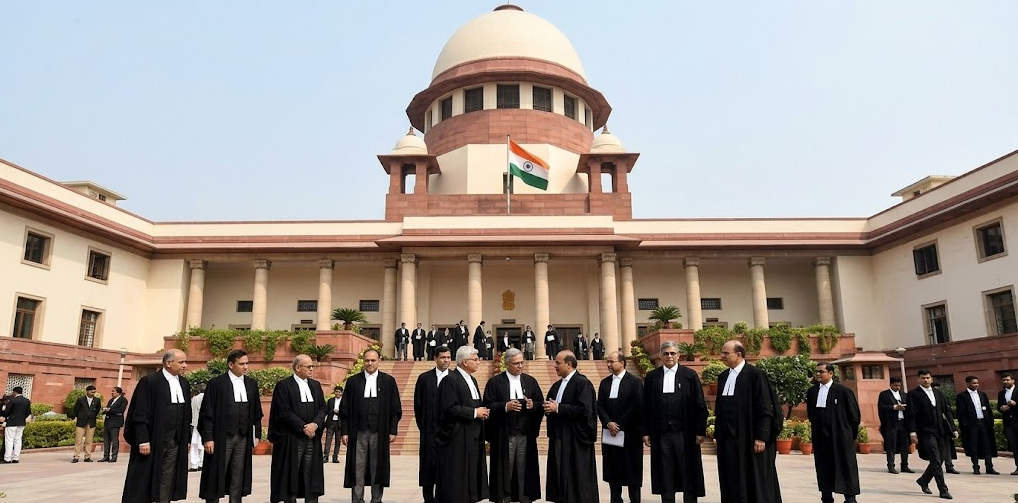
Recently, the President of India promulgated the Supreme Court (Number of Judges) Amendment Ordinance, 2026, increasing the sanctioned strength of Supreme Court judges from 33 to 37 (excluding the Chief Justice of India).
With this, the total sanctioned judicial strength of the apex court, including the Chief Justice of India (CJI), rises from 34 to 38.
Key Highlights of the Ordinance
- Amendment to the 1956 Act: The ordinance amends Section 2 of the Supreme Court (Number of Judges) Act, 1956, replacing the word “thirty-three” with “thirty-seven”.
- Constitutional Basis: It has been promulgated under Article 123 of the Constitution, which empowers the President to issue ordinances when Parliament is not in session and immediate action is deemed necessary.
- Parliamentary Scrutiny:
- The ordinance will be laid before both Houses of Parliament when it reconvenes.
- It will cease to operate if six weeks expire from the reassembly of Parliament without a resolution passing it, or if both Houses pass resolutions disapproving it.
- The President retains the power to withdraw the ordinance at any time.
Need for Increasing Judicial Strength
- Severe Case Pendency: The current backlog in the Supreme Court has crossed 93,000 cases and is on the verge of reaching six figures.
- Impact of Technology: The introduction and popularity of e-filing facilities post-COVID-19 have significantly increased the volume of cases being filed.
- Impending Vacation & Recess: The backlog is rising sharply just as the court enters its summer recess (or “partial working days”).
- Mitigating Vacancies & Retirements:
- The court currently has two vacancies (following the retirements of former CJI B.R. Gavai in November 2025 and Justice Rajesh Bindal in April 2026).
- Three more judges (Justices J.K. Maheshwari, Pankaj Mithal, and Sanjay Karol) are scheduled to retire by August 2026.
Constitutional Framework & Evolution of SC Strength
Constitutional Provision
- Article 124(1): The Framers of the Constitution originally envisaged a Supreme Court consisting of a Chief Justice of India and “not more than seven judges”, unless Parliament by law prescribed a larger number. Thus, the power to increase the strength of SC judges rests exclusively with Parliament.
Historical Evolution of Sanctioned Strength (Excluding CJI)
| Year | Sanctioned Strength (Excluding CJI) | Total Strength (Including CJI) | Legal Mechanism |
| 1950 | 7 | 8 | Original Constitutional Provision |
| 1956 | 10 | 11 | Supreme Court (Number of Judges) Act, 1956 |
| 1960 | 13 | 14 | Amendment Act |
| 1977 | 17 | 18 | Amendment Act |
| 1986 | 25 | 26 | Amendment Act |
| 2009 | 30 | 31 | Amendment Act |
| 2019 | 33 | 34 | Amendment Act (Last change before a 6-year hiatus) |
| 2026 | 37 | 38 | Supreme Court (Number of Judges) Amendment Ordinance, 2026 |
Way Forward
While increasing judge strength is a positive structural step after a six-year hiatus, bridging the pendency gap requires a multi-pronged approach:
- Timely Appointments: The Collegium and the Executive must coordinate to fill existing and upcoming vacancies promptly to maximize the utilization of the newly expanded strength.
- Judicial Reforms: Structural reforms, such as setting up a National Court of Appeal for routine civil/criminal matters, could leave the Supreme Court to focus primarily on Constitutional issues.
- Alternative Dispute Resolution (ADR): Strengthening mediation and arbitration mechanisms to filter out cases before they reach the apex court.
PRACTICE QUESTION
PRELIMS (PT) PRACTICE QUESTION
Q. Consider the following statements regarding the structure of the Supreme Court and the Ordinance-making power in India:
- The power to increase or decrease the number of judges in the Supreme Court of India is vested exclusively in the Parliament by law.
- An ordinance promulgated by the President under Article 123 will automatically cease to operate upon the expiry of six months from the reassembly of Parliament, unless disapproved earlier.
- The original text of the Constitution of India envisaged a Supreme Court consisting of a Chief Justice and not more than ten other judges.
How many of the statements given above are correct?
(a) Only one
(b) Only two
(c) All three
(d) None
Answer: (a) Only one
MAINS PRACTICE QUESTION
Q. “While increasing the sanctioned strength of judges is a necessary step to address the severe backlog plaguing the apex court, structural and systemic reforms are equally imperative to resolve India’s judicial pendency crisis.” Critically analyze. (15 Marks, 250 Words)