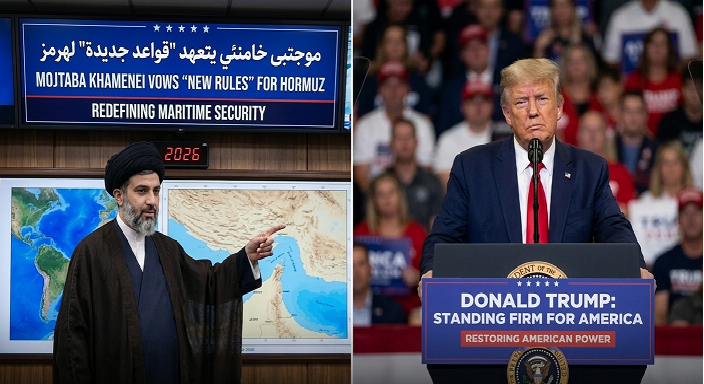
The ceasefire between the United States and Iran has formally come to an end following a recent dispute over the control and status of the Strait of Hormuz. Recent strikes by both nations targeting each other’s military installations have further deepened geopolitical tensions in the Middle East.
Key Points
Memorandum of Understanding (MoU) and Its Violation
- The United States and Iran signed a Memorandum of Understanding (MoU) on June 17, aimed at extending the ceasefire and initiating negotiations toward a final settlement.
- According to Iran, U.S. violations have rendered several parts of this MoU ineffective, while the U.S. President termed dealing with them a “waste of time,” accusing Iran of violating the agreement daily.
Core Cause of the Dispute – The Strait of Hormuz
- At the heart of the conflict lies the question of who will control the Strait of Hormuz, the world’s most critical chokepoint for oil trade.
- The MoU called for the safe passage of tankers through the strait.
- Iran has opened a new route along its coast and directed commercial vessels to use this “designated route” in coordination with local authorities.
Attacks on Commercial Vessels and Diplomatic Impact
- Three commercial vessels passing through an alternative route along the Omani coast—the Marshall Islands-flagged M/T Al Rekayyat, Saudi Arabia-flagged M/T Wedyan, and Liberia-flagged M/T Cyprus Prosperity—were attacked.
- Following these attacks, the U.S. revoked the sanctions waiver granted to Iran, which had allowed it to sell its oil.
Military Escalation and Airstrikes
- U.S. Action: U.S. Central Command (USCENTCOM) conducted precision airstrikes hitting over 80 Iranian targets (air defense systems, radar sites, anti-ship missiles, and more than 60 IRGC vessels) to secure international trade flows in the Strait of Hormuz.
- Iranian Retaliation: In response to the U.S. strikes (which killed 8 Iranian military personnel), Iran claimed to have targeted 85 U.S. military assets in the Persian Gulf.
India’s Stance
- India has expressed deep concern over the incidents of targeting commercial shipping in the Strait of Hormuz.
- The Ministry of External Affairs (MEA) has urged all parties to exercise maximum restraint.
- India emphasized that all parties should immediately return to the path of dialogue and diplomacy to achieve a peaceful and lasting solution to the conflict.
Prelims Practice Question
Q. With reference to the recently discussed ‘Strait of Hormuz’ and the U.S.-Iran dispute, consider the following statements:
- The primary cause of this dispute is establishing control over the safe passage of commercial tankers through the Strait of Hormuz.
- Following the recent escalation, the U.S. has revoked the sanctions waiver that permitted the sale of Iranian oil.
Which of the statements given above is/are correct?
- (a) 1 only
- (b) 2 only
- (c) Both 1 and 2
- (d) Neither 1 nor 2
Answer: (c) Both 1 and 2
Explanation: According to the text, both statements are correct. Control of the Strait of Hormuz lies at the core of the dispute, and following attacks on three vessels near the Omani coast, the U.S. revoked the sanctions waiver regarding Iran’s oil sales.
Mains Practice Question
Q. “The escalating U.S.-Iran military tension in the Strait of Hormuz poses a serious threat not only to regional peace but also to global trade.” In light of this statement, analyze the main causes of the recent dispute. What has been India’s diplomatic response to this crisis? (250 words)
Approach for Mains Answer:
- Introduction: Provide a brief overview of the broken ceasefire between the U.S. and Iran and the resulting crisis in the Strait of Hormuz.
- Body Part 1 (Causes of Dispute): Explain factors such as the failure of the MoU, the competition for control over the strait, Iran’s designation of a new route, attacks on commercial vessels, and the revocation of the sanctions waiver by the U.S.
- Body Part 2 (Impact on Global Trade): Mention the geographical and economic significance of the Strait of Hormuz (a major chokepoint for oil trade) and the impact of instability there on global energy security.
- Body Part 3 (India’s Response): Describe India’s concerns regarding the safety of commercial shipping and its appeal for a peaceful resolution through “dialogue and diplomacy.”
- Conclusion: Conclude by highlighting the need for restraint and emphasizing the importance of maintaining a rules-based maritime trade order.