Table of Contents
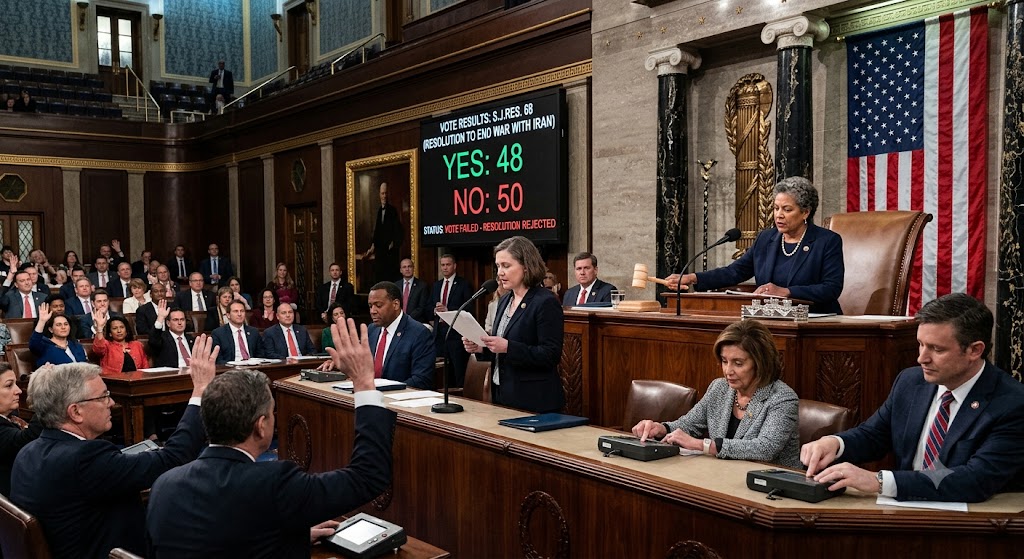
The U.S. Senate recently passed a largely symbolic concurrent resolution (50-48 vote) directing the U.S. President to end hostilities with Iran unless Congress explicitly authorizes military action.
More on the News
- Legislative Stand: The measure, already passed by the House of Representatives, places both chambers of the U.S. Congress on record against the ongoing conflict.
- Nature of the Resolution: Because it is a “concurrent resolution,” it does not go to the President’s desk for a signature and carries disputed legal force. It acts primarily as a strong political rebuke.
- Executive Pushback: The White House has argued that resolutions seeking to curb the President’s constitutional powers to wage war are unconstitutional.
Background of the Conflict
- Trigger: The current phase of the conflict escalated following U.S. and Israeli military strikes on Iran in late February.
- Regional Spillover: The hostilities have widened into a broader regional conflict drawing in neighboring actors, including Lebanon and various Gulf states.
- Economic Impact: The resulting instability has significantly rattled global energy markets, raising concerns over oil supply chain disruptions.
- Historical Precedent: During the President’s first term, Congress passed similar War Powers Bills in 2019 (Yemen) and 2020 (Iran). Both were vetoed, and the Senate failed to secure the two-thirds majority required to override the vetoes.
Understanding the 1973 War Powers Act
- Origin: Enacted in the aftermath of the Vietnam War to check the President’s power to commit the United States to an armed conflict without the consent of the U.S. Congress.
- Key Provision: It mandates that the President must obtain formal authorization from Congress within 60 days of introducing U.S. armed forces into imminent or ongoing hostilities.
- Controversy: Administrations from both major U.S. political parties have historically contested the constitutionality and specific applications of this law, citing the President’s inherent powers as Commander-in-Chief.
Prelims Question
Q. With reference to the legislative mechanisms and the War Powers Act of the United States, consider the following statements:
- A “concurrent resolution” passed by the U.S. Congress requires the mandatory signature of the President to have binding legal force.
- The 1973 War Powers Act mandates the U.S. President to obtain Congressional authorization within 60 days of introducing forces into hostilities.
Which of the statements given above is/are correct?
(a) 1 only
(b) 2 only
(c) Both 1 and 2
(d) Neither 1 nor 2
Answer: (b) Explanation: Statement 1 is incorrect because a concurrent resolution is generally used to make or amend rules that apply to both houses or to express the sentiment of both houses. It does not go to the President for a signature and does not have the force of law. Statement 2 is correct as per the core provision of the 1973 War Powers Act.
Mains Question
Q. “The escalation of hostilities between the US and Iran not only threatens the geopolitical stability of West Asia but also exposes the deep institutional friction between the Executive and Legislature in US foreign policy making.” Analyze this statement in the context of global energy security and regional stability. (15 Marks, 250 Words)