Table of Contents
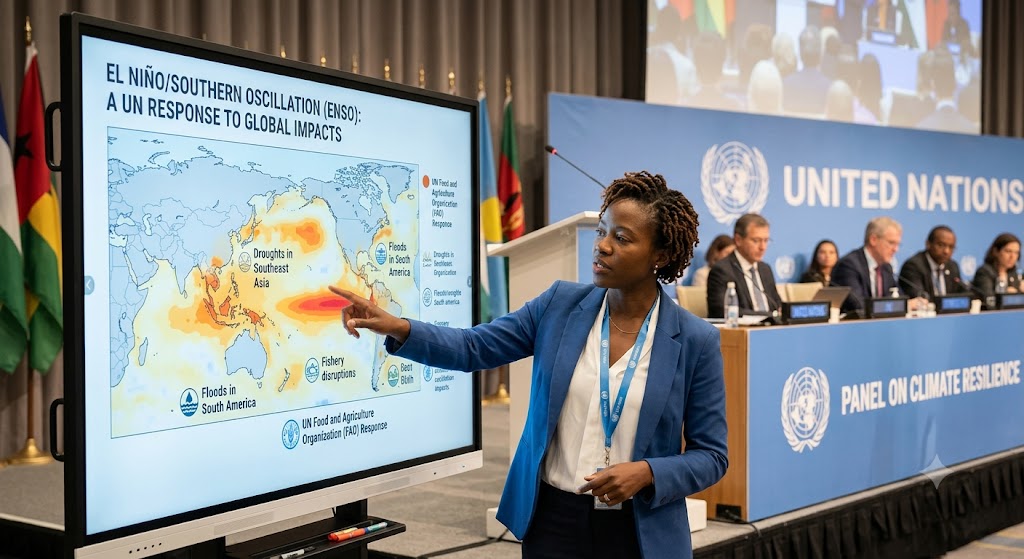
The United Nations’ Food and Agriculture Organization (FAO) and the World Food Programme (WFP) have launched a joint global appeal seeking $202 million. The objective is to proactively shield 8.8 million people across 22 high-risk countries from the devastating agricultural and humanitarian impacts of a forecasted strong El Niño weather pattern.
Key Highlights of the Joint Appeal
- Anticipatory Action Paradigm: The appeal marks a crucial shift in humanitarian aid—moving away from reacting to crises after they unfold, to financing anticipatory action before a climate disaster strikes.
- Target Demographics: The funds aim to protect vulnerable populations in 22 priority countries spanning Africa (e.g., Ethiopia, Somalia, Zimbabwe), the Asia-Pacific (e.g., Afghanistan, Philippines), and Latin America/Caribbean (e.g., Colombia, Haiti).
- Proposed Interventions: The $202 million will fund a package of locally tailored, proactive measures. These include:
- Pre-emptive cash transfers.
- Distribution of drought-tolerant and flood-resistant seeds.
- Livestock protection and water harvesting systems.
- Flood control infrastructure and the dissemination of early climate warnings.
- Economic Viability: The FAO and WFP emphasize that anticipatory action is highly cost-efficient. Data shows that every $1 invested in early action can generate up to $7 in avoided agricultural losses and emergency response costs.
El Niño and Global Weather Disruptions
El Niño is the warm phase of the El Niño-Southern Oscillation (ENSO) cycle, characterized by the periodic, abnormal warming of sea surface temperatures (SSTs) in the central and eastern equatorial Pacific Ocean. This oceanic warming completely upends the global atmospheric circulation system known as the Walker Circulation.
- Weakening Trade Winds: Under normal conditions, strong trade winds blow from east to west, pushing warm surface water toward the Western Pacific (around Indonesia). During an El Niño, these trade winds weaken or completely reverse, allowing the pool of warm water to drift eastward toward South America.
- Shifting Convection Zones: As the warm water moves, the atmospheric zone of rising air, cloud formation, and heavy rainfall shifts with it. This creates massive atmospheric anomalies globally.
- Global Climatic Extremes: The shift causes catastrophic weather extremes worldwide. It brings torrential rains and flooding to the hyper-arid coasts of Peru and Ecuador, while plunging traditionally wet zones like northern Australia, Indonesia, parts of Southeast Asia, and Southern Africa into severe, prolonged droughts.
The Indian Ocean Dipole (IOD) and El Niño Interaction
The Indian Ocean Dipole (IOD), often referred to as the “Indian Niño,” is a localized climate phenomenon involving an irregular fluctuation of sea surface temperatures across the western and eastern equatorial Indian Ocean. The IOD interacts dynamically with ENSO, acting either as an amplifier or a dampener of El Niño’s global effects.
The IOD operates in three distinct phases:
| IOD Phase | Temperature Anomaly Distribution | Impact on the Indian Monsoon |
| Positive Phase | Western Indian Ocean (near Africa) is warmer than normal; Eastern Indian Ocean (near Indonesia) is cooler. | Strongly Enhances Monsoon: Increases convection and rainfall over India, often neutralizing El Niño’s drought effect. |
| Negative Phase | Western Indian Ocean is cooler than normal; Eastern Indian Ocean is warmer. | Suppresses Monsoon: Diverts moisture away from India toward Indonesia, worsening El Niño-induced droughts. |
| Neutral Phase | Water temperatures across the equatorial Indian Ocean remain close to historical averages. | Minimal Direct Impact: Allows global forces like El Niño to dominate without localized ocean-driven alteration. |
Structural Impact on India
Because the Indian economy is profoundly reliant on agriculture—where over 50% of arable land lacks artificial irrigation—the coupled behavior of El Niño and the IOD has immense macroeconomic ramifications.
- Weakening of the Southwest Monsoon: El Niño acts as a major atmospheric suppressant for India. By shifting global convection cells eastward, it creates a sinking motion of dry air over the Indian subcontinent. This weakens the moisture-laden winds of the Southwest Monsoon, frequently leading to delayed onset, lengthy dry spells, and an overall seasonal rainfall deficit.
- Agricultural Stress and Food Insecurity: Deficient monsoon rainfall leads to poor soil moisture, depleted groundwater tables, and low reservoir levels. This directly harms major summer crops (Kharif crops) such as rice, pulses, sugarcane, and oilseeds, leading to lower crop yields.
- Macroeconomic Inflationary Shocks: Lower agricultural production creates immediate supply shortages in domestic markets. This triggers rapid food inflation, drives up rural economic distress, and forces the government to impose export bans on staples (like rice or sugar) to protect domestic supply.
- The Positive IOD Mitigation: The primary mitigating factor against an El Niño-induced drought is a concurrent Positive Indian Ocean Dipole (+IOD). When a strong +IOD develops simultaneously, the warm water in the western Indian Ocean acts as a localized engine for cloud formation. This pushes strong moisture currents directly into the subcontinent, effectively canceling out the drying effects of El Niño—as seen historically during the anomalous monsoon season of 1997.
Way Forward
1. The Global Diplomatic Way Forward
To move from a fragile, leaked framework agreement to a permanent geopolitical settlement, the international community must focus on structured, verifiable steps:
- Phased Sanctions Relief tied to Verifiable Compliance: Trust between the US and Iran is non-existent. Therefore, the agreement must be executed in staggered phases. The US should release frozen funds and lift oil sanctions incrementally, strictly tied to the IAEA verifying that Iran is actively downblending its uranium and dismantling excess centrifuges.
- Decoupling Nuclear Diplomacy from Proxy Conflicts: Attempting to solve Iran’s nuclear program and the Israel-Hezbollah-Hamas conflicts in a single treaty is a recipe for failure. Mediators must compartmentalize these issues. The immediate focus should be securing the nuclear baseline and maritime shipping (Strait of Hormuz), followed by separate, dedicated peace tracks for Lebanon and Gaza.
- Building an Inclusive Regional Security Architecture: Any treaty that excludes major regional stakeholders will eventually collapse. Future negotiations must bring Gulf Cooperation Council (GCC) states—such as Saudi Arabia and the UAE—to the table alongside Iran and the US. A shared regional security forum would help replace proxy warfare with direct diplomatic channels.
- Codifying Maritime Transit Laws in the Gulf: To prevent the Strait of Hormuz from being continually weaponized, an internationally backed maritime agreement must be established. This would acknowledge Iran’s environmental and territorial concerns while legally cementing the unrestricted right of commercial transit passage, backed by a multinational naval observation force.
2. India’s Strategic Way Forward
India walks a tightrope in West Asia, holding deep strategic ties with Israel, crucial energy partnerships with Arab states, and historical connectivity links with Iran. Here is how New Delhi should navigate the road ahead:
- Aggressively Revitalizing Chabahar & the INSTC: With the potential lifting of US secondary sanctions, India must accelerate its investments in Iran’s Chabahar Port. This is critical for operationalizing the International North-South Transport Corridor (INSTC), giving India direct trade access to Central Asia and Russia while completely bypassing Pakistan.
- Strategic Energy Diversification & Negotiation: If Iranian crude oil legally re-enters the global market, India should immediately negotiate long-term, discounted procurement contracts to lower its import bill and check domestic inflation. However, India must avoid over-reliance on any single region, maintaining the diverse supplier base (including Russia and the Americas) it built during the sanctions era.
- Doubling Down on “Multi-Aligned” Diplomacy: India must continue its successful policy of “Strategic Autonomy.” This means actively supporting the two-state solution for Israel and Palestine, utilizing its strong technological and defense ties with Israel, and leveraging its historical goodwill with Tehran to act as a trusted, neutral backchannel mediator when Western channels break down.
- Safeguarding the Diaspora and Remittances: There are over 8 million Indians living and working in the Gulf and broader West Asia, contributing billions in vital remittances. India’s forward-looking policy must prioritize advanced evacuation contingencies (similar to Operation Ganga or Operation Ajay) and labor protection agreements to ensure this massive diaspora is shielded from sudden regional escalations.
UPSC Prelims Practice Question
Q. With reference to the El Niño phenomenon and global food security, consider the following statements:
- El Niño is characterized by the periodic cooling of sea surface temperatures in the eastern equatorial Pacific Ocean.
- The United Nations’ Food and Agriculture Organization (FAO) is headquartered in Rome, Italy.
- Historically, strong El Niño events tend to strengthen the Southwest Monsoon over the Indian subcontinent, leading to widespread floods.
Which of the statements given above is/are correct?
(a) 1 and 2 only
(b) 2 only
(c) 1 and 3 only
(d) 1, 2 and 3
Correct Answer: (b)
- Statement 1 is incorrect: El Niño involves the abnormal warming of sea surface temperatures in the eastern Pacific. (The cooling phase is known as La Niña).
- Statement 2 is correct: The FAO is a specialized agency of the UN that leads international efforts to defeat hunger, headquartered in Rome.
- Statement 3 is incorrect: El Niño is generally associated with a weakening of the Southwest Monsoon in India, often leading to rainfall deficits and agricultural stress, not strengthening it.
UPSC Mains Practice Question
Q. “The paradigm of disaster management must shift from post-disaster relief to pre-disaster anticipatory action.” Analyze this statement in the context of the recent FAO-WFP joint appeal to mitigate the impacts of the El Niño weather pattern. (150 words, 10 marks)
Brief Approach for Mains:
- Introduction: Mention the recent FAO-WFP appeal for $202 million to protect 8.8 million people from El Niño, highlighting it as a prime example of “anticipatory climate action.”
- The Need for a Paradigm Shift:
- Frequency of Shocks: Climate change is accelerating the intensity of extreme weather events, making traditional post-disaster relief too slow and financially unsustainable.
- Compounding Crises: Vulnerable populations are already dealing with conflicts and economic instability; post-disaster aid often arrives after critical livelihoods (like livestock and crops) are irreversibly destroyed.
- Benefits of Anticipatory Action:
- Cost-Effectiveness: Highlight the FAO data metric (every $1 invested pre-emptively saves up to $7 in emergency relief).
- Livelihood Protection: Proactive measures like distributing climate-resilient seeds and building water harvesting systems prevent forced migration and protect core agricultural assets before the weather shock hits.
- Conclusion: Conclude that embedding anticipatory financing within global and national climate adaptation frameworks is essential to building long-term community resilience and achieving “Zero Hunger” (SDG 2).