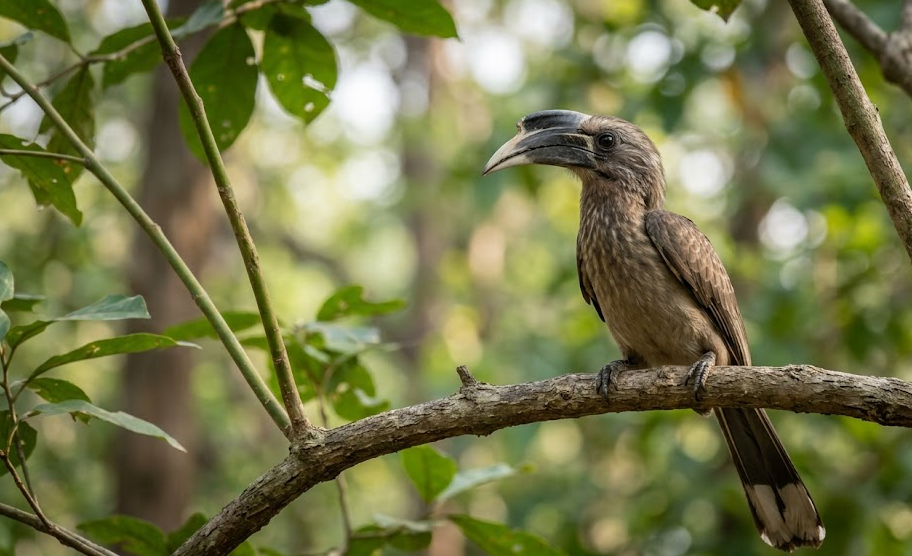
More than 60 years after becoming locally extinct in Gujarat’s Gir forests, the Indian Grey Hornbill has recorded four consecutive years of successful breeding. This achievement follows a systematic reintroduction programme undertaken by the Gujarat Forest Department, marking a major milestone in species recovery and ecological restoration.
Key Highlights of the Reintroduction Programme
- Historical Disappearance & Phased Release:
- The Indian Grey Hornbill disappeared from the Gir landscape between the 1950s and 1960s.
- To restore the population, the forest department released 40 birds in two phases—28 birds between 2021 and 2022, and another 12 in 2023.
- Scientific Monitoring:
- To ensure the success of the program, 11 male hornbills were fitted with satellite transmitters. This enabled scientists to track their post-release movements, habitat use, territorial establishment, and breeding behavior over several years.
- Breeding Success:
- According to a study published in the peer-reviewed journal Birds, the species has adapted well to its new habitat. One pair successfully bred during the first year of release, while three additional pairs nested in the second year, indicating that the population is establishing itself naturally.
- Ecological Significance:
- ‘Farmers of the Forest’ (Seed Dispersal): Hornbills are primarily frugivorous (fruit-eating). Because they have a large gape, they swallow fruits whole and regurgitate or excrete the seeds intact across vast distances. This makes them critical for the natural regeneration of forest ecosystems, especially for large-seeded trees like Ficus (Banyan, Peepal, and Fig).
- Indicator of Forest Health: They are considered an “indicator species.” Their presence signifies a mature and healthy ecosystem because they rely exclusively on large, old trees with natural hollow cavities for nesting. A declining hornbill population often points to deforestation or the loss of old-growth trees.
- Pest Population Control: While their diet is dominated by fruits, they are opportunistically omnivorous. They consume insects, locusts, small reptiles (like lizards), and rodents, thereby playing a supplementary role in controlling pest populations within their habitat.
Additional Conservation Milestone: Great Indian Bustard (GIB)
- Alongside the hornbill success, Gujarat reported another significant wildlife milestone.
- A second Great Indian Bustard (GIB) chick, hatched using the “jump-start” technique, successfully survived beyond the highly critical 40-day period.
- The “jump-start” method involves collecting eggs from the wild, artificially incubating them, and safely rearing the chicks in captivity to boost the survival rates of critically endangered species.
Static Facts: Indian Grey Hornbill
- Scientific Name: Ocyceros birostris
- Physical Appearance: It is a medium-sized bird characterized by a brownish-grey body, a prominent curved beak with a small, pointed ‘casque’ (a helmet-like structure on the upper beak), and a long tail with black and white tips.
- Habitat and Distribution: It is largely endemic to the Indian subcontinent. Unlike other hornbill species that require dense rainforests, the Indian Grey Hornbill is highly adaptable. It thrives in dry deciduous forests, open woodlands, and even urban areas with large avenue trees.
- Unique Nesting Behavior: They are secondary cavity nesters (they use existing tree hollows). During the breeding season, the female enters the tree cavity and seals the entrance from the inside using mud, bark, and droppings, leaving only a narrow slit. The male takes full responsibility for foraging and passes food through this slit to the female and the chicks until they are ready to fledge.
- Dietary Habits: They are omnivorous but primarily rely on wild fruits, particularly figs, which form the staple of their diet.
- Conservation Status:
- IUCN Red List: Least Concern (LC)
- Wildlife Protection Act (WPA), 1972: Schedule I (offering it the highest degree of protection).
Prelims Practice Question
Question: With reference to recent wildlife conservation efforts in India, consider the following statements:
- The Indian Grey Hornbill is a crucial seed disperser naturally found only in the evergreen forests of the Western Ghats and the Northeast.
- The Indian Grey Hornbill is categorized as ‘Critically Endangered’ under the IUCN Red List.
- The “jump-start” technique is an artificial incubation and rearing method recently used successfully for the conservation of the Great Indian Bustard (GIB).
Which of the statements given above is/are correct?
(a) 1 and 2 only
(b) 3 only
(c) 2 and 3 only
(d) 1, 2 and 3
Answer: (b) 3 only
Explanation:
- Statement 1 is incorrect: The Indian Grey Hornbill is widely distributed across the Indian subcontinent and is highly adaptable, often found in dry deciduous forests and urban/rural landscapes with fruiting trees, not just restricted to evergreen forests. (The Great Hornbill is more typical of dense evergreen forests).
- Statement 2 is incorrect: Its IUCN Red List status is ‘Least Concern’, though it receives high legal protection in India.
- Statement 3 is correct: The “jump-start” technique is being actively used to save the Critically Endangered Great Indian Bustard by rearing collected eggs in safe, controlled environments.
Mains Practice Question
Question: “Species reintroduction programmes are not merely about saving a single species, but are fundamental to the ecological restoration of entire landscapes.” Discuss this statement in light of the successful reintroduction of the Indian Grey Hornbill in the Gir forests. (250 words)
Approach for Mains Answer:
- Introduction: Briefly define species reintroduction and mention the recent success of the Indian Grey Hornbill in Gujarat’s Gir forests after a 60-year absence.
- Body Paragraph 1 (Ecological Role of a Single Species): Explain why the hornbill is critical (keystone/umbrella species). Detail its role as a “forest farmer” through long-distance seed dispersal, which ensures genetic diversity in flora and forest regeneration.
- Body Paragraph 2 (Broader Landscape Restoration): Discuss how reintroducing one species fixes broken ecological links (food webs). Relate this to Gir—how the return of the hornbill will positively impact the habitat of other flora and fauna, including the Asiatic Lion, by improving forest cover.
- Body Paragraph 3 (Challenges & Scientific Management): Highlight the importance of modern conservation tools used in the Gir project, such as satellite telemetry, phased releases, and habitat monitoring, which are crucial to overcoming the high failure rates typical of reintroduction programs.
- Conclusion: Conclude by emphasizing that successful reintroductions (like Project Cheetah or the Gir Hornbill) are long-term commitments that ultimately heal degraded ecosystems and build climate resilience.