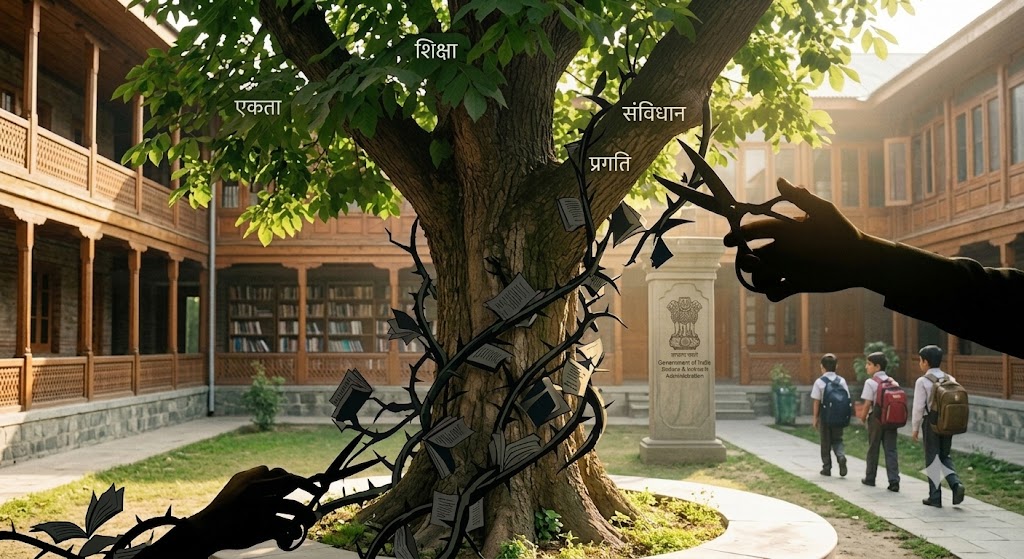
Recently, the Counter-Intelligence Unit of the Jammu and Kashmir Police arrested three publishers on charges of printing and distributing “pro-separatist” books for school children under the ‘Samagra Shiksha Scheme’. A case has been registered against them under the new criminal law, Bharatiya Nyaya Sanhita (BNS), and the anti-terror law, Unlawful Activities (Prevention) Act (UAPA).
Key Highlights
- Weaponization of Education: Attempts were being made to sow seeds of separatist ideology and radicalization in young minds through textbooks, representing a dangerous form of ideological warfare.
- Misuse of Government Machinery and Funds: The flagship ‘Samagra Shiksha Scheme’ of the Government of India and the funds allocated under it were directly misused to spread anti-national narratives.
- Failure of Monitoring Mechanism: The printing and distribution of such content under a government scheme highlights a major lapse in the State Education Department, the monitoring mechanism, and content audit protocols.
- Long-term Psychological Warfare: This incident is not merely a routine crime, but part of a long-term conspiracy to alienate youth from the mainstream, foster distrust toward state institutions, and create psychological alienation.
Legal and Institutional Framework
- Unlawful Activities (Prevention) Act (UAPA): This is India’s primary anti-terror law. It is utilized to penalize activities that incite disaffection against the state, support separatism, and challenge national sovereignty.
- Role of Bharatiya Nyaya Sanhita (BNS): Replacing the old sedition law, this new criminal framework includes extremely stringent penal provisions under ‘Offences Against the State’ for acts endangering the unity and integrity of India.
- Nature of Samagra Shiksha Abhiyan: It is an integrated Centrally Sponsored Scheme covering school education from pre-school to Class 12, aimed at providing equitable and inclusive education.
- Nature of Financial Assistance: Under this scheme, financial grants are provided by the Central Government to state governments and Union Territories for the development and distribution of textbooks, school uniforms, and other learning materials.
Necessary Corrective Measures for the Future
- Constitution of an Independent ‘Content Audit Committee’: An impartial and independent committee should be established within the State Education Department to conduct thorough national security and quality audits of any textbook or learning material prior to printing.
- Coordination Between Intelligence Machinery and Education Department: Continuous information sharing between counter-intelligence agencies and the Education Department must be ensured to break any potential nexus between state education boards and private publishing houses.
- Strict Financial Tracking: Rigorous tracking and auditing mechanisms should be implemented for funds released under Samagra Shiksha or any other government scheme to prevent public money from being siphoned into anti-national activities.
- Promotion of Value-Based Education: Special priority should be given in school curricula to subjects promoting nation-building, constitutional values, and integrity to safeguard students against ‘soft radicalization’.
UPSC Prelims Practice Question
Q. Consider the following statements:
- The ‘Samagra Shiksha Scheme’ is an integrated Centrally Sponsored Scheme for primary and upper primary (Class 1 to 8) education only.
- Under the Unlawful Activities (Prevention) Act (UAPA), only Indian citizens can be prosecuted, not foreign nationals.
Which of the statements given above is/are correct?
(a) 1 only
(b) 2 only
(c) Both 1 and 2
(d) Neither 1 nor 2
Answer: (d) Neither 1 nor 2
Explanation:
- Statement 1 is incorrect: The Samagra Shiksha Scheme is not limited to Classes 1 to 8; rather, it is a comprehensive scheme covering school education from pre-school to Class 12.
- Statement 2 is incorrect: The provisions of UAPA apply equally to both Indian and foreign citizens. Even if the offense is committed outside India, foreign nationals can also be held accountable under this law.
UPSC Mains Practice Question
Q. “The entry of radicalism and separatist ideology into the education system poses an invisible yet severe threat to the internal security of any nation.” Evaluate this statement in the context of recent developments in Jammu and Kashmir. Additionally, suggest institutional measures to prevent such misuse of government education schemes. (250 words, 15 marks)
Approach for Mains Answer:
- Introduction: Begin by contextualizing the recent arrest of publishers printing separatist content under the ‘Samagra Shiksha Scheme’ in J&K, highlighting how this represents a form of ‘soft radicalization’.
- Body Part 1 (Threat to Internal Security):
- Brainwashing young minds and creating psychological alienation.
- Fostering distrust toward state institutions.
- Preparing the ideological ground for future sleeper cells and proxy warfare.
- Body Part 2 (Institutional Measures/Solutions):
- Strict Monitoring: Establishment of an independent ‘Content Audit Committee’ in the Education Department to ensure no material opposes national interests.
- Active Intelligence Gathering: Coordination between counter-intelligence and education departments to break the nexus between state education boards and publishing houses.
- Financial Audit: Implementing strict tracking of the utilization of government funds.
- Conclusion: Emphasize that the ‘Zero Tolerance’ policy against terrorism must not remain restricted to arms alone but must also be fought on the ideological front. Conclude by stressing the importance of national value-based education.