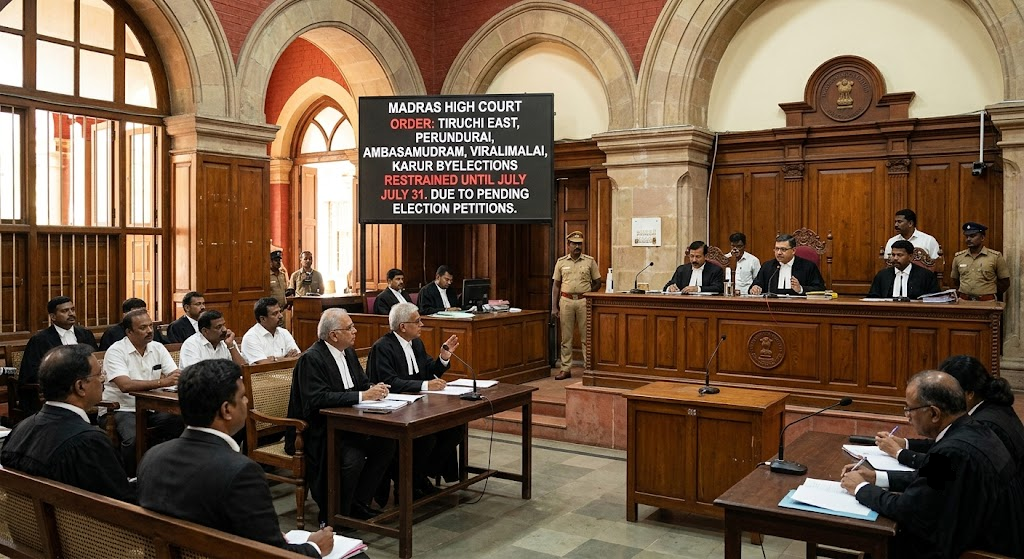
Recently, the Madras High Court restrained the Election Commission of India (EC) from notifying byelections in five assembly constituencies of Tamil Nadu (Tiruchi East, Perundurai, Ambasamudram, Viralimalai, and Karur) until July 31. This interim order was passed during the hearing of a Public Interest Litigation (PIL) challenging the legality of conducting byelections while election petitions remain pending.
Key Highlights
Background of the Dispute
- The elected representatives of these five assembly constituencies have resigned from their posts.
- However, ‘election petitions’ challenging their victory in the recent elections are still pending before the court. In these petitions, the defeated candidates have not only challenged the election results but have also sought a consequential prayer to be declared the winning candidates themselves.
Petitioner’s Main Arguments
- Anomalous Situation: If byelections are held before the disposal of the election petitions and the court later allows the original election petition, declaring the challenging candidate as the winner, an unprecedented crisis of having two representatives from a single constituency (one from the byelection and one by court order) would arise.
- Representation of the People Act, 1951 (RPA, 1951): According to the petitioner, the vacancies created by these resignations cannot be treated as a ‘clear vacancy’ under Section 151A of the RPA, 1951, as they are subject to the final outcome of the election petitions.
- Supreme Court Precedents: Reference was made to D. Sanjeevayya v. Election Commission of India (1967), Election Commission of India v. Telangana Rashtra Samithi (2011), and Pramod Laxman Gudadhe v. Election Commission of India (2018), where the apex court held that byelections should not be conducted when election petitions related to those constituencies are pending adjudication.
Arguments of the Respondents (Advocate-General & CM’s Counsel)
- Timing of Resignation: The Advocate-General argued that a distinction must be made between legislators who resigned before the filing of the election petition (such as in the case of Tiruchi East) and those who resigned after it was filed.
- Locus Standi: Questioning the standing of the petitioner, it was argued that the PIL petition was premature since the Election Commission had not yet issued any notification or taken a formal decision to conduct byelections.
Court’s Observation
- The Chief Justice’s Bench clarified that in matters touching upon the “purity of the democratic process,” a narrow and pedantic interpretation of locus standi cannot be applied.
- However, the court agreed that the nuanced legal aspect concerning the gap between the date of resignation and the date of filing the election petition (as argued by the Advocate-General) requires a deeper examination.
UPSC Prelims Practice Question
Q. With reference to ‘Election Petitions’ and ‘Byelections’ in India, consider the following statements:
- According to various decisions of the Supreme Court, if an election petition concerning a constituency is pending in court, byelections generally cannot be conducted there.
- In matters of public interest concerning the purity of the democratic process, courts can relax the rule of Locus Standi and permit any citizen to file a petition.
Which of the statements given above is/are correct?
- (a) 1 only
- (b) 2 only
- (c) Both 1 and 2
- (d) Neither 1 nor 2
Answer: (c) Both 1 and 2
Explanation: According to the recent Madras High Court case and earlier Supreme Court precedents (such as Sanjeevayya v. Election Commission), if an election petition is pending (especially when the petitioner has sought to be declared the winner), holding a byelection there could lead to an anomalous situation (Statement 1 is correct). The court clarified that a narrow interpretation of Locus Standi does not apply in matters of democratic importance (Statement 2 is correct).
UPSC Mains Practice Question
Q. “The lack of time-bound disposal of election petitions in India and the resignations of public representatives often give rise to complex constitutional and democratic anomalies.” Analytically examine this statement in light of the recent interim order of the Madras High Court and the provisions of the Representation of the People Act, 1951. (250 words, 15 marks)
Approach for Mains Answer:
- Introduction: Briefly mention the significance of election petitions under the Representation of the People Act, 1951, and the recent stay granted by the Madras High Court on byelections across five constituencies.
- Body Part 1 (Constitutional and Democratic Anomalies): Explain the crisis that can arise if byelections occur while election petitions remain pending (e.g., the scenario of two claimants for a single seat). Discuss the legal ambiguity surrounding a ‘clear vacancy’.
- Body Part 2 (Judicial Precedents and Legal Provisions): Refer to landmark Supreme Court rulings (such as the Sanjeevayya case, 1967, etc.) and provisions under Section 151A of the RPA, 1951. Explain the expansion of the principle of Locus Standi.
- Body Part 3 (Need for Time-bound Disposal): Highlight how years of delay in disposing of election petitions undermines the democratic mandate.
- Conclusion: Conclude by suggesting reforms such as establishing designated fast-track courts or introducing strict timeframes for the judiciary to dispose of election petitions, alongside balancing the role of the Election Commission.