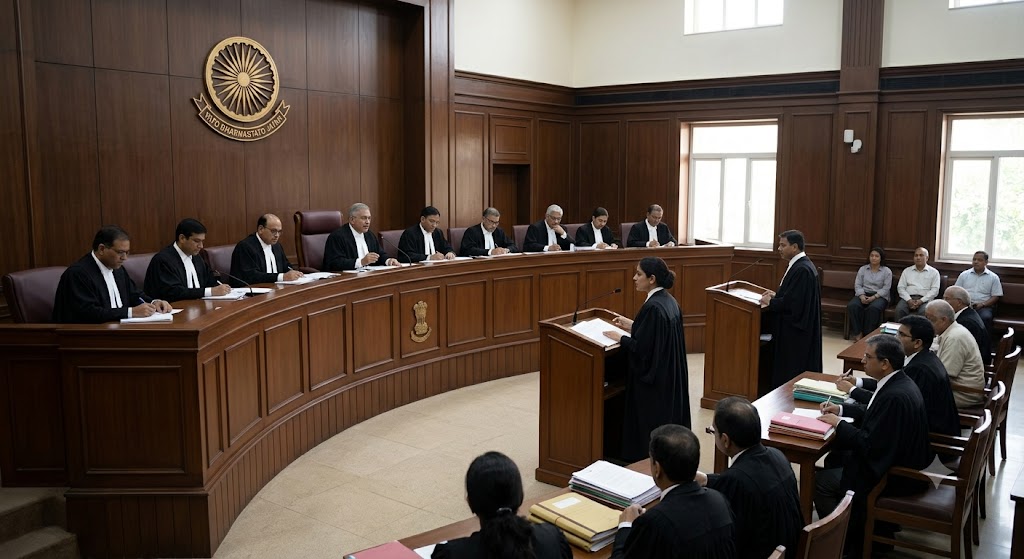
The Supreme Court of India has agreed to consider formulating a Standard Operating Procedure (SOP) that would allow citizens to access courts at any time—day or night—for urgent matters affecting life and personal liberty. This includes cases of illegal detentions, imminent home demolitions, deportations, and custodial violence.
Key Highlights
- The Core Issue (Temporal Boundaries of Justice):
- The petition highlighted that executive actions, such as late-night arrests, early-morning demolition drives, and deportations, frequently occur during weekends, holidays, or late at night.
- It argued that in a constitutional democracy governed by the rule of law, “the Constitution cannot fall silent at night,” and the protection of liberty cannot be restricted by court schedules.
- Supreme Court’s Observations:
- Response Time: The Bench emphasized the need to reduce the response time for urgent requests involving life and liberty, suggesting that the court’s response should ideally come within an hour of an urgent mentioning.
- Administrative vs. Judicial Mandate: Solicitor-General Tushar Mehta suggested the SOP be framed on the Supreme Court’s administrative side. However, the Chief Justice noted that in India’s federal setup, High Courts do not fall under the administrative ambit of the Supreme Court, indicating that a judicial order might be necessary to enforce a uniform SOP nationwide.
- Graded Approach: Justice Joymalya Bagchi observed that having a “graded approach” to accessing justice after office hours does not equate to a denial of justice.
- The Role of Technology:
- The Court noted that technological advancements like e-filing, electronic court records, and virtual hearings mean courts never truly “close up.”
- An email, a letter, or a phone call is often sufficient to activate the justice system.
- However, the petitioner pointed out a critical gap: these digital capabilities have not yet been integrated into a uniform institutional framework for emergency judicial access outside regular hours.
Significance of the Move
- Upholding Fundamental Rights (Article 21): The move reinforces the principle that the Right to Life and Personal Liberty is absolute and continuous. It ensures that constitutional protections do not “sleep” or depend on the temporal boundaries of regular court working hours.
- Preventing Irreversible Consequences: It provides an immediate safeguard against arbitrary state actions—such as late-night arrests, sudden dawn demolitions, or weekend deportations—ensuring judicial intervention before irreversible harm is done to a citizen.
- Institutionalizing Emergency Access: Currently, after-hours hearings (like midnight hearings) are rare, ad-hoc, and often depend on the discretion of the registry or the Chief Justice. An SOP will create a formalized, predictable, and uniform institutional mechanism accessible to all.
- Check on Executive Overreach: A 24×7 functioning judicial avenue acts as a strong deterrent against law enforcement or executive authorities timing their coercive actions during weekends, public holidays, or court recesses to avoid immediate judicial scrutiny.
- Leveraging Technology for Justice: It bridges the gap between technological capabilities and judicial administration. By fully utilizing e-filing, electronic records, and virtual hearing infrastructure, it transforms the theoretical concept of “remote justice” into a practical reality.
Way Forward
- Defining Clear Thresholds: The proposed SOP must clearly define what constitutes an “emergency” concerning life and liberty. Strict parameters are necessary to filter out frivolous or non-urgent matters so that the after-hours system is not overwhelmed.
- Dedicated Emergency Rosters: The Supreme Court and High Courts should establish dedicated, rotating rosters of judges and registry staff specifically designated to handle night, weekend, and holiday emergencies.
- Decentralized Implementation: While the Supreme Court can frame guidelines on its judicial side, a consultative approach with all High Courts is essential to ensure a decentralized, nationwide framework. High Courts are often the first port of call for citizens facing state overreach.
- Strengthening Digital Infrastructure: The e-courts system must be upgraded for seamless, secure, and rapid electronic filing. Additionally, there must be a mechanism to instantly communicate judicial stay orders directly to the executing authorities on the ground.
- Time-Bound Response Mechanism: As suggested by the Chief Justice, the SOP should institutionalize a strict “response time” (e.g., within one hour of an urgent mentioning) to ensure the system is genuinely responsive to imminent threats.
Prelims Practice Question
Question: With reference to the judicial system and constitutional remedies in India, consider the following statements:
- The Supreme Court of India exercises direct administrative control over all High Courts to enforce uniform judicial procedures across the country.
- The protection of life and personal liberty under Article 21 is absolute and remains enforceable even outside regular court working hours.
Which of the statements given above is/are correct?
(a) 1 only
(b) 2 only
(c) Both 1 and 2
(d) Neither 1 nor 2
Answer: (b) 2 only
Explanation:
- Statement 1 is incorrect: In India’s federal judicial setup, the Supreme Court does not exercise administrative control over the High Courts. High Courts are administratively independent, which is why a uniform SOP for all courts may require a judicial order rather than an administrative one from the SC.
- Statement 2 is correct: The fundamental right to life and personal liberty (Article 21) is continuous. As highlighted in recent Supreme Court discussions, constitutional remedies can be activated digitally outside of regular court hours for urgent matters of life and liberty.
Mains Practice Question
Question: “In a constitutional democracy governed by the rule of law, the protection of liberty cannot remain dependent upon the temporal boundaries of court schedules.” In light of this statement, discuss the necessity of integrating technological advancements into a uniform Standard Operating Procedure (SOP) for 24/7 access to courts in India. (250 words)
Approach for Mains Answer:
- Introduction: Briefly mention the Supreme Court’s recent move to consider an SOP for around-the-clock judicial access for cases involving life and liberty (Article 21).
- Body Paragraph 1 (The Necessity): Discuss why this is needed. Cite examples of state actions conducted during “blind spots” (weekends, late nights) such as imminent demolitions, illegal detentions, and custodial violence.
- Body Paragraph 2 (Administrative & Structural Challenges): Mention the current “graded approach” to after-hours justice. Highlight the federal challenge—the Supreme Court’s lack of administrative control over High Courts necessitates a strong judicial framework.
- Body Paragraph 3 (Role of Technology): Explain how e-filing, virtual hearings, and digital records have created the capacity for 24/7 access, but stress that these tools need to be consolidated into a formal, predictable institutional framework (SOP) rather than relying on ad-hoc mentions.
- Conclusion: Conclude by affirming that access to justice cannot exist merely in theory. Institutionalizing 24/7 access ensures that the Constitution remains a living, protective document at all hours, reinforcing public trust in the judiciary.