Subject: Internal Security and Science & Technology (General Studies Paper-III)
Table of Contents
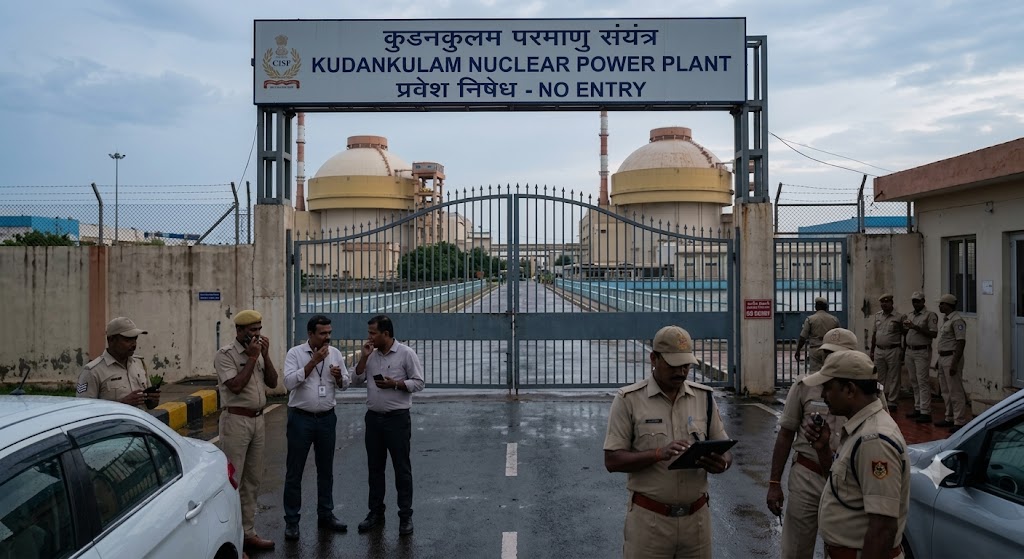
Reports have recently emerged regarding the leak of highly sensitive files associated with the Kudankulam Nuclear Power Plant (KKNPP) by a ransomware group known as World Leaks. Originating from a contractor’s server, this data leak has once again brought to light the pressing cybersecurity vulnerabilities within India’s Critical Information Infrastructure (CII).
Key Highlights
1. Nature and Source of the Data Leak
- Scope: Nearly 19,000 leaked files pertain to the engineering blueprints of the plant’s control, cooling, and ventilation systems, alongside lists of suppliers and vendors.
- Origin: The leak did not originate from the core plant network; instead, it breached a third-party server hosted by Yotta, utilized by KKNPP’s contractor (Reliance Group).
2. NPCIL’s Clarification: Nuclear Safety vs. Conventional Facilities
- The Nuclear Power Corporation of India Limited (NPCIL) clarified that the leaked information concerns the plant’s “Conventional balance of plant common service facilities.”
- NPCIL emphasized that the compromised data does not involve primary nuclear safety systems or reactor core operations.
3. Security Implications
- System Mapping: Even if primary nuclear operations remain untouched, access to secondary blueprints enables adversaries to map support architectures and identify operational vulnerabilities.
- Supply Chain Cyber Attacks: This incident underscores the rising risk of supply chain vulnerabilities, where threat actors target less-fortified third-party contractors to gain indirect exposure to critical assets.
4. Past Cyber Incidents & Ongoing Probe
- Investigation: The incident is currently under joint investigation by NPCIL and the Indian Computer Emergency Response Team (CERT-In).
- Historical Context: In 2019, KKNPP suffered an infection on its administrative network caused by North Korean malware (Dtrack). NPCIL maintained then—as now—that the core nuclear control systems operate on an isolated, air-gapped network disconnected from the internet.
Understanding Critical Information Infrastructure (CII)
Definition (IT Act, 2000): Under Section 70 of the Information Technology Act, 2000, CII is defined as any computer resource, network, or system whose destruction or incapacitation would have a debilitating impact on national security, the economy, public health, or safety.
- Core Sectors: Energy (e.g., nuclear power plants, national power grids), Banking & Finance, Telecommunications, Transportation (Aviation/Railways), and Strategic/Defense sectors.
- Nodal Agency: The National Critical Information Infrastructure Protection Centre (NCIIPC), operating under the National Technical Research Organisation (NTRO), serves as the designated national nodal agency for CII protection.
Associated Cybersecurity Concerns
- Supply Chain & Third-Party Risks: While core systems may feature robust perimeter security, contractors and third-party vendors often represent softer targets.
- SCADA & ICS Mapping: Industrial Control Systems (ICS) and Supervisory Control and Data Acquisition (SCADA) networks rely on precise engineering configurations. Leaked blueprints allow attackers to craft highly targeted exploits.
- Ransomware & Dark Web Exposure: The exfiltration and sale of sensitive operational data on dark web forums expose critical state assets to extortion and hostile state actors.
- State-Sponsored Cyber Warfare: Modern hybrid warfare increasingly utilizes cyber capabilities to target strategic infrastructure (e.g., power grids or energy plants) to cause paralysis without conventional armed conflict.
Existing Countermeasures
- Institutional Framework: NCIIPC oversees CII resilience, while CERT-In serves as the primary national agency for emergency cyber incident response.
- Network Air-Gapping: Critical operational and control systems across Indian nuclear facilities are physically and logically segregated (air-gapped) from external networks and public internet infrastructure.
- National Cyber Security Policy (2013): Establishes the foundational framework for building secure digital ecosystems across sectors.
- Security Audits: Periodic mandatory cybersecurity audits (aligned with ISO 27001 standards) and initiatives like the Cyber Swachhta Kendra are routinely deployed.
Way Forward
- Zero-Trust Architecture: Transition CII operational models to a strict “Never trust, always verify” framework—particularly for third-party access and remote administrative endpoints.
- Mandatory Vendor Audits: Enforce rigorous, continuous cybersecurity audits across all external suppliers, contractors, and sub-contractors, making compliance a legally binding contractual prerequisite.
- AI & Machine Learning Integration: Deploy automated Threat Intelligence platforms powered by AI/ML to detect network anomalies in real time and minimize containment response times.
- Updated National Cyber Security Strategy: Formulate and release a modernized National Cyber Security Strategy tailored to mitigate threats stemming from emerging domains like Quantum Computing, IoT, and advanced malware.
- Capacity Building & Training: Build a specialized cadre of cybersecurity experts and maintain continuous security awareness programs to mitigate phishing and social engineering vulnerabilities among personnel.
Practice Questions
Prelims Practice Question
Q. With reference to the Kudankulam Nuclear Power Plant (KKNPP) and India’s cybersecurity framework, consider the following statements:
- The Kudankulam Nuclear Power Plant (KKNPP) has been developed with technical collaboration from Russia, utilizing VVER (Water-Water Energetic Reactor) technology.
- The primary responsibility for protecting ‘Critical Information Infrastructure’ (CII) in India rests with the ‘Indian Computer Emergency Response Team’ (CERT-In).
Which of the statements given above is/are correct?
(a) 1 only
(b) 2 only
(c) Both 1 and 2
(d) Neither 1 nor 2
Answer: (a) 1 only
Explanation:
- Statement 1 is correct: KKNPP is located in Tamil Nadu and utilizes Russian VVER reactor technology.
- Statement 2 is incorrect: The National Critical Information Infrastructure Protection Centre (NCIIPC) is the national nodal agency dedicated to protecting Critical Information Infrastructure (CII). CERT-In is the national nodal agency responsible for responding to general cybersecurity incidents and emergency threats.
Mains Practice Question
Q. “Cyberattacks on Critical Information Infrastructure (CII), such as nuclear power plants, pose a serious and emerging threat to national security.” In light of the recent data leak at the Kudankulam Nuclear Power Plant (KKNPP), analyze the challenges facing the cybersecurity of India’s critical infrastructure and suggest necessary measures. (250 words)
Answer Structure / Approach:
- Introduction: Briefly introduce the recent KKNPP data leak incident involving third-party vendor vulnerabilities and define Critical Information Infrastructure (CII).
- Body Paragraph 1 (Challenges & Vulnerabilities):
- Third-party supply chain risks (e.g., vendor/contractor server breaches).
- Risks posed by system blueprint exposure (mapping support architecture for sabotage or targeted strikes).
- Evolving state-sponsored cyber threats capable of bypassing traditional air-gap defenses.
- Body Paragraph 2 (Suggested Measures):
- Enforcing mandatory, legally binding cybersecurity compliance and audits for third-party contractors.
- Implementing a Zero-Trust Architecture across all critical systems and vendor touchpoints.
- Strengthening institutional synergy between NCIIPC and CERT-In, alongside AI-driven real-time threat detection.
- Conclusion: Emphasize that cybersecurity must no longer be treated merely as an IT issue, but as a vital pillar of core national defense and sovereignty.