Subject: Polity & Governance (General Studies Paper-II) and Geography (General Studies Paper-I)
Table of Contents
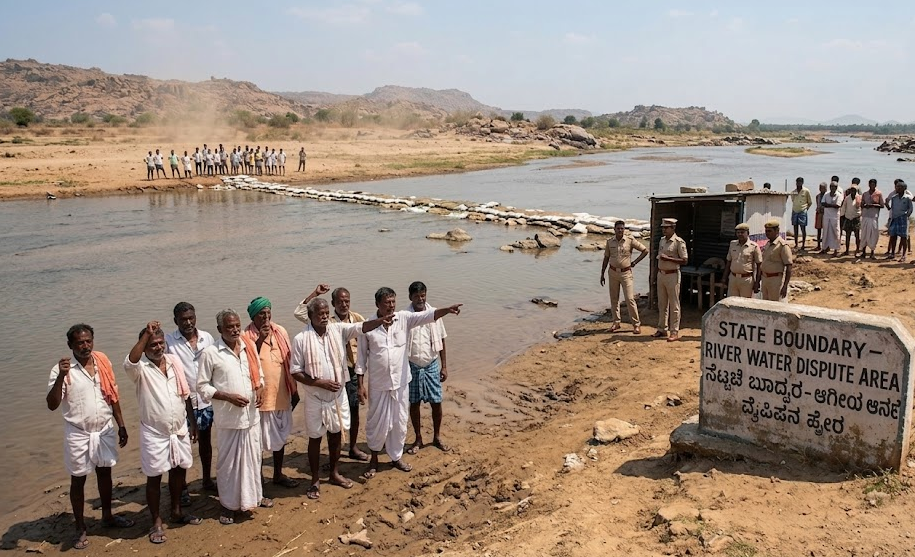
Taking serious note of the poor monsoon rainfall and a looming deficit in the Cauvery basin, the Cauvery Water Management Authority (CWMA) has directed the riparian states of Karnataka and Tamil Nadu to strictly restrict the use of their reservoir storage solely for drinking water purposes.
Key Highlights of the CWMA Directive
- Declaration of a ‘Distress Year’: Based on the India Meteorological Department (IMD) forecast indicating continued poor rainfall, the CWMA observed that the current year is going to be a “distress year” for the Cauvery basin.
- Prioritization of Drinking Water: The Authority explicitly warned both states against utilizing the stored water for agricultural (irrigation) or other purposes. The current storage is only sufficient to meet drinking water requirements, provided it is used judiciously.
- Status Quo on Water Release: Both states have been directed to maintain the status quo regarding water release and utilization.
- Release Deficit: It was noted during the meeting that Karnataka released only 2.5 tmcft (thousand million cubic feet) of water in June and 0.54 tmcft in July to Tamil Nadu, which is significantly lower than the prescribed quota.
- Future Review: The situation will be monitored and reviewed closely by the Cauvery Water Regulation Committee (CWRC), which assists the CWMA in regulating storage and releases.
Cauvery Water Management Authority (CWMA)
- Origin and Establishment: The CWMA was constituted by the Central Government in 2018 under Section 6A of the Inter-State River Water Disputes Act, 1956, strictly adhering to the final directive of the Supreme Court of India.
- Core Mandate: It serves as the apex body responsible for monitoring, regulating, and ensuring the implementation of the Supreme Court’s 2018 award regarding the equitable sharing of Cauvery waters among Karnataka, Tamil Nadu, Kerala, and Puducherry.
- Organizational Structure: The Authority is headed by a Chairman and includes representatives from the Central Government as well as the four basin states/UT. It is technically and administratively assisted by the Cauvery Water Regulation Committee (CWRC), which monitors ground-level data.
- Regulatory Powers: The CWMA holds the authority to regulate water releases from Karnataka’s reservoirs, determine the specific quantum of water to be released during ‘distress years’, and ensure that no state utilizes water beyond its allocated quota for irrigation.
The Cauvery Basin
- Geographical Extent: It is a major inter-state river basin covering an area of 81,155 sq. km. The basin is distributed across Tamil Nadu (which holds the largest catchment area), Karnataka, Kerala, and the Union Territory of Puducherry.
- Origin and Course: The river originates at Talakaveri in the Brahmagiri range of the Western Ghats in Karnataka. It flows southeastwards, traversing the Deccan Plateau, and eventually forms a vast delta before emptying into the Bay of Bengal at Poompuhar, Tamil Nadu.
- Key Tributaries: The basin is fed by numerous crucial tributaries. The prominent left-bank tributaries include the Harangi, Hemavati, Shimsha, and Arkavati, while the right-bank tributaries include the Lakshmantirtha, Kabini, Suvarnavati, Bhavani, Noyyal, and Amaravati.
- Economic and Cultural Significance: Often revered as the ‘Ganga of the South’ (Dakshina Ganga), the basin is the economic lifeline of the region. It supports the extensive agrarian economy of the Cauvery delta (the “rice bowl” of Tamil Nadu), provides drinking water to megacities like Bengaluru, and supports hydroelectric power generation (e.g., Shivanasamudra falls).
The ‘Distress Sharing’ Formula
- Conceptual Definition: It is a conflict-resolution mechanism designed to proportionally reduce the water allocation of all riparian states when the total availability of water in the basin falls below the normal designated quantum, usually due to a deficient monsoon.
- Pro-Rata Basis: The Supreme Court mandated that during a ‘distress year’, the deficit cannot be borne by the lower riparian state alone. Instead, the available water must be shared on a pro-rata (proportional) basis among all stakeholders.
- Absence of a Rigid Mathematical Model: Currently, there is no fixed, universally accepted mathematical formula for distress sharing. The CWMA assesses ground realities on a case-by-case basis—analyzing rainfall deficits, reservoir inflows, and soil moisture—to determine the exact release volume.
- Implementation Challenges: The formula frequently becomes a flashpoint. Upper riparian states (like Karnataka) tend to prioritize their own domestic and irrigation needs during droughts, while lower riparian states (like Tamil Nadu) demand their timely share to save standing crops, leading to political friction.
River Water Disputes in India: Constitutional Provision
- Constitutional Framework: Water is primarily a State subject (Entry 17 of the State List). However, the regulation and development of inter-state rivers and river valleys fall under the Union List (Entry 56). Article 262 explicitly empowers Parliament to adjudicate disputes over inter-state rivers.
- Legislative Mechanism: These conflicts are primarily governed by the Inter-State River Water Disputes (ISRWD) Act, 1956. The Act allows the Centre to constitute ad-hoc tribunals to adjudicate disputes when mutual negotiations between states fail.
- Exclusion of Judicial Intervention: Originally, Article 262(2) barred the Supreme Court and other courts from interfering in these disputes. However, the Supreme Court frequently intervenes under Article 136 (Special Leave Petition) to ensure the enforcement of tribunal awards or to protect fundamental rights (Article 21).
Major Ongoing Conflicts
- The Cauvery issue is just one of many. Other prominent disputes include the Sutlej-Yamuna Link canal (Punjab vs. Haryana), the Krishna Water Dispute (Maharashtra, Karnataka, Andhra Pradesh, Telangana), and the Mahanadi Water Dispute (Odisha vs. Chhattisgarh).
Causes of Such Disputes
- Geographical and Climatic Stress: Highly erratic monsoon patterns, prolonged dry spells, and the overarching impacts of climate change lead to severe water scarcity. This makes it geographically impossible to fulfill the water allocations agreed upon during surplus years.
- Unsustainable Agricultural Practices: The widespread cultivation of highly water-intensive crops (such as paddy and sugarcane) in semi-arid and water-stressed regions deeply exacerbates the water deficit and intensifies competition between states.
- Exploding Urban Demand: Rapid urbanization, industrialization, and unchecked population growth have exponentially increased the demand for water. For instance, the drinking water demands of a rapidly expanding Bengaluru heavily strain the Cauvery’s resources.
- Political Weaponization: River water is a highly emotive issue intertwined with regional identity, sub-nationalism, and farmer vote banks. Consequently, state governments often adopt rigid, unyielding stances for electoral gains, making political consensus nearly impossible.
Way Forward
- Permanent Single Tribunal: Replacing the delayed and fragmented ad-hoc tribunal system with a single, permanent Inter-State River Water Disputes Tribunal (as proposed in the ISRWD Amendment Bill) featuring multiple benches to ensure faster, uniform, and legally binding adjudication.
- Integrated River Basin Management: Shifting from a fragmented, state-centric approach to a ‘River Basin Organization’ model (as recommended by the Mihir Shah Committee). This approach treats the entire river basin as a single ecological and hydrological unit for sustainable planning.
- Agro-Climatic Farming and Micro-Irrigation: States must enforce crop diversification based on their agro-climatic zones (e.g., shifting from paddy to millets in dry regions) and aggressively subsidize micro-irrigation techniques (drip and sprinkler) under the motto of “Per Drop More Crop”.
- Independent National Water Data Agency: Establishing a transparent, independent, and centralized national agency to collect and publish real-time hydrological data (rainfall, reservoir levels, groundwater). This would build trust among states and eliminate disputes based on conflicting data claims.
Prelims Practice Question
Question: With reference to the Cauvery River and its water dispute management, consider the following statements:
- The Cauvery River basin extends over the states of Karnataka, Tamil Nadu, Kerala, and the Union Territory of Puducherry.
- The Cauvery Water Management Authority (CWMA) was established directly by a Constitutional amendment to resolve the dispute.
- According to the National Water Policy, drinking water allocation is given the highest priority among all water uses.
Which of the statements given above is/are correct? (a) 1 and 2 only (b) 1 and 3 only (c) 3 only (d) 1, 2, and 3
Answer: (b) 1 and 3 only
Explanation:
- Statement 1 is correct: The Cauvery basin spans Karnataka, Tamil Nadu, Kerala, and Puducherry.
- Statement 2 is incorrect: The CWMA was constituted by the Central Government under the Inter-State River Water Disputes Act, 1956, based on a Supreme Court directive, not via a Constitutional amendment.
- Statement 3 is correct: The National Water Policy of India explicitly states that drinking water needs must be the first priority in water allocation.
Mains Practice Question
Question: “Inter-state river water disputes in India are increasingly becoming less about historical sharing agreements and more about managing extreme weather events and climate change-induced water stress.” Analyze this statement in the context of the recurrent Cauvery water dispute between Karnataka and Tamil Nadu. (250 words)
Approach for Mains Answer:
- Introduction: Briefly introduce the Cauvery water dispute and mention the recent CWMA directive declaring a “distress year” due to poor rainfall.
- Body Paragraph 1 (The Traditional Dispute): Briefly explain the historical context—the upper riparian (Karnataka) vs. lower riparian (Tamil Nadu) conflict and the Supreme Court’s allocation formula.
- Body Paragraph 2 (Impact of Climate Change): Discuss how erratic monsoons, changing rainfall patterns, and frequent droughts have made the “normal year” allocations obsolete. Explain the difficulty of implementing the pro-rata distress sharing formula when both states face severe agricultural and drinking water crises.
- Body Paragraph 3 (Systemic Issues): Mention over-reliance on water-intensive crops (like paddy and sugarcane) in the basin, rapid urbanization (drinking water needs of Bengaluru and Chennai), and groundwater depletion.
- Conclusion: Conclude by suggesting that resolving these disputes requires moving beyond legal tribunals toward holistic basin-level management, promoting water-efficient micro-irrigation, and treating water as a shared national resource rather than a regional property.