Table of Contents
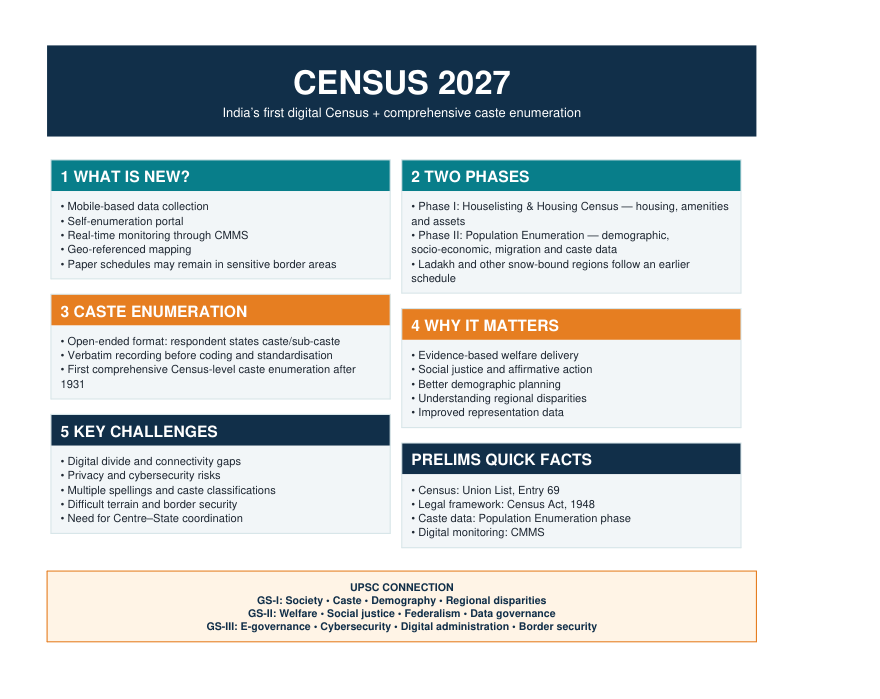
Census 2027 marks a major shift in India’s population data system. It is planned as India’s first digital Census, using mobile applications, satellite-based mapping, self-enumeration and real-time monitoring platforms. Ladakh and other snow-bound regions will undertake the exercise earlier because harsh winter conditions make normal-season fieldwork difficult.
Operational clarification: The August 17 date refers primarily to the opening of the self-enumeration facility in the snow-bound regions. Door-to-door Population Enumeration is scheduled to follow from September 1 to 30, 2026, while the rest of the country is scheduled for February 2027.economictimes.
Key Features
1. Digital Census
Census 2027 will use:
- Mobile applications for enumerators.
- A Self-Enumeration Portal for households.
- Satellite imagery and digital mapping for Houselisting Blocks.
- The Census Management and Monitoring System (CMMS) for real-time supervision.
- Multilingual digital tools and offline-enabled field applications.
- Digital data transmission from the field to centralised systems.
2. Hybrid approach in sensitive areas
- Digital tools will be used extensively across the country.
- Paper schedules may be retained in sensitive border and difficult-access areas where:
- Mobile connectivity is weak.
- Geo-tagging may create security concerns.
- Terrain and weather make digital field operations difficult.
- This reflects a technology-plus-security approach, rather than unconditional digitisation.
3. Caste Enumeration
- Census 2027 will include caste enumeration in the Population Enumeration phase.
- It will be the first comprehensive caste enumeration in the Census after 1931.censusindia+1
- The proposed approach involves an open-ended caste field.
- Respondents will state their caste, and the enumerator will record it as provided rather than selecting only from a fixed drop-down list.
- The objective is to reduce the possibility of the enumerator imposing an official classification on the respondent’s identity.
Open-Ended Caste Format
Meaning
In an open-ended format:
- The respondent declares the caste or sub-caste.
- The enumerator records the response verbatim.
- The enumerator does not classify surnames or sub-castes into a broader caste category.
- The raw data may subsequently require coding, standardisation and deduplication.
Advantages
- Recognises diversity in caste and sub-caste identities.
- Reduces arbitrary classification by enumerators.
- Captures locally used names and community identities.
- May improve perceived legitimacy among respondents.
- Provides a large database for studying social and educational inequalities.
Concerns
- The same caste may be reported using different spellings or names.
- One community may use several regional or sub-caste identifiers.
- Similar names may refer to different communities in different States.
- Raw data may become difficult to aggregate and compare.
- Political and administrative disputes may arise over classification.
- Open-ended responses may create challenges for implementing reservation and welfare policies.
The 2026 pre-tests across 16 States and Union Territories were intended to examine the feasibility of recording caste responses through an open field.
Constitutional and Legal Basis
- Constitutional basis: Census is a Union subject under Entry 69 of the Union List, Seventh Schedule.
- Article 246: Gives Parliament legislative competence over subjects in the Union List.
- Census Act, 1948: Provides the legal framework for conducting the Census.
- Census Rules, 1990: Supplement the legal framework governing Census operations.
- Census data is subject to confidentiality safeguards; personal information collected during the exercise is not meant for general public disclosure.
Significance
Governance and welfare
Reliable demographic data can help in:
- Targeting welfare schemes.
- Planning schools, hospitals and housing.
- Estimating regional variations in poverty and deprivation.
- Improving representation and resource allocation.
- Updating migration, disability, literacy and employment data.
Social justice
Caste data may help assess:
- Representation of different communities.
- Educational and occupational inequalities.
- Access to welfare schemes.
- Effectiveness of affirmative action.
- Need for evidence-based social policy.
Federalism
- Caste identities and classifications vary across States.
- State-specific data can improve the design of welfare schemes.
- Differences between Central and State lists may create coordination challenges.
- The exercise may influence debates on reservation limits, sub-categorisation and redistribution of benefits.
Digital governance
- Real-time monitoring can reduce delays and improve accountability.
- Geo-referenced mapping may reduce omission and duplication.
- Self-enumeration can increase citizen participation.
- Digital data can be processed faster than paper schedules.
Challenges
Digital divide
- Elderly, poor, remote and digitally excluded households may find self-enumeration difficult.
- Language and disability barriers may affect participation.
- Digital literacy cannot be assumed across all regions.
Data privacy and cybersecurity
- Census data contains sensitive personal and demographic information.
- Risks include:
- Unauthorised access.
- Data leaks.
- Cyberattacks.
- Misuse for profiling or exclusion.
- Strong encryption, access controls and independent auditing are essential.
Security concerns
- Geo-tagging in border areas may expose sensitive information.
- Data collection in militarised or difficult terrain requires special protocols.
- Ladakh presents logistical challenges due to altitude, weather and sparse settlements.
Caste data management
- Verbatim responses may produce millions of distinct entries.
- Standardisation must not erase legitimate diversity.
- A transparent methodology is required for:
- Coding.
- Merging similar entries.
- Resolving contradictions.
- Publishing aggregated results.
Political sensitivity
- Census findings may influence reservation and representation debates.
- Different groups may contest the accuracy or classification of data.
- The government must separate statistical collection from political manipulation.
Way Forward
- Use a hybrid model combining digital and paper-based enumeration where necessary.
- Provide offline digital applications for remote regions.
- Conduct independent cybersecurity and privacy audits.
- Train enumerators in caste sensitivity, multilingual interviewing and data protection.
- Publish the caste-coding methodology before releasing final data.
- Constitute an expert body involving:
- Registrar General of India.
- National Commission for Backward Classes.
- National Commissions for Scheduled Castes and Scheduled Tribes.
- Anthropologists and sociologists.
- State governments and civil-society representatives.
- Release data in aggregated form while protecting individual confidentiality.
- Create an effective grievance-redress mechanism for errors and exclusion.
Important Terms
- Population Enumeration: Collection of individual-level demographic information.
- Houselisting: Listing of houses, buildings and household-related details before population enumeration.
- Self-enumeration: Voluntary submission of household and individual details through an official digital portal.
- Open-ended enumeration: Recording the respondent’s answer without restricting it to a predetermined list.
- Geo-tagging: Attaching geographical coordinates to a building, household or enumeration block.
- Verbatim recording: Recording the response exactly as stated by the respondent.
- Digital divide: Unequal access to digital devices, connectivity and digital skills.
- Census confidentiality: Legal protection of information provided by respondents during the Census.
Prelims Facts
- Census is a subject under Entry 69 of the Union List.
- The Census is governed by the Census Act, 1948.
- Census 2027 is projected to be India’s first digital Census.
- Ladakh is participating in the Census as a Union Territory created in 2019.
- Snow-bound regions undertake enumeration earlier because of severe winter conditions.
- The last comprehensive caste enumeration in the Indian Census was conducted in 1931.censusindia+1
- Caste enumeration is being linked with the Population Enumeration phase.
- The CMMS will enable centralised monitoring of field operations.
- Census 2027 includes self-enumeration, digital mapping and mobile-based data collection.
Prelims Practice Questions
Q1. With reference to Census 2027, consider the following statements:
- Census is a subject under the Union List of the Constitution.
- Census 2027 is proposed to be India’s first digital Census.
- Caste enumeration will use only a fixed list of pre-existing caste categories.
Which of the statements given above is/are correct?
(a) 1 and 2 only
(b) 2 and 3 only
(c) 1 and 3 only
(d) 1, 2 and 3
Answer: (a)
Explanation: Census is under Entry 69 of the Union List, and Census 2027 is planned as India’s first digital Census. The proposed caste enumeration uses an open-ended format rather than only a fixed drop-down list.
Q2. The open-ended format for caste enumeration primarily means that:
(a) Only Scheduled Castes and Scheduled Tribes will be enumerated
(b) Respondents may state their caste or sub-caste in their own words
(c) Caste data will be collected only through self-enumeration
(d) Caste categories will be decided by State governments after enumeration
Answer: (b)
Explanation: In an open-ended format, respondents state their caste or sub-caste, and the response is recorded rather than being restricted to a predetermined list.
Q3. Consider the following pairs:
| Feature | Relevance |
| Self-enumeration | Digital submission of household information |
| Geo-tagging | Linking a location or building with geographical coordinates |
| Population Enumeration | Collection of individual-level demographic information |
Which of the pairs given above is/are correctly matched?
(a) 1 only
(b) 1 and 2 only
(c) 2 and 3 only
(d) 1, 2 and 3
Answer: (d)
Mains Question
Q. Census 2027 combines digital governance with caste enumeration. Discuss the opportunities and challenges associated with this approach.
Answer Framework
Introduction:
Census 2027 is significant because it combines India’s first digital population enumeration with the collection of caste data. The exercise is intended to improve evidence-based policymaking while addressing long-standing demands for updated social data.
Opportunities:
- Faster and more efficient data collection.
- Better monitoring through digital dashboards.
- Improved planning of welfare and public infrastructure.
- More accurate understanding of social inequalities.
- Greater citizen participation through self-enumeration.
- Better demographic and caste data for affirmative-action policies.
Challenges:
- Digital exclusion and connectivity gaps.
- Cybersecurity and privacy risks.
- Difficulties in geo-tagging sensitive border areas.
- Inconsistent spelling and classification of caste responses.
- Political contestation over data interpretation.
- Logistical difficulties in Ladakh and other snow-bound regions.
Way forward:
- Adopt a hybrid digital-paper system.
- Ensure privacy-by-design and independent cybersecurity audits.
- Train enumerators and improve accessibility.
- Publish transparent caste-coding standards.
- Involve States, commissions and experts.
- Protect individual confidentiality while releasing useful aggregate data.
Conclusion:
Census 2027 can become a major instrument of evidence-based governance if technological modernisation is combined with social sensitivity, data protection and transparent methodology. Its success will depend not merely on digitisation, but on the credibility, inclusiveness and usability of the data generated.