Table of Contents
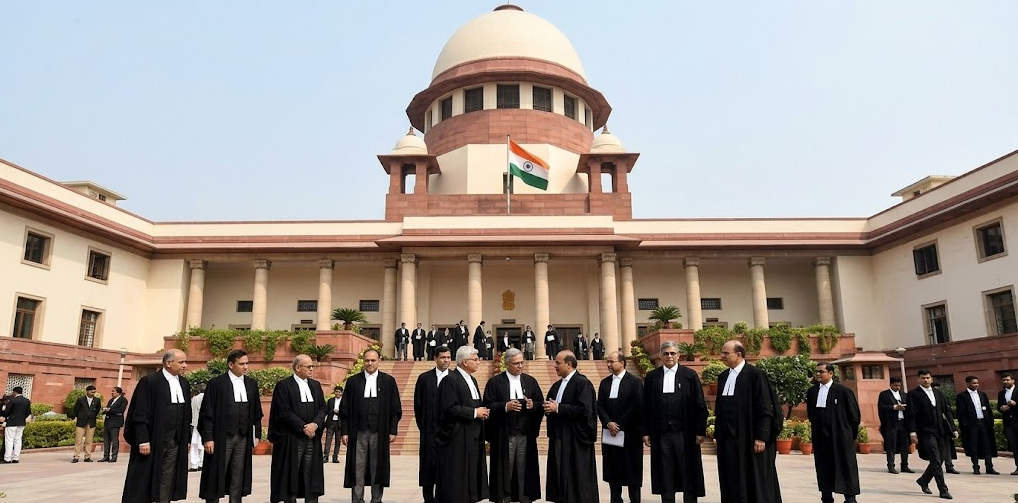
The Supreme Court dismissed a Public Interest Litigation (PIL) that challenged the constitutional validity of execution by hanging as the method of carrying out the death penalty in India. A division bench comprising Justice Vikram Nath and Justice Sandeep Mehta held that no sufficient case was made out to refer the landmark Deena v. Union of India (1983) judgment to a larger Constitution Bench.
The Court clarified that its order does not prevent the Union Government from constituting an expert committee to review alternative execution methods that may cause less physical trauma and better preserve human dignity.
Statutory Framework
Section 354(5), CrPC, 1973
- Provides that when a person is sentenced to death, the sentence shall direct that the convict “be hanged by the neck till he is dead.”
- This provision applies to death sentences under the ordinary criminal law.
Section 393(5), BNSS, 2023
- The Bharatiya Nagarik Suraksha Sanhita (BNSS), 2023 replaces the CrPC in many respects.
- It retains a similar provision prescribing hanging as the method of execution for death sentences.
Military laws
- Under the Army Act, Navy Act and Air Force Act, execution by shooting is permitted in certain cases, subject to court-martial procedures.
- This shows that Indian law already recognises different methods of execution in specific contexts.
Petitioner’s Contentions
The PIL, filed by senior advocate Rishi Malhotra, argued that:
- Execution by hanging causes prolonged physical pain and suffering.
- It violates the right to dignity under Article 21 of the Constitution.
- Modern, less painful methods such as:
- Lethal injection
- Inert gas asphyxiation
should be explored or adopted.
The petitioner sought a direction to the government to examine and implement more humane execution methods consistent with contemporary medical and scientific understanding.
The Precedent: Deena v. Union of India (1983)
In Deena v. Union of India, a three-judge bench of the Supreme Court examined various methods of execution, including:
- Hanging
- Shooting
- Electrocution
- Lethal gas
- Lethal injection
The Court concluded that:
- Hanging, as prescribed under Section 354(5), CrPC, does not involve unnecessary pain or cruelty compared to other available methods at that time.
- The method is constitutionally valid and does not violate Article 21.
- The death penalty itself is not unconstitutional, but the method of execution must not be cruel, barbarous or degrading.
This judgment has remained the binding precedent on the method of execution for over four decades.
Supreme Court’s 2026 Ruling
Refusal to refer Deena to a larger bench
- The division bench held that the arguments advanced did not justify reopening the settled precedent in Deena.
- The Court declined to refer the 1983 judgment to a larger Constitution Bench for reconsideration.
Possibility of future judicial examination
- The Court clarified that its order does not foreclose future judicial examination.
- If substantial and compelling scientific or medical empirical evidence is placed before the Court in appropriate proceedings, the issue can be revisited.
Scope for executive action
- The bench noted that the Union Government is free to:
- Constitute an expert committee.
- Review alternative execution methods.
- Examine whether other methods can minimise physical trauma and preserve human dignity.
- This leaves room for policy-level reform even though the judicial challenge has been dismissed.
Global Practices in Execution Methods
Lethal injection
- Widely used in many states of the United States.
- Involves administering a combination of drugs to cause unconsciousness, paralysis and cardiac arrest.
- Has faced criticism for:
- Botched executions.
- Drug shortages.
- Ethical concerns regarding medical participation.
Inert gas asphyxiation
- Uses nitrogen or other inert gases to cause death by oxygen deprivation.
- Argued by some proponents to be painless and rapid.
- Still relatively new and not universally adopted.
Other methods
- Electrocution, lethal gas, firing squad and hanging continue to be used in different jurisdictions.
- Many countries have abolished the death penalty entirely.
- International human-rights bodies increasingly argue that all methods of execution involve some degree of suffering.
India remains among the countries that retain the death penalty for the “rarest of rare” cases, with hanging as the standard method.
Constitutional Issues
Article 21 — Right to life and personal liberty
- Article 21 guarantees that no person shall be deprived of life or liberty except according to procedure established by law.
- The Supreme Court has interpreted this to include the right to a dignified life and protection against cruel, inhuman or degrading treatment.
- The core question is whether hanging, as a method of execution, violates the dignity component of Article 21.
Proportionality and evolving standards
- The Court has increasingly applied the proportionality test in rights-based cases.
- In earlier observations, the bench noted that the 1983 Deena judgment did not apply the proportionality test or compare empirical data on pain and suffering across methods.
- However, in the 2026 ruling, the Court did not find sufficient grounds to overturn Deena on this basis.
Separation of powers
- The Court indicated that while it is not revisiting the precedent, the executive can examine alternative methods.
- This reflects judicial restraint and leaves policy innovation to the government, subject to future constitutional scrutiny if needed.
Significance
For criminal justice
- Confirms that hanging remains the lawful method of execution in India.
- Reinforces the binding nature of the Deena precedent.
- Leaves open the possibility of future challenges based on new scientific evidence.
For human rights
- Keeps the debate alive on whether execution methods can be made more humane.
- Highlights the tension between:
- Retention of the death penalty.
- The constitutional requirement of dignity under Article 21.
For governance
- Signals that the government may constitute an expert body to review execution methods.
- Encourages evidence-based policy-making in a sensitive domain.
- Balances judicial finality with scope for executive reform.timesofindia.
Challenges and Concerns
- Lack of comprehensive Indian empirical data on pain and suffering associated with different execution methods.
- Ethical concerns regarding medical professionals’ involvement in executions.
- Risk of arbitrary or inconsistent adoption of new methods without clear guidelines.
- Potential conflict between human-dignity arguments and public opinion on capital punishment.
- International pressure to abolish or restrict the death penalty.
Way Forward
- The government may constitute an expert committee comprising:
- Medical professionals.
- Forensic experts.
- Legal scholars.
- Human-rights representatives.
- The committee can examine:
- Comparative pain and suffering across methods.
- Feasibility of lethal injection, inert gas asphyxiation or other alternatives.
- Ethical, legal and logistical implications.
- Any reform must:
- Comply with Article 21 and existing precedents.
- Ensure transparency and accountability.
- Avoid arbitrary or discriminatory application.
- Parliament may consider amending the BNSS if a new method is adopted, with clear statutory safeguards.
Important Terms
- Death penalty: Capital punishment imposed for the most serious offences, subject to the “rarest of rare” doctrine.
- Section 354(5), CrPC: Provision prescribing hanging as the method of execution for death sentences.
- Section 393(5), BNSS: Corresponding provision in the 2023 criminal procedure code.
- Article 21: Constitutional guarantee of life and personal liberty, interpreted to include dignity and protection from cruel treatment.
- Proportionality test: Judicial method to assess whether a restriction on rights is suitable, necessary and balanced.
- Lethal injection: Execution method involving administration of drugs to cause death.
- Inert gas asphyxiation: Execution method using nitrogen or other inert gases to cause death by oxygen deprivation.
- Deena v. Union of India (1983): Landmark Supreme Court judgment upholding the constitutional validity of hanging as a method of execution.
Prelims Facts
- Case: Supreme Court PIL on execution by hanging (2026).
- Bench: Justice Vikram Nath and Justice Sandeep Mehta.
- Statutory provision: Section 354(5), CrPC, 1973 and Section 393(5), BNSS, 2023.
- Precedent: Deena v. Union of India (1983) upheld hanging as constitutionally valid.
- Court’s position: No sufficient case to refer Deena to a larger bench; hanging remains the method for now.
- Court’s clarification: Future judicial examination possible if compelling scientific or medical evidence is presented.
- Executive scope: Union Government may constitute an expert committee to review alternative execution methods.ndtv+2
Prelims Practice
Q1. With reference to execution of death sentences in India, consider the following statements:
- Section 354(5) of the CrPC, 1973 prescribes that a person sentenced to death shall be hanged by the neck till he is dead.
- In Deena v. Union of India (1983), the Supreme Court held that execution by hanging violates Article 21 of the Constitution.
- The Supreme Court in 2026 refused to refer the Deena judgment to a larger Constitution Bench.
Which of the statements given above is/are correct?
(a) 1 and 2 only
(b) 2 and 3 only
(c) 1 and 3 only
(d) 1, 2 and 3
Answer: (c)
Explanation: Section 354(5), CrPC prescribes hanging as the method of execution. In Deena (1983), the Supreme Court upheld the constitutional validity of hanging and held that it does not violate Article 21. In 2026, the Court refused to refer Deena to a larger bench.
Q2. Consider the following pairs:
| Provision | Subject |
|---|---|
| Section 354(5), CrPC | Method of execution of death sentence |
| Article 21, Constitution | Right to life and personal liberty |
| Deena v. Union of India (1983) | Validity of hanging as execution method |
Which of the pairs given above is/are correctly matched?
(a) 1 only
(b) 1 and 2 only
(c) 2 and 3 only
(d) 1, 2 and 3
Answer: (d)
Explanation: Section 354(5), CrPC deals with the method of execution of death sentences. Article 21 guarantees the right to life and personal liberty. Deena v. Union of India is the landmark case on the constitutional validity of hanging.
Q3. The Supreme Court’s 2026 ruling on execution by hanging primarily indicates that:
(a) Hanging has been declared unconstitutional and must be replaced immediately
(b) The death penalty itself has been abolished in India
(c) Hanging remains the lawful method, but the government may explore alternative methods through an expert committee
(d) All death row convicts must be given the option to choose their method of execution
Answer: (c)
Explanation: The Court upheld hanging as the lawful method for now, declined to refer Deena to a larger bench, but clarified that the government may constitute an expert committee to review alternative execution methods that minimise pain and preserve dignity.