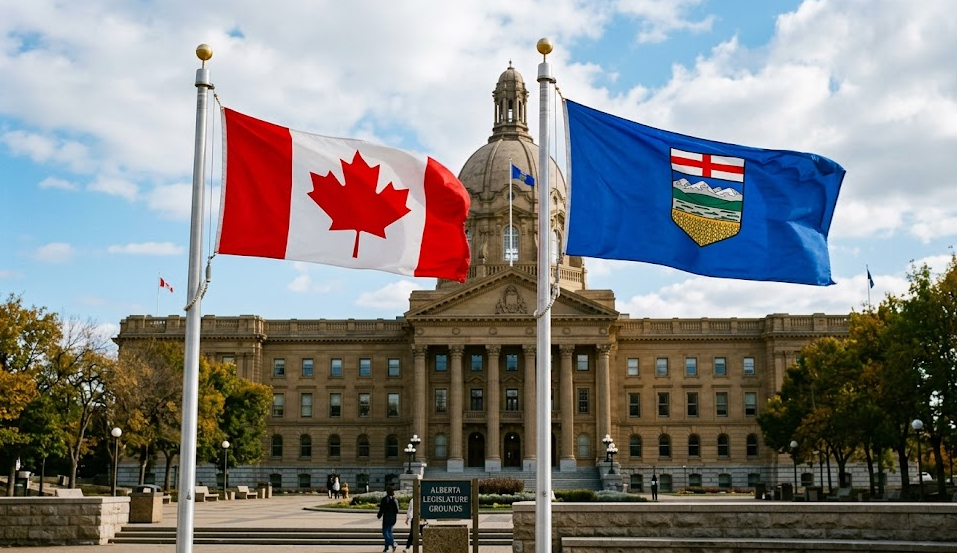
Recently, a separatist group in Canada, “Stay Free Alberta,” formally submitted over 302,000 signatures to Elections Alberta. This exceeds the statutory requirement of 178,000 signatures needed to force the provincial government to consider a referendum on Alberta’s independence from Canada.
Background: The Roots of “Wexit” (Western Exit)
Alberta, often referred to as the “energy heartland” of Canada, has a long-standing history of friction with the federal government in Ottawa.
- Economic Grievances: The province holds the world’s third-largest oil reserves. The provincial government accuses federal environmental and trade legislation of “hamstringing” the oil industry, leading to billions in lost revenue.
- Federal vs. Provincial Jurisdiction: Similar to debates in India regarding the Seventh Schedule, Alberta seeks greater autonomy over its natural resources and internal policy, resisting what it terms as federal “meddling.”
- Political Catalyst: While Premier Danielle Smith does not support secession, she has championed the Alberta Sovereignty within a United Canada Act, which seeks to grant the province the power to ignore federal laws it deems unconstitutional.
The Legal and Constitutional Roadblocks
Secession in a modern federation is a complex legal process rather than a simple ballot outcome:
- Negotiation, Not Automation: A “Yes” vote in a referendum does not grant immediate independence. Under the Clarity Act (2000)—a federal law enacted following the Quebec referendums—any move toward secession requires a “clear majority” on a “clear question,” followed by constitutional negotiations involving all provinces and the federal government.
- The “Treaty Rights” Hurdle: A significant challenge has been launched by First Nations (Indigenous) groups. They argue that Alberta cannot separate because the land is governed by historic Treaties signed between the Indigenous peoples and the British Crown (now represented by the Canadian federal state). Secession could be seen as a violation of these sovereign agreements.
Comparative Analysis: Canada vs. India Federalism
| Feature | Canadian Federation | Indian Federation |
| Nature of Union | “Coming Together” / Constitutional compact. | “Indestructible Union of Destructible States.” |
| Right to Secede | No explicit right, but the Supreme Court has laid out a path via negotiations (Quebec Secession Reference). | No right to secede; protected by Article 1 and the 16th Amendment. |
| Residual Powers | Reside with the Federal Government (mostly). | Reside with the Union Government (Article 248). |
Significance of the Region (Geography & Economy)
- Athabasca Oil Sands: Located in northern Alberta, these are the primary source of Canada’s crude oil production.
- Landlocked Status: A major strategic challenge for an independent Alberta would be exporting oil, as it would need to negotiate transit through Canada or the U.S. to reach international waters.
Way Forward
- Verification: Elections Alberta must now verify the 302,000 signatures.
- Judicial Review: The courts will likely decide if the referendum infringes upon Indigenous treaty rights before a ballot can be held.
- Political Dialogue: Most experts suggest that the referendum is a “leverage tool” to force the federal government to grant Alberta more economic concessions rather than a precursor to a new nation.
PRACTICE QUESTIONS
Q1. With reference to the Canadian Federal System and recent developments, consider the following statements:
- Alberta is a landlocked province known for hosting the majority of Canada’s oil reserves.
- Under the Canadian Constitution, a provincial referendum result automatically triggers independence.
- The “First Nations” in Canada refers to the indigenous peoples who have historic treaty rights with the Crown.
Which of the statements given above is/are correct?
A) 1 and 2 only
B) 2 and 3 only
C) 1 and 3 only
D) 1, 2, and 3
Q2. The “Clarity Act,” often discussed in the context of secessionist movements, is a legislation belonging to which country?
A) United Kingdom (referring to Scotland)
B) Spain (referring to Catalonia)
C) Canada (referring to Quebec and other provinces)
D) India (referring to Article 3)
ANSWERS AND EXPLANATIONS
Ans 1: C (1 and 3 only)
- Statement 1 is correct: Alberta is landlocked and home to the oil sands.
- Statement 2 is incorrect: A referendum is only the first step; it must be followed by extensive constitutional negotiations with the federal government.
- Statement 3 is correct: First Nations are the indigenous groups whose legal standing is tied to historic treaties.
Ans 2: C
- Explanation: The Clarity Act was passed by the Parliament of Canada in 2000 to establish the conditions under which the Government of Canada would enter into negotiations that might lead to secession following a referendum.
MAINS PRACTICE QUESTION
“Secessionist tendencies in resource-rich sub-national units often stem from perceived ‘fiscal injustice’ and federal overreach.” In light of the Alberta separatism movement, compare the mechanisms available in the Canadian and Indian constitutions to address regional aspirations and maintain national integrity. (250 words)