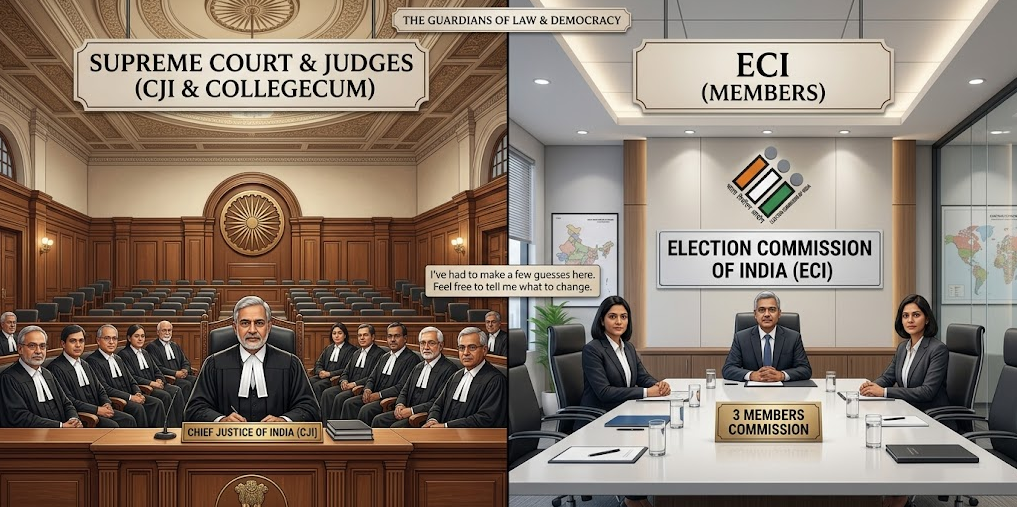
The Supreme Court (SC) recently heard petitions challenging the Chief Election Commissioner and other Election Commissioners (Appointment, Conditions of Service, and Term of Office) Act, 2023. The petitioners argue that the Act grants the executive “exclusive control” over appointments to the Election Commission of India (ECI), potentially undermining its independence.
Background: The Evolution of the Appointment Process
Historically, the appointment of the CEC and ECs was governed by Article 324(2) of the Constitution. However, for decades, no specific law was enacted by Parliament, leading to a “legislative vacuum.”
- Pre-March 2023: Appointments were made by the President on the sole advice of the Prime Minister (Executive-led).
- Anoop Baranwal v. Union of India (March 2023): A Constitution Bench ruled that until Parliament makes a law, appointments should be done by a committee comprising:
- The Prime Minister (PM)
- The Leader of the Opposition (LoP) in Lok Sabha
- The Chief Justice of India (CJI)
- The 2023 Act: In December 2023, Parliament enacted a new law, effectively replacing the CJI in the selection committee with a Union Cabinet Minister nominated by the PM.
Comparative Analysis of the Selection Mechanism
The following table illustrates the shift in the selection committee’s composition:
| Feature | SC Judgment (Anoop Baranwal) | The 2023 Act |
| Chairperson | Prime Minister | Prime Minister |
| Member 1 | Leader of Opposition (or largest party) | Leader of Opposition (or largest party) |
| Member 2 | Chief Justice of India (CJI) | A Union Cabinet Minister (nominated by PM) |
| Search Committee | Not specified | Headed by Law Minister; prepares a panel of 5 names. |
Key Issues and Arguments
Arguments by Petitioners (ADR & Others)
- Executive Dominance: By replacing the CJI with a Cabinet Minister, the committee effectively has a 2:1 majority in favor of the Executive. This allows the government to choose any candidate of its preference.
- Violation of Independence: Petitioners argue that the ECI must be “fiercely independent” to ensure free and fair elections. An executive-controlled body might lack the neutrality required to oversee the ruling party.
- Countermanding Judicial Intent: The law is seen as a move to bypass the SC’s attempt to insulate the ECI from political interference.
Observations by the Supreme Court
- Legislative Competence: Justice Datta noted that the March 2023 judgment was explicitly intended to be a “pro tem” (temporary) measure until Parliament exercised its power under Article 324(2).
- Mandamus to Parliament: The Court questioned whether it could issue a mandamus (order) to Parliament to legislate in a specific way, as law-making is the exclusive domain of the legislature.
- Separation of Powers: The court highlighted the fine line between judicial review and encroaching upon the legislative functions of Parliament.
Constitutional Provisions Involved
- Article 324(2): Specifies that the appointment of the CEC and ECs shall be made by the President, subject to the provisions of any law made by Parliament.
- Independence of ECI: While the Constitution provides for the removal of the CEC (similar to a SC Judge), the security of tenure for ECs is not as robust, as they can be removed on the recommendation of the CEC.
DINESH GOSWAMI COMMITTEE ON ELECTORAL REFORMS (1990)
The Dinesh Goswami Committee was a landmark committee formed in 1990 under the National Front Government (V.P. Singh Government) to address the growing influence of money and muscle power in Indian elections. Its recommendations remain the bedrock of many modern electoral practices.
Key Recommendations
The committee provided a comprehensive set of reforms categorized into structural, procedural, and legislative changes:
A. Strengthening the Election Commission (ECI)
- Multi-member Body: Recommended that the ECI should be a three-member body to ensure collective decision-making.
- Appointment Process: Proposed a selection committee for the CEC and ECs comprising the Prime Minister, the Leader of the Opposition (LoP) in the Lok Sabha, and the Chief Justice of India (CJI).
- Independence: Advocated for the ECI to have its own independent secretariat and for the ECs to have the same protection from removal as the CEC.
B. Curbing “Money and Muscle Power”
- State Funding: Suggested state funding “in kind” (providing fuel, vehicles, paper, and electoral rolls) rather than cash to recognized political parties.
- EVMs: Strongly recommended the use of Electronic Voting Machines (EVMs) to eliminate booth capturing and rigging.
- Security Deposits: Proposed a significant hike in security deposits to discourage “non-serious” independent candidates.
C. Administrative and Procedural Reforms
- Bye-elections: Mandated a six-month time limit for holding bye-elections to fill vacancies.
- Contesting Limits: Suggested that no candidate should be allowed to contest from more than two constituencies simultaneously.
- Voter Identity: Proposed the issuance of Photo Identity Cards (EPIC) to all voters to prevent impersonation.
D. Anti-Defection Law (10th Schedule)
- Adjudicating Authority: Recommended that the power to disqualify a member for defection should rest with the President or Governor (acting on the ECI’s advice), rather than the Speaker or Chairman of the House, to ensure neutrality.
- Limited Disqualification: Suggested restricting disqualification only to cases where a member voluntarily resigns or votes against a party whip in a Confidence Motion.
Implementation Status
Many of the committee’s suggestions have been integrated into the Indian electoral system over the decades:
| Status | Reform Measure |
| Implemented | Three-member Election Commission (made permanent in 1993). |
| Implemented | Wide-scale use of EVMs and introduction of Photo Identity Cards. |
| Implemented | Six-month statutory limit for holding bye-elections. |
| Partial/Modified | Candidates are now limited to two seats (Representation of the People Act, 1996 amendment). |
| Pending | Appointment of CEC/ECs via a PM-LoP-CJI committee (The 2023 Act replaced the CJI with a Cabinet Minister). |
| Pending | Vesting the power of disqualification (10th Schedule) in the President/ECI. |
Conclusion and Way Forward
- The debate highlights the tension between Executive Prerogative and Institutional Independence.
- While Parliament has the right to legislate, the “basic structure” of the Constitution demands that the machinery of elections remains impartial.
- For a robust democracy, the ECI must not only be independent but also seen to be independent. Possible reforms could include a “Selection Committee” with more diverse stakeholders or requiring a unanimous decision for appointments to bolster public confidence.
- The Goswami Committee was the first to formalize the idea that the integrity of the ECI depends on its selection process.
- By suggesting the inclusion of the CJI, it sought to balance executive power with judicial oversight—a debate that continues to dominate current legal discourse.
- However, the challenge remains in the criminalization of politics.
- While procedural reforms (like EVMs and ID cards) have reduced booth capturing, the “muscle power” has largely been replaced by “money power” and the influence of candidates with pending criminal cases.
Questions for Practice
Preliminary Examination (Objective Type)
Q1. Consider the following statements regarding the appointment of the Chief Election Commissioner (CEC) and Election Commissioners (ECs) in India:
- Under Article 324(2), the President appoints the CEC and ECs subject to the provisions of any law made by Parliament.
- The Supreme Court in the Anoop Baranwal (2023) case ruled that the selection committee must include the Chief Justice of India until Parliament enacts a specific law.
- The Chief Election Commissioner and other Election Commissioners Act, 2023, completely removed the Leader of the Opposition from the selection panel.
Which of the statements given above are correct? (a) 1 and 2 only
(b) 2 and 3 only
(c) 1 and 3 only
(d) 1, 2 and 3
- Answer: (a) 1 and 2 only
- Explanation: * Statement 1 is correct: Article 324(2) of the Constitution explicitly states that the appointment of the CEC and other ECs shall be made by the President, subject to the provisions of any law made by Parliament.
- Statement 2 is correct: In March 2023, the SC ruled that a committee comprising the PM, LoP, and the CJI should advise the President on these appointments until a law is passed by Parliament.
- Statement 3 is incorrect: The 2023 Act did not remove the Leader of the Opposition. It replaced the Chief Justice of India (CJI) with a Union Cabinet Minister nominated by the Prime Minister. The current committee consists of the PM, the LoP (or leader of the single largest opposition party), and a Union Cabinet Minister.
Q2. With reference to the recommendations of the Dinesh Goswami Committee (1990) on electoral reforms, consider the following statements:
- It recommended that the selection committee for appointing the CEC and ECs should include the Chief Justice of India.
- It proposed that the power of disqualification under the Tenth Schedule (Anti-Defection Law) should vest in the Speaker or Chairman of the House.
- It advocated for state funding of elections in kind rather than in cash.
Which of the statements given above are correct? (a) 1 and 2 only
(b) 1 and 3 only
(c) 2 and 3 only
(d) 1, 2 and 3
- Answer: (b) 1 and 3 only
- Explanation: * Statement 1 is correct: The committee recommended a selection panel consisting of the PM, the LoP, and the CJI.
- Statement 2 is incorrect: The Dinesh Goswami Committee actually recommended that the power of disqualification under the Anti-Defection Law should vest in the President or Governor (acting on the advice of the ECI) to ensure neutral adjudication, rather than leaving it to the Speaker/Chairman.
- Statement 3 is correct: The committee strongly recommended state funding of elections strictly in kind (such as providing fuel, paper, and vehicle allocations to recognized parties) to minimize cash-induced corruption.
PART 2: Mains Examination (Descriptive Type)
Q1. “The independence of the Election Commission of India is a vital ingredient for securing the ‘basic structure’ of the Constitution.” In light of the Chief Election Commissioner and other Election Commissioners Act, 2023, critically analyze the balance between executive prerogative and institutional autonomy in electoral appointments. (15 Marks, 250 Words)
Model Structure for Answer:
- Introduction (approx. 30–40 words):
- Define the role of the Election Commission of India (ECI) under Article 324 as the guardian of free and fair elections, which is a core component of democracy and the basic structure of the Constitution. Mention the transition from the Anoop Baranwal judgment (March 2023) to the enactment of the 2023 Act.
- Body Paragraph 1: The Rationale for Executive Prerogative (The Government’s and Court’s perspective):
- Explain that law-making is the exclusive domain of the Legislature under the Separation of Powers.
- Highlight the SC’s own observation (Justice Datta) that the inclusion of the CJI in the March 2023 judgment was explicitly a temporary (pro tem) measure to fill a “legislative vacuum” until Parliament stepped in.
- The Constitution (Article 324(2)) deliberately left the mechanism to parliamentary legislation, and the executive must have a decisive say in administrative appointments to ensure governance accountability.
- Body Paragraph 2: Concerns regarding Institutional Autonomy (The Critics’ perspective):
- Discuss the composition imbalance: Replacing the CJI with a Cabinet Minister creates a 2:1 majority in favor of the ruling executive (PM + Cabinet Minister vs. LoP).
- This risks creating a perception of a “government monopoly” or executive-dominated selection process, potentially compromising the “fierce independence and neutrality” envisaged by the Constitution makers.
- Unlike the CAG or UPSC chairpersons, the security of tenure for Election Commissioners (ECs) is already vulnerable (as they can be removed on the recommendation of the CEC), and executive control over their appointments further accentuates this vulnerability.
- Way Forward / Recommendations (approx. 40–50 words):
- Mention the recommendations of the Dinesh Goswami Committee (1990) and the Law Commission’s 255th Report, which advocated for a balanced, non-partisan committee.
- Suggest institutional safeguards, such as requiring a unanimous decision or expanding the committee to include broader democratic representation (e.g., presiding officers of both houses) to restore public trust.
- Conclusion (approx. 20–30 words):
- Conclude that for a robust democracy, the electoral process must not only be fair but must also indisputably appear to be fair. Striking a harmonious balance between executive authority and judicial/independent oversight is essential to keep the democratic fabric intact.