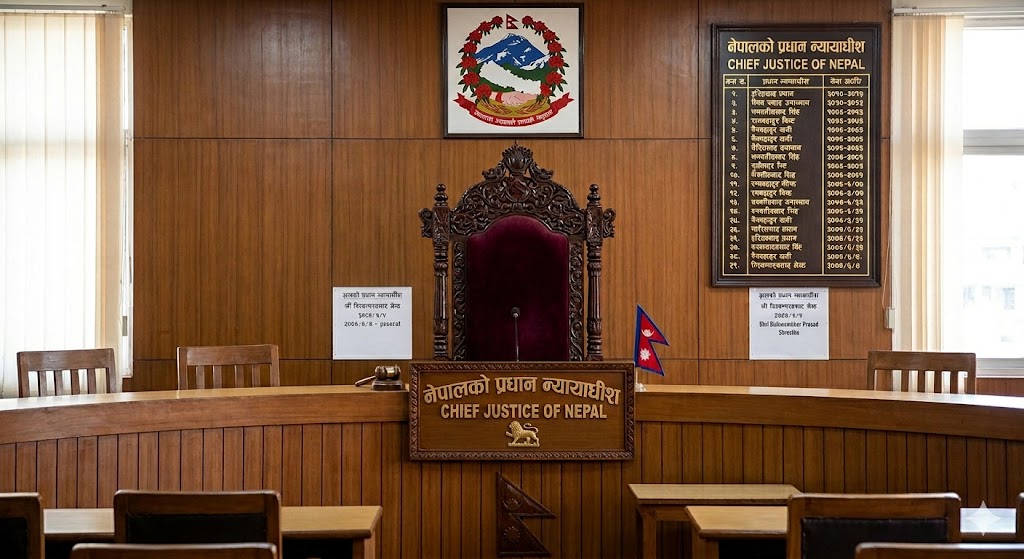
In May 2026, Nepal’s democratic framework faced a significant “real-time test” following a series of executive decisions that have strained the relationship between the government, the presidency, and the judiciary. The core of the controversy lies in the recommendation of a junior judge as the new Chief Justice (CJ), bypassing long-standing traditions, and the issuance of a controversial ordinance that alters the power dynamics of the Constitutional Council.
The Genesis of the Conflict
A. The Constitutional Council Ordinance
The crisis began with an ordinance related to the Constitutional Council, the body responsible for recommending appointments to constitutional posts, including the Chief Justice.
- The Shift in Power: The original provision required consensus among Council members. The new ordinance, issued by President Ram Chandra Poudel on May 5 (after initial hesitation), allows recommendations to be passed with the approval of just three members.
- Executive Dominance: Given that the Council includes the Prime Minister and the Law Minister, this change effectively grants the Prime Minister (Mr. Shah of the RSP) the upper hand, marginalizing the Opposition Leader and other members.
B. Bypassing the Seniority Principle
On May 7, the Constitutional Council recommended Manoj Sharma, the fourth-ranking Supreme Court judge, for the post of Chief Justice.
- The Tradition: For seven decades, Nepal has followed a custom of appointing the senior-most justice as the CJ.
- The Snub: The Council bypassed Acting CJ Sapana Pradhan Malla, leading to allegations of gender bias (as she would have been a deserving female CJ) and a move toward a “compliant judiciary.”
Arguments and Counter-Arguments
| Perspective | Arguments |
| The Government (RSP) | 1. Competence over Seniority: Claimed Manoj Sharma had the highest case disposal rates. 2. Legal Discretion: Argued that seniority is a custom, not a legally binding mandate under the Constitution. |
| The Judiciary (Acting CJ Malla) | 1. Executive Shadow: Accused the government of seeking a “compliant judiciary” and unequal application of law. 2. Data Dispute: Questioned the accuracy of the case disposal rates presented by the government. |
| Legal Experts & Civil Society | 1. Instability: Warned that ignoring seniority triggers a “race to the center of power” among judges. 2. Institutional Decay: Former CJ Sushila Karki warned that interference undermines the independence of democratic institutions. |
Political Landscape: The Rise of RSP
The Rastriya Swatantra Party (RSP), led by Mr. Shah, holds 182 seats (just two short of a two-thirds majority).
- Governance Style: The government has been characterized as “high-handed,” challenging established norms and utilizing its near-supermajority to push through legislative changes (like the CC Ordinance).
- Parliamentary Hearing: Since the RSP holds a majority in the parliamentary hearing committee, Mr. Sharma’s appointment is viewed as an “inevitability.”
Comparative Analysis: Nepal vs. India
| Feature | Nepal (Current Crisis) | India (Constitutional Context) |
| CJ Appointment | Constitutional Council (Executive-heavy) recommends to the President. | Collegium System (Judiciary-led) recommends to the President. |
| Seniority Rule | Customary, recently bypassed. | Established by the Second Judges Case (1993); seniority is strictly followed (with rare exceptions like 1973/1977). |
| Executive Influence | High, due to recent ordinances and simple majority rules in the Council. | Managed through the “Memorandum of Procedure,” though friction exists. |
| Judicial Reaction | Public statements/interviews by sitting judges (Sapana Pradhan Malla). | Generally restricted to “Judicial Orders,” though the 2018 Press Conference was a notable exception. |
Major Concerns & Implications
- Independence of the Judiciary: If judges feel they must please the executive to be promoted, the “separation of powers” is compromised.
- Predictability: The seniority convention provides a stable succession plan. Its removal creates uncertainty and internal friction within the Supreme Court.
- Constitutional Morality: Bypassing a qualified woman (Sapana Pradhan Malla) for the top post is seen as a setback for gender representation in high constitutional offices.
- Public Trust: Public disagreements between the Acting CJ and the Prime Minister erode the perceived neutrality of the courts.
Value Addition for Mains
The “Seniority Convention” Philosophy:
The primary reason for the seniority rule is to prevent “political packing” of the courts. In a democracy, if the executive chooses the Chief Justice based on “disposal rates” or “competence” (subjective metrics), it opens the door for choosing judges who align with the ruling party’s ideology.
The Role of the Constitutional Council:
In Nepal, the CC is a unique “hybrid” body meant to ensure checks and balances. However, when ordinances dilute the requirement for consensus, the body ceases to be a “check” and becomes a “rubber stamp” for the executive.
Practice Questions
Prelims Specific
Q1. Consider the following statements regarding the appointment of the Chief Justice in Nepal:
- The Constitution of Nepal makes it legally mandatory to appoint the senior-most judge of the Supreme Court as the Chief Justice.
- The Constitutional Council, which recommends the Chief Justice, includes the Leader of the Opposition.
- Recommendations by the Constitutional Council must be approved by a parliamentary hearing committee.
Which of the statements given above are correct?
(a) 1 and 2 only
(b) 2 and 3 only
(c) 1 and 3 only
(d) 1, 2, and 3
Q2. The “Mithuna” model, in the context of recent South Asian developments, refers to:
(a) A new judicial case management software in Nepal.
(b) A high-resolution weather forecasting model used by IMD.
(c) A regional trade agreement between India, Oman, and Chile.
(d) The constitutional framework for the appointment of judges in Nepal.
Mains Specific
Q1. “The independence of the judiciary is not just about the absence of executive interference in judgements, but also about the integrity of the appointment process.” Discuss this statement in the context of the recent constitutional crisis in Nepal. (250 Words)
Q2. Compare and contrast the methods of judicial appointments in India and Nepal. How do these systems balance executive involvement with judicial independence? (150 Words)