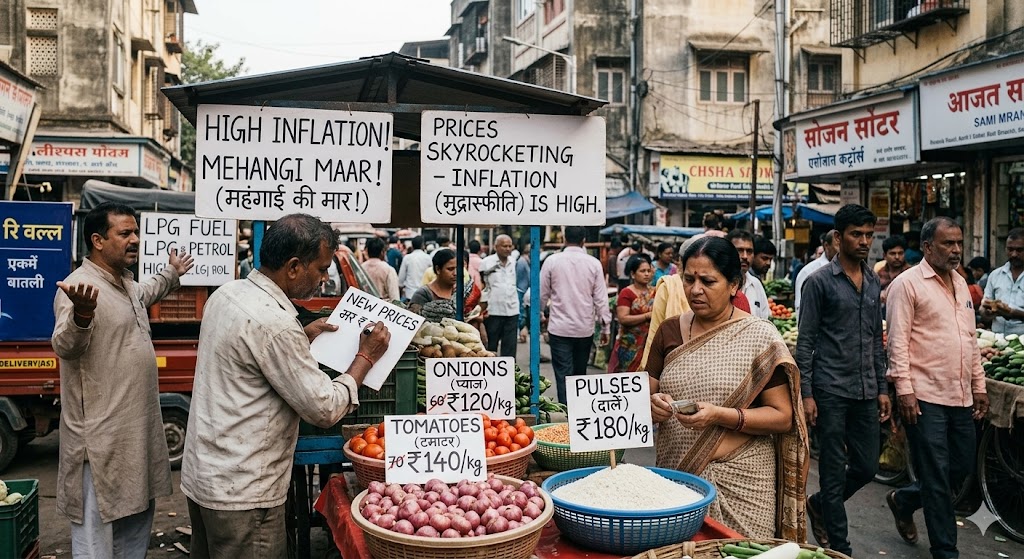
In April 2026, India’s retail inflation, measured by the Consumer Price Index (CPI), touched a 13-month high of 3.5%. While the headline number indicates a quickening of price pressures compared to March (3.4%). The rise is primarily attributed to supply-side shocks emanating from the volatile geopolitical situation in West Asia and emerging climatic risks.
Key Data Points: A Snapshot
| Indicator | March 2026 (%) | April 2026 (%) | Trend |
| Headline Retail Inflation (CPI) | 3.4 | 3.5 | $\uparrow$ |
| Food & Beverages Inflation | 3.7 | 4.0 | $\uparrow$ |
| Restaurant & Accommodation | 2.9 | 4.2 | $\uparrow$ |
| Overall Transport & Communication | 0.0 | -0.01 | $\downarrow$ |
| Transport of Goods (Logistics) | – | 7.6 | $\uparrow$ |
Major Drivers of Inflation in April 2026
A. The Food & Beverages Surge
Inflation in this category climbed to 4%, up from 3.7% in March.
- Supply Disruptions: Early signals of El Niño have created apprehension regarding the summer crop output, leading to preemptive price firming in essential commodities.
- Seasonal Volatility: Perishables have seen a seasonal uptick, exacerbated by higher storage and cooling costs.
B. The “Pass-Through” Effect in Services
The Restaurant and Accommodation sector witnessed a sharp spike to 4.2%.
- Cost-Push Inflation: As fuel prices rose due to the West Asia conflict, service providers (hotels and eateries) moved to protect margins by passing these costs directly to consumers.
- Post-War Lag: April was the first full month reflecting the economic fallout of the West Asian war, showing how quickly energy shocks can transmit to the services sector.
C. The Transport Sector Paradox
A unique trend emerged where the overall transport inflation stood at -0.01%, despite rising fuel costs.
- Passenger vs. Goods: Passenger transport services saw easing prices (likely due to high base effects or competitive pricing in aviation/railways).
- Logistics Stress: Conversely, the cost of transporting goods surged by 7.6%. This indicates that while “moving people” became cheaper or stable, “moving products” became significantly more expensive, directly impacting the wholesale cost of goods.
Expert Perspectives & Economic Outlook
Economists from leading financial institutions (Kotak Mahindra, Bank of Baroda, and L&T Finance) maintain a “cautious but not alarmed” stance.
- Softer than Expectations: Most analysts had predicted a steeper rise due to the war. The 3.5% print suggests that domestic demand remains managed and the government’s supply-side interventions (buffer stocks, trade policy) are providing a cushion.
- The “Clouded” Outlook: The primary concern remains Upside Risks.
- Geopolitics: If the conflict in West Asia escalates, crude oil volatility will eventually breach the current “softness” in headline numbers.
- Climate Change: The shadow of El Niño poses a direct threat to the disinflationary process in the food basket.
UPSC Value Addition: Theoretical Constructs
I. Consumer Price Index (CPI) vs. Wholesale Price Index (WPI)
- CPI: Measures price changes from the perspective of the retail buyer. It is the “Headline Inflation” used by the RBI for monetary policy.
- WPI: Measures price changes at the level of producers/wholesalers. It does not include services, which makes the current 4.2% spike in the “Restaurant & Accommodation” sector a CPI-specific observation.
II. Core vs. Headline Inflation
- Headline Inflation: The total inflation within an economy, including commodities such as food and energy prices (e.g., the 3.5% figure).
- Core Inflation: Excludes the volatile food and fuel components. Given the current surge in food (4%) and fuel-linked services (4.2%), core inflation likely remains more stable than headline inflation.
Way Forward
- Monetary Policy: The RBI’s Monetary Policy Committee (MPC) is likely to maintain a “Status Quo” on interest rates. Since inflation is still well below the 4% median target, there is no immediate pressure for a rate hike.
- Supply Chain Management: The 7.6% rise in goods transport costs necessitates government intervention in logistics (e.g., PM Gati Shakti) to reduce the “hidden” costs of inflation.
- Agriculture Preparedness: Strengthening irrigation coverage and micro-irrigation is essential to mitigate the El Niño impact on the food basket.
Practice Questions
Prelims Specific
Q1. With reference to the Consumer Price Index (CPI) in India, consider the following statements:
- It is released monthly by the Department for Promotion of Industry and Internal Trade (DPIIT).
- The RBI uses CPI-Combined as its primary anchor for monetary policy.
- The base year for the current CPI series is 2011-12.
Which of the statements given above is/are correct?
(a) 1 and 2 only
(b) 2 and 3 only
(c) 3 only
(d) 1, 2, and 3
Q2. A “Pass-through effect” in the context of inflation refers to:
(a) The reduction of taxes by the government to control prices.
(b) The process by which an increase in input costs (like fuel) leads to an increase in the final price of goods and services.
(c) The impact of international trade on domestic currency valuation.
(d) The transition of inflation from the wholesale market to the retail market only.
Mains Specific
Q1. “The divergence between the cost of passenger transport and the cost of goods transport in recent inflation data highlights a structural challenge in India’s logistics sector.” Discuss. (150 Words)
Q2. Explain how geopolitical tensions in West Asia and climatic phenomena like El Niño create ‘supply-side’ shocks for the Indian economy. To what extent can Monetary Policy be effective in controlling such inflation? (250 Words)