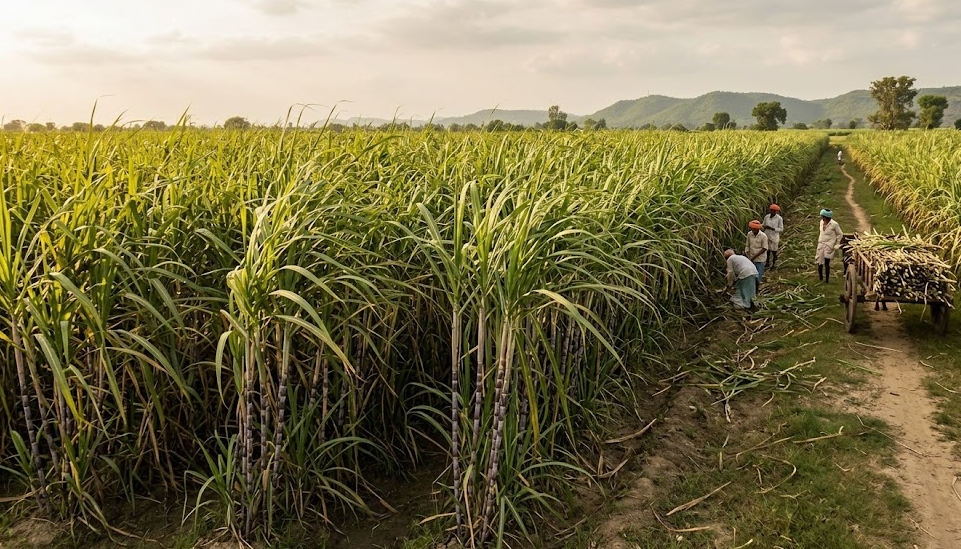
The Cabinet Committee on Economic Affairs (CCEA), chaired by the Prime Minister, has approved the Fair and Remunerative Price (FRP) of sugarcane for the sugar season 2026-27 (October-September) at ₹365 per quintal.
Key Highlights of the Pricing Decision
- Price Increase: An increase of ₹10 per quintal from the previous year.
- Basic Recovery Rate: The ₹365/quintal price is linked to a basic sugar recovery rate of 10.25%.
- Premium for Efficiency: For every 0.1% increase in recovery over 10.25%, farmers will receive an additional premium of ₹3.56/quintal.
- Floor Price Protection: To protect the interests of farmers where recovery is low, the Cabinet ensured no deduction for recovery below 9.5%. Such farmers will receive a guaranteed floor price of ₹338.3 per quintal.
Mechanism of Sugarcane Pricing in India
Sugarcane pricing is governed by the Sugarcane (Control) Order, 1966.
- FRP (Fair and Remunerative Price):
- Recommended by: Commission for Agricultural Costs and Prices (CACP).
- Approved by: Cabinet Committee on Economic Affairs (CCEA).
- Logic: It ensures a guaranteed price to cane growers by sugar mills, keeping in view the cost of production and a reasonable profit margin.
- SAP (State Advised Price):
- Several states (like UP, Punjab, Haryana) announce their own SAP, which is generally higher than the FRP.
What is Fair and Remunerative Price
Fair and Remunerative Price (FRP) is the minimum price that sugar mills are legally bound to pay to sugarcane farmers for their crop. It is a pricing mechanism designed to protect sugarcane farmers from market fluctuations and ensure they receive a fair margin over their cost of production.
Here are the key aspects of the FRP:
1. Who decides the FRP?
- Recommended by: The Commission for Agricultural Costs and Prices (CACP), which is an attached office of the Ministry of Agriculture and Farmers Welfare.
- Approved by: The Cabinet Committee on Economic Affairs (CCEA), chaired by the Prime Minister of India.
2. Legal Backing
The FRP is fixed under the Sugarcane (Control) Order, 1966, which draws its power from the Essential Commodities Act (ECA), 1955. This makes it a statutory obligation for sugar mills to pay this price; failing to do so can result in legal action and the recovery of dues as arrears of land revenue.
3. How is it calculated?
Unlike other crops where a flat rate is given, the FRP for sugarcane is linked to the “sugar recovery rate” (the amount of sugar extracted from the cane).
- Basic Recovery Rate: The government sets a base price for a standard recovery rate (e.g., ₹365 per quintal for a 10.25% recovery rate in the 2026-27 season).
- Premiums: If a farmer’s sugarcane yields a higher recovery rate than the base, they receive a proportional premium on top of the base price.
- Floor Price Protection: To protect farmers in areas where cane has lower sugar content (often due to weather or soil), the government sets a floor recovery rate (e.g., 9.5%). Even if the actual recovery is lower than this floor, farmers are guaranteed a minimum price with no further deductions.
4. Factors Considered by CACP for FRP
When recommending the FRP, the CACP looks at several factors:
- Cost of production of sugarcane.
- Return to the growers from alternative crops.
- Trends in the prices of agricultural commodities.
- Availability of sugar to consumers at a fair price.
- The price at which sugar produced from sugarcane is sold by sugar producers.
- The recovery of sugar from sugarcane.
5. FRP vs. MSP (Minimum Support Price) vs. SAP (State Advised Price)
- FRP vs. MSP: While the government announces Minimum Support Prices (MSP) for 22 mandated crops and actively procures them through agencies like the FCI, the government does not procure sugarcane. The FRP is strictly a transaction between the farmer and the private/cooperative sugar mills.
- FRP vs. SAP: While the Central Government announces the FRP, several state governments (such as Uttar Pradesh, Punjab, Haryana, and Tamil Nadu) announce their own State Advised Price (SAP). The SAP is usually higher than the FRP. In these states, mills are obligated to pay the higher SAP to the farmers.
PRACTICE QUESTIONS
Q1. Consider the following statements regarding the Fair and Remunerative Price (FRP) of sugarcane:
- The FRP is determined based on the recommendations of the Commission for Agricultural Costs and Prices (CACP).
- The final approval for the FRP is given by the Ministry of Consumer Affairs, Food and Public Distribution.
- The FRP is a statutory minimum price that sugar mills must pay to farmers.
Which of the statements given above is/are correct?
A) 1 and 2 only
B) 2 and 3 only
C) 1 and 3 only
D) 1, 2, and 3
ANSWERS AND EXPLANATIONS
Ans 1: C (1 and 3 only)
- Statement 1 is correct: CACP provides the recommendations.
- Statement 2 is incorrect: The final approval is given by the Cabinet Committee on Economic Affairs (CCEA), chaired by the PM.
- Statement 3 is correct: It is legally binding on mills under the Sugarcane (Control) Order, 1966.
MAINS PRACTICE QUESTION
Q. Explain the relevance of Fair and Remunerative Price in Indian economy with suitable examples.