Table of Contents
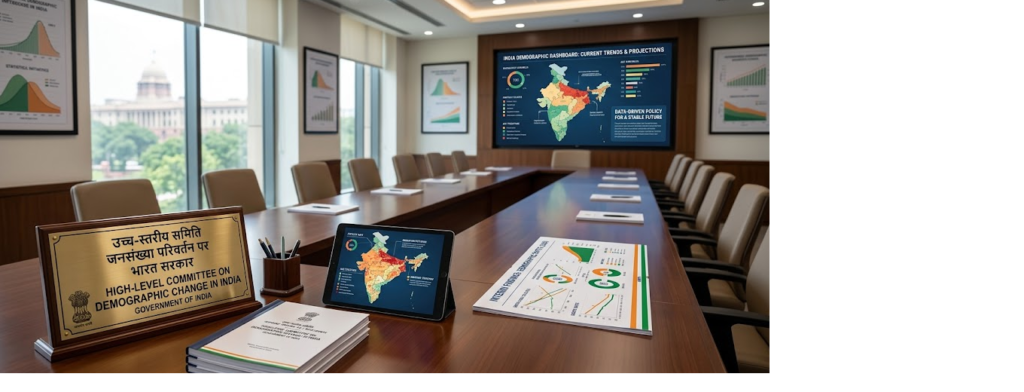
The Union Government has constituted a High-Level Committee on Demographic Change, chaired by retired Supreme Court Justice Prakash Prabhakar Navlekar, to scientifically study demographic shifts arising from illegal immigration and other abnormal factors.
This follows the announcement of a ‘High-powered Demography Mission’ by the Prime Minister on Independence Day (August 15, 2025).
Key Highlights of the Committee
- Composition:
- Chairman: Justice Prakash Prabhakar Navlekar (Retd.).
- Members: The Census Commissioner, Durga Shanker Mishra (Retd. IAS), Balaji Srivastava (Retd. IPS), and Dr. Shamika Ravi (Member, PM’s Economic Advisory Council).
- Member Secretary: Joint Secretary (Foreigners-I), Ministry of Home Affairs.
- Tenure: The committee is directed to submit its report within one year, with a provision for a six-month extension if necessary.
- Core Objective: To conduct a comprehensive assessment of demographic changes occurring across India due to illegal immigration, abnormal settlement patterns, and orchestrated migration.
Terms of Reference (ToR)
- Pattern Analysis: To analyze structural population changes and patterns of abnormal population shifts at the level of specific religious and social communities, particularly where they deviate from broader national trends.
- Operational Mechanism: To recommend a streamlined, permanent, and fair operational mechanism for the time-bound identification, detention, and deportation of illegal immigrants already residing in the country.
- Institutional Framework: To suggest an appropriate institutional mechanism for continuous monitoring of border management and population stabilisation.
- Centre-State Coordination: To propose a comprehensive policy framework enhancing coordination between the Central and State Governments on matters related to illegal immigration and resulting demographic imbalances.
Need for the Committee: Associated Concerns
- National Security and Sovereignty: Illegal infiltration often runs parallel to cross-border crimes such as human trafficking, arms smuggling, and narcotics trade, posing a direct threat to sovereignty.
- Strain on Resources: Abnormal population spikes in specific regions create immense pressure on local infrastructure, public services, and economic opportunities.
- Social Structure and Identity: Sudden demographic shifts can disrupt the local socio-cultural fabric, leading to law and order challenges and threatening the protection and rights of vulnerable tribal societies.
Current Demographic Trends in India
While the committee addresses unnatural population spikes, India’s broader natural demographic indicators are showing a declining trend:
- Falling Birth Rate: The latest Sample Registration System (SRS) report (2024) indicates that India’s birth rate fell from 21 in 2014 to 18.3 in 2024.
- Below Replacement Level TFR: According to the National Family Health Survey-V (NFHS-5) published in 2022, the country’s Total Fertility Rate (TFR) dropped to 2.0, which is lower than the replacement level of 2.1.
- Census Status: The last Census was conducted in 2011. The ongoing Census exercise is scheduled for completion in 2027.
Challenges Posed by Illegal Immigration
- Internal Security and Cross-Border Crime: Illegal immigration often coexists with transnational criminal networks. This leads to increased vulnerability to cross-border infiltration, trafficking of small arms, counterfeit currency circulation, and narcotics smuggling along porous border patches.
- Socio-Cultural Imbalances and Conflicts: Rapid and unnatural demographic changes can alter the voting patterns and socio-cultural fabric of border districts. In sensitive areas like the Northeast, this causes friction over land, local resources, and political representation, occasionally triggering ethnic and social conflicts.
- Economic Strain on Local Infrastructure: Sudden population spikes put intense pressure on public infrastructure, including healthcare, education, subsidized food distribution channels, and civic amenities. It also increases competition in the unorganized labor market, affecting local wages.
- Marginalization of Indigenous and Tribal Societies: Unchecked settlement patterns often encroach upon traditional tribal lands. This directly threatens the land rights, distinct cultural identities, and customary laws protected under the Fifth and Sixth Schedules of the Indian Constitution.
Proposed Solutions
- Smart Border Management (CIBMS): Accelerate the deployment of the Comprehensive Integrated Border Management System (CIBMS) using thermal imagers, infrared sensors, subterranean sensors, and laser barriers to plug gaps along riverine and porous terrain.
- National Documentation and Registry System: Expedite the digitization of land and citizenship records, integrated with the upcoming 2027 Census data. A secure, decentralized database makes the unauthorized acquisition of civil documents (like Aadhaar or PAN) significantly harder.
- Legal and Institutional Streamlining: Implement a standardized, time-bound legal framework across states for the fair identification, legal processing, and temporary housing of undocumented individuals within designated transit camps, adhering strictly to humanitarian protocols.
- Regional Economic Mapping: Track internal migration and labor flows at the panchayat and municipal levels to identify abnormal localized settlement spikes, allowing state machinery to distinguish between internal economic migration and external illegal infiltration.
Way Forward
- Enact a Comprehensive Refugee and Asylum Law: India needs to clearly distinguish between illegal economic migrants and genuine asylum seekers fleeing persecution. Enacting a dedicated national refugee law would provide institutional clarity and align security measures with global humanitarian standards.
- Neighborhood Diplomacy and Bilateral Treaties: Engage with neighboring countries—particularly Bangladesh and Myanmar—to establish structured institutional frameworks for verification, repatriation treaties, and intelligence sharing regarding human trafficking syndicates.
- Economic Integration of Border Areas: Deprivation in border districts breeds local support networks for cross-border smuggling. Strengthening local economies through border haats (markets), infrastructure development, and skill training can turn border communities into active partners in national security.
- Empower Local Community Vigilance: Strengthen institutional mechanisms like village defense parties and border-area panchayats, training them to report unauthorized border crossings or suspicious demographic shifts to central security forces in real time.
Prelims (PT) Question
Q. Consider the following statements regarding the recently constituted High-Level Committee on Demographic Change:
- It is chaired by the Union Home Minister to study demographic changes arising from illegal immigration.
- It is tasked with recommending an institutional mechanism for population stabilisation and border management.
- According to the latest National Family Health Survey-V (NFHS-5), India’s Total Fertility Rate (TFR) currently stands above the demographic replacement level.
Which of the statements given above is/are correct?
(a) 1 and 2 only
(b) 2 only
(c) 1 and 3 only
(d) 1, 2 and 3
Answer: (b) 2 only
- Statement 1 is incorrect: The committee is chaired by retired Supreme Court Judge, Justice Prakash Prabhakar Navlekar, not the Union Home Minister.
- Statement 2 is correct: The Terms of Reference include recommending mechanisms for population stabilization, border management, and the deportation of illegal immigrants.
- Statement 3 is incorrect: As per NFHS-5, India’s TFR has dropped to 2.0, which is below the replacement level of 2.1.
Mains Question
Q. “Illegal immigration and unnatural demographic changes pose a multifaceted threat to India’s internal security and social fabric.” In the light of the mandate given to the High-Level Committee on Demographic Change, critically examine the challenges posed by cross-border infiltration and suggest measures for its effective management. (250 words)