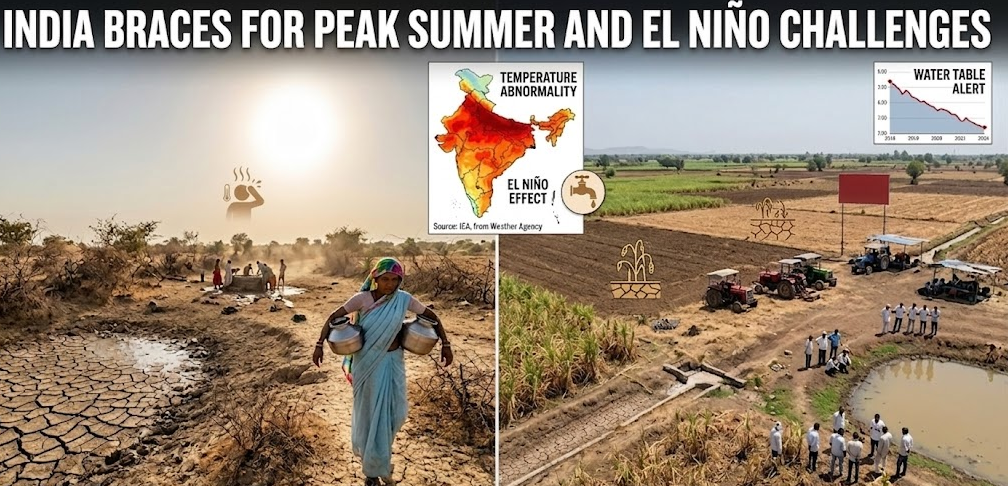
As India faces a record peak power demand of 256.1 GW amidst approaching heatwaves, the energy sector is relying on a “dual paradigm” of traditional thermal power and rapidly augmented solar capacity. The convergence of peak summer and a forecasted El Niño year has put India’s grid resilience and coal stocks under the spotlight.
Key Points
- Record Power Demand: India touched a peak demand of 256.1 GW on April 25, 2026, where thermal power contributed 66.9% and solar power showed a significant jump to 21.5% of the generation mix.
- Solar Power Revolution: India added a record 44.61 GW of solar capacity in FY 2025-26—more than double the previous year’s addition—taking solar to roughly 30% of total installed capacity.
- Storage Bottlenecks: Despite high installation, solar utilization is hampered by limited Battery Energy Storage Systems (BESS), leading to frequent “curtailment” to maintain grid stability during non-sunny hours.
- Robust Coal Reserves: The government maintains a comfortable cushion with 200 million tonnes of coal stocks, sufficient to power thermal plants for over 83 days at current consumption rates.
- Heatwave Forecast: The IMD has warned of increased heatwave days in Gujarat, Maharashtra, Odisha, West Bengal, and Andhra Pradesh, with El Niño likely to persist through the monsoon months (June–September).
Understanding El Niño
El Niño (Spanish for ‘The Boy Child’) is a climate pattern describing the unusual warming of surface waters in the central and eastern tropical Pacific Ocean. It is the “warm phase” of a larger phenomenon called the El Niño-Southern Oscillation (ENSO).
1. How it is Formed (The Process)
- Normal Conditions: Usually, strong “Trade Winds” blow from East to West (from South America toward Asia), pushing warm surface water toward Indonesia. This allows cold, nutrient-rich water to rise up (upwelling) near South America.
- El Niño Onset: During El Niño, these trade winds weaken or even reverse.
- Water Movement: The warm water that was pushed toward Asia starts flowing back toward the central and eastern Pacific (South America).
- Atmospheric Shift: The heat from this warm water rises into the atmosphere, changing circulation patterns and shifting rain clouds away from Asia toward the Americas.
2. Causes of El Niño
While the exact trigger is still a subject of intense research, primary causes include:
- Changes in Air Pressure: Shifts in the pressure differential between the western and eastern Pacific (the Southern Oscillation).
- Weakening Trade Winds: A sudden drop in the strength of winds that usually maintain the “Pacific Warm Pool” in the west.
- Subsurface Waves: Deep-sea waves (Kelvin waves) that carry heat across the ocean.
Global and Regional Effects
Impact on World Weather
- Americas: Heavy rainfall and flooding in Peru, Ecuador, and the Southern United States.
- Australia/S.E. Asia: Severe droughts and increased risk of bushfires/forest fires.
- Marine Life: The cessation of nutrient-rich upwelling near South America leads to a massive decline in fish populations (impacting global food chains).
Impact on India
- Monsoon Suppression: El Niño is historically linked to weak monsoon rains and a higher probability of drought in India.
- Agricultural Stress: Reduced rains during the Kharif season lead to lower crop yields (especially rice and pulses), triggering food inflation.
- Extreme Heat: It intensifies summer heatwaves, leading to the surge in power demand described in the current news.
- Economic Impact: As 50% of India’s workforce depends on agriculture, a weak monsoon directly impacts rural demand and GDP growth.
India’s Initiatives Against El Niño & Energy Crisis
To mitigate the “dual threat” of weather extremes and energy spikes, India has launched several strategic initiatives:
- Mission Electrification & Solarization: The massive addition of 44.61 GW solar capacity acts as a hedge against daytime peak loads during heatwaves.
- National Framework for Climate Services (NFCS): Launched to provide localized, climate-informed advisories to farmers and grid operators to prepare for El Niño-induced dry spells.
- BESS Implementation: The government has introduced Viability Gap Funding (VGF) for Battery Energy Storage Systems to ensure that solar energy generated during the day can be used during evening peaks.
- Coal Stock Monitoring: The “Railway-Power-Coal” inter-ministerial mechanism ensures seamless logistics to keep 80+ days of stock at thermal plants.
- PM-KUSUM: Solarizing agricultural pumps reduces the burden on the traditional grid during dry El Niño months when irrigation demand spikes.
UPSC Practice Questions
Prelims (PT) Question
Q. With reference to ‘El Niño’, consider the following statements:
- It involves the warming of the western tropical Pacific Ocean near the coast of Australia.
- It generally leads to an increase in the ‘upwelling’ of cold water near the Peruvian coast.
- In India, it is often associated with a deficit in monsoon rainfall and increased heatwave frequency.
Which of the statements given above is/are correct?
A) 3 only
B) 1 and 3 only
C) 2 and 3 only
D) 1, 2, and 3
Answer: A) 3 only
Explanation: Statement 1 is wrong (it warms the Eastern/Central Pacific). Statement 2 is wrong (it suppresses upwelling).
Mains Question
Q. “The recurring phenomenon of El Niño presents a multifaceted challenge to India’s energy security and agricultural stability.” Discuss the strategies India must adopt to build a ‘weather-resilient’ economy. (250 words)