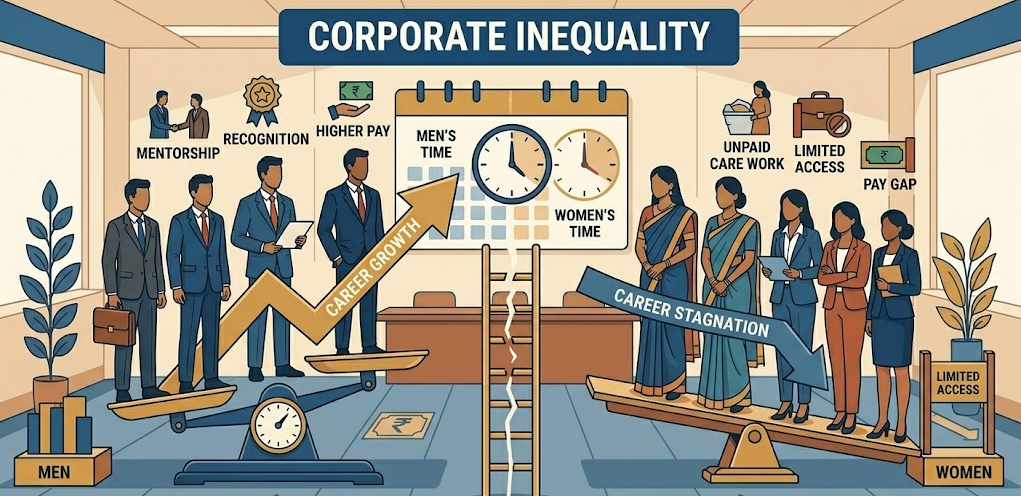
A recent analysis by the Udaiti Foundation (2024-25) reveals a stark gender imbalance in India’s formal workforce, noting that nearly 50% of NSE-listed companies have zero women in Key Managerial Positions (KMPs), highlighting a “glass ceiling” in corporate leadership and a decline in high-paying formal jobs for women.
Key Points
- Leadership Crisis: Out of 2,647 NSE-listed firms, almost half have no women in KMPs. On average, there are only 0.64 women per company in leadership, with a mere 10% of firms employing more than one woman at the top.
- Stagnant Participation: Women’s representation in the formal workforce has dipped from 19% in 2020-21 to 18% in 2024-25.
- The “Shunting” Effect: There is a concerning trend where women are being “shunted” to lower-wage jobs. While women’s share in high-paying jobs (above ₹18,000/month) crashed from 21% to 12%, their representation in lower-paid roles rose from 19% to 23%.
- Sectoral Disparity: Gender representation varies wildly by industry:
- High: Hospitals & Labs (48%), Textiles (37%), IT (34%).
- Low: Banks (26%), FMCG (21%), and Construction (a dismal 2%).
- The “Quality” Gap: Even in regular wage jobs, 57% of women have no written contract. Furthermore, the gender pay gap remains significant, with women earning approximately ₹5,664 less per month than men (₹18,353 vs ₹24,217).
Sociological and Economic Dimensions
1. The “Glass Ceiling” and “Leaky Pipeline”
- The lack of women in KMPs indicates a Glass Ceiling—an invisible barrier preventing women from rising to the upper rungs of the corporate ladder regardless of their qualifications.
- The Leaky Pipeline refers to women dropping out of the workforce at mid-management levels due to marriage, maternity, or “double burden” (household chores + office work).
2. Formalization without “Social Security”
- The study highlights that many women in the “formal” sector lack written contracts. In UPSC terms, this is Informalization of the Formal Sector.
- Even when jobs are officially recorded, they lack the “decency” of work defined by the International Labour Organization (ILO).
3. Occupational Segregation
- The concentration of women in textiles and healthcare vs. their absence in construction/finance is known as Horizontal Segregation.
- When women are prevented from reaching leadership, it is Vertical Segregation.
Government Initiatives & Legal Framework
- Companies Act, 2013: Mandates that every listed company and every public company with a certain turnover must have at least one woman director on its board.
- Code on Wages, 2019: Includes provisions for pay parity and prohibits gender-based discrimination in matters related to wages and recruitment for the same or similar work.
- Maternity Benefit (Amendment) Act, 2017: Increased paid maternity leave from 12 to 26 weeks to retain women in the workforce.
- PLFS (Periodic Labour Force Survey): The government’s official data tool (latest 2025) used to track Female Labour Force Participation Rate (FLFPR).
UPSC Practice Questions
Prelims (PT) Question
Q. With reference to the Companies Act, 2013, consider the following statements:
- It is mandatory for every listed company in India to have at least one woman director.
- Key Managerial Personnel (KMP) as defined by the Act includes the Chief Executive Officer and the Company Secretary.
- The Act mandates that at least 33% of the total board strength must be women in all public companies.
Which of the statements given above are correct?
A) 1 and 2 only
B) 2 and 3 only
C) 1 and 3 only
D) 1, 2, and 3
Answer: A) 1 and 2 only
Explanation: Statement 3 is incorrect. The law currently mandates at least one woman director, not 33% (though the Women’s Reservation Bill 2023 mandates 33% for legislatures, not private corporate boards).
Mains Question
Q. “Despite legislative measures like the Companies Act and the Code on Wages, the gender gap in corporate leadership and high-paying formal jobs remains a persistent challenge for India.” Critically analyze the socio-economic barriers that prevent women from breaking the ‘glass ceiling’ in the Indian private sector. (250 words)