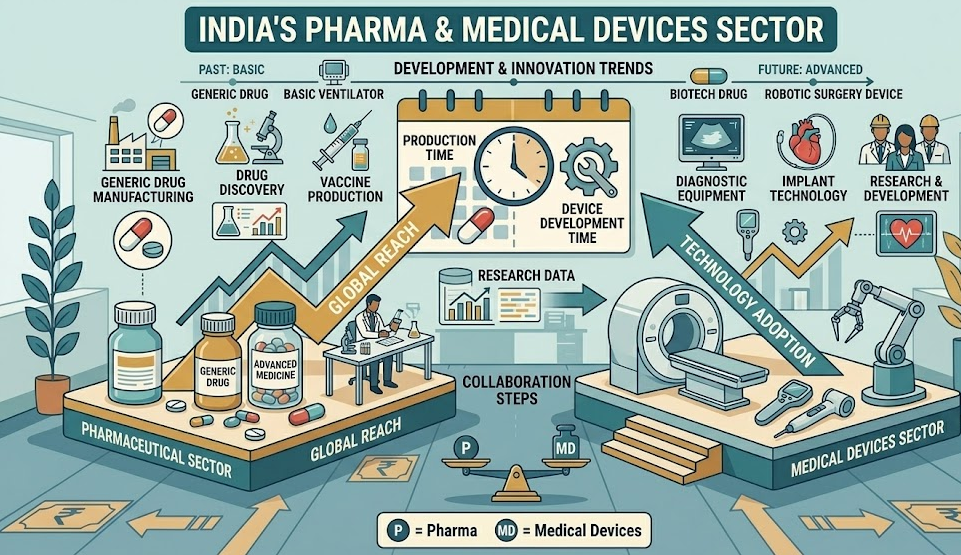
The Department of Commerce, through Pharmexcil, has launched a nationwide assessment of the pharmaceutical and medical devices sector to identify supply chain vulnerabilities and boost domestic manufacturing under the “Atmanirbhar Bharat” initiative.
Key Points
- Policy Objective: The exercise aims to map critical dependencies (especially on imports) and shape policy interventions to reduce external shocks, similar to those experienced during the COVID-19 pandemic.
- The PLI Connection: The assessment will help refine the Production-Linked Incentive (PLI) schemes, ensuring they target specific “ecosystem gaps” rather than just general production.
- Vulnerability Mapping: Pharmexcil is seeking data on Import Vulnerabilities (particularly raw materials like APIs), logistics risks, and global price fluctuations that impact the “cost-to-market” for Indian exporters.
- Competitiveness Constraints: The questionnaire focuses on “ground-level” challenges, including skill shortages, productivity gaps, and regulatory hurdles that hinder India’s goal of moving from the “Pharmacy of the World” to a “Global Med-Tech Hub.”
- Investment Roadmap: By identifying domestic gaps, the government intends to create a targeted support system to attract higher investment in local production and high-end medical technology.
Structural Challenges & Strategic Importance
1. The API Dependency (The “Dragon” in the Room)
Despite being a leader in generic formulations, India historically depended on a single country (China) for nearly 70% of its Active Pharmaceutical Ingredients (APIs). This assessment is a step toward “de-risking” this supply chain through China Plus One strategies.
2. The Medical Devices Sector (A “Sunrise Sector”)
India currently imports nearly 75-80% of its medical devices, particularly high-end equipment like MRI machines, pacemakers, and robotic surgical tools. The assessment seeks to bridge the gap between “low-tech disposables” (where India is strong) and “high-tech electronics.”
3. Logistics and “Soft Infrastructure”
The focus on Logistics Risks aligns with the National Logistics Policy, aiming to reduce the cost of logistics from 13-14% of GDP to single digits, making Indian pharma exports more price-competitive globally.
Relevant Government Initiatives
- PLI 1.0 & 2.0: Focuses on Key Starting Materials (KSMs), Drug Intermediates, and APIs.
- PLI for Medical Devices: Focuses on four target segments: Cancer care, Radiology, Anaesthetics, and Implants.
- Promotion of Bulk Drug Parks: A scheme to provide world-class common infrastructure facilities to reduce the manufacturing cost of bulk drugs.
- PRIP Scheme (Promotion of Research and Innovation in Pharma-MedTech): Launched to shift the focus from “Volume” to “Value” through R&D.
Explanation of Relevant Terms
| Term | Definition for UPSC |
| Pharmexcil | Pharmaceuticals Export Promotion Council of India. Set up by the Ministry of Commerce and Industry to promote Indian pharma exports. |
| API (Active Pharmaceutical Ingredient) | The central ingredient in a drug that produces the intended effects (e.g., the Paracetamol chemical in a Tylenol pill). |
| Supply Chain Resilience | The ability of a supply chain to persist, adapt, or transform in the face of change and disruptions. |
| KSM (Key Starting Material) | The raw materials used to manufacture APIs. Dependency here is the “deepest” point of vulnerability. |
UPSC Practice Questions
1. Prelims (PT) Question
Q. The ‘Production Linked Incentive (PLI)’ scheme for the pharmaceutical sector in India specifically aims to achieve which of the following?
- To reduce the dependence on imported Active Pharmaceutical Ingredients (APIs).
- To promote the manufacturing of high-value products like complex generics and cell-based medicines.
- To mandate that 100% of the raw materials used in exported drugs must be sourced domestically.
Select the correct answer:
A) 1 and 2 only
B) 2 and 3 only
C) 1 and 3 only
D) 1, 2, and 3
Answer: A) 1 and 2 only
Explanation: Statement 3 is incorrect; the scheme encourages domestic sourcing but does not mandate 100% domestic raw materials for exports.
2. Mains Question
Q. “India’s journey from being the ‘Pharmacy of the World’ to a self-reliant leader in the Global Value Chain requires bridging the gap between manufacturing volume and research-led value.” In light of the recent supply chain assessments, discuss the hurdles in achieving ‘Atmanirbharta’ in the medical devices and API sectors. (250 words)