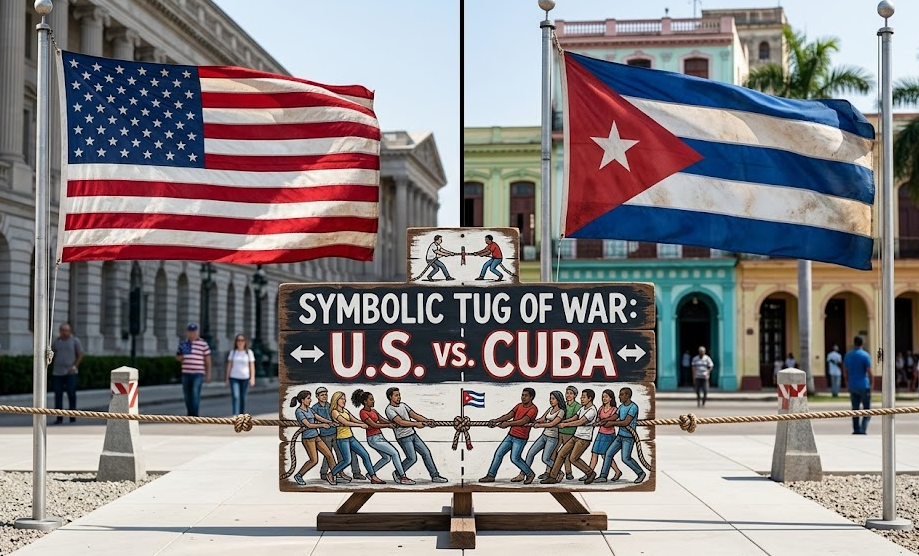
On May 1, 2026, U.S. President Donald Trump signed an executive order significantly expanding economic sanctions on Cuba. This move comes amid a severe energy crisis on the island, exacerbated by a U.S.-led fuel blockade that began earlier this year following the ousting of Venezuela’s leader.
Key Points of the Executive Order
- Sectoral Targeting: The sanctions apply to individuals and entities operating in critical sectors of the Cuban economy, including Energy, Defence, Metals and Mining, Financial Services, and Security.
- Secondary Sanctions: In a major shift, the U.S. will now target foreign financial institutions (banks) and people that conduct significant transactions with the sanctioned Cuban entities. This aims to isolate Cuba from the global banking system.
- Asset Freezing: All property and financial interests belonging to the targeted individuals that are under U.S. jurisdiction are now frozen and cannot be transferred or sold.
- Human Rights & Corruption: The order specifically targets Cuban officials judged to be involved in “serious human rights abuses” or corruption, barring them and their affiliates from entering the United States.
- Geopolitical Strategy: Experts view this as a “maximum pressure” campaign intended to force regime change. Secretary of State Marco Rubio has echoed this, calling for significant political and economic reforms on the island.
Economic and Social Impacts
- The Energy Crisis: Cuba is currently facing its worst energy crisis in decades. Following the U.S. intervention in Venezuela in early 2026, the flow of subsidized oil to the island was cut off. The U.S. has since been blocking tankers from other nations (like Mexico) from delivering crude, leading to widespread blackouts.
- Humanitarian Concerns: Reports from May 2026 indicate a sharp decline in public health metrics. The inability to pay for food and medicine—due to banking restrictions—has contributed to a nearly 150% increase in infant mortality since 2018.
- International Reaction: Cuban President Miguel Díaz-Canel has condemned the measures as “collective punishment” and a “genocidal blockade.” Meanwhile, countries like Mexico have called the U.S. pressure an affront to sovereignty, though many have temporarily halted oil shipments to avoid U.S. tariffs.
- Hyperinflation: As the supply of goods vanishes and the government prints money to sustain public salaries, the Cuban Peso (CUP) has plummeted. The black-market exchange rate is currently the only functional metric for most citizens.
- Tourism Sector Decay: By targeting “financial services” and “security sectors” (which own many hotels), the U.S. has effectively banned American and many European travelers from using major Cuban resorts, crippling the island’s primary source of hard currency.
Explanation of Relevant Terms
| Term | Definition for UPSC |
| Secondary Sanctions | Sanctions that target third-party countries or companies (not directly involved in the conflict) for doing business with a sanctioned nation. |
| Maximum Pressure | A foreign policy strategy using intense economic and diplomatic sanctions to force a government to change its behavior or step down. |
| Trade Embargo | A government order that restricts commerce or exchange with a specified country or the exchange of specific goods. The U.S. embargo on Cuba has existed since 1962. |
| Regime Change | The replacement of one government or administration by another, especially by means of military force or political pressure from an outside power. |
UPSC Practice Questions
1. Prelims (PT) Question
Q. With reference to ‘Secondary Sanctions’ often imposed by the United States, consider the following statements:
- They are primarily designed to prevent non-U.S. entities from conducting business with a country already under primary U.S. sanctions.
- They are legally binding on all United Nations member states as per the UN Charter.
- They often involve cutting off the targeted foreign entity’s access to the U.S. financial system and markets.
Which of the statements given above are correct?
A) 1 and 2 only
B) 2 and 3 only
C) 1 and 3 only
D) 1, 2, and 3
Answer: C) 1 and 3 only
Explanation: Secondary sanctions are unilateral U.S. measures, not UN-mandated international law (Statement 2 is false).
2. Mains Question
Q. “Unilateral economic sanctions, while a tool of foreign policy, often lead to unintended humanitarian crises and challenge the principles of global sovereign equality.” Critically analyze this statement in the context of the 2026 U.S. sanctions on Cuba. (250 words)