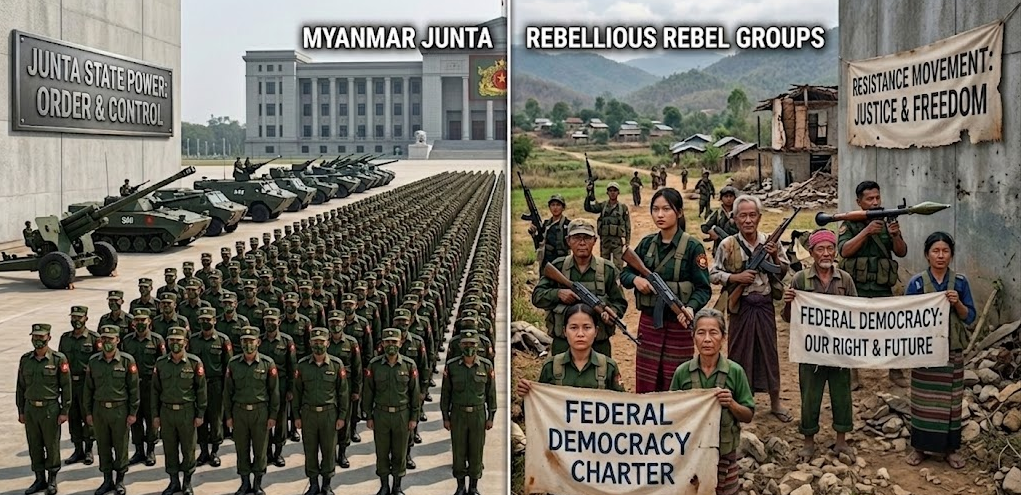
After facing major territorial losses throughout 2023 and 2024, the military junta (Tatmadaw) has regained the strategic initiative through a combination of mass conscription, political restructuring, and a “divide and conquer” strategy against opposition groups.
1. The Military’s Strategic Reassertion
The Tatmadaw, once considered on the verge of collapse by some analysts, has stabilized its front lines.
- Mass Conscription: By utilizing mandatory enlistment laws, the military has replenished its ranks with tens of thousands of new conscripts. This has allowed it to reverse territory losses in central Myanmar and the north.
- Presidential Transition: On April 10, 2026, Senior General Min Aung Hlaing was officially sworn in as President of Myanmar following junta-controlled elections held between December 2025 and January 2026. This move is seen as an attempt to pivot from a “direct junta” to a “quasi-civilian” proxy government to gain international legitimacy.
- Offensive Operations: The military is currently pressing a major offensive in the Sagaing region, aiming to retake strategic cities like Indaw, which had been captured by resistance forces last year.
Fractures in the Resistance Alliance
The Three Brotherhood Alliance, which led the massive “Operation 1027” offensive in 2023, has largely been neutralized as a unified front:
- Brokered Ceasefires: Under immense pressure from China, two of the three alliance members—the MNDAA (Myanmar National Democratic Alliance Army) and the TNLA (Ta’ang National Liberation Army)—signed ceasefires in late 2025 and early 2026.
- The Arakan Army (AA): Currently the only member of the original alliance still actively fighting, the AA remains a formidable force in western Rakhine State, where it continues to seize territory.
- Infighting: Strategic rivalries have emerged; for instance, in March 2026, clashes broke out between the MNDAA and the TNLA over control of the strategic town of Kutkai, reflecting shifting interests as groups prioritize regional control over the broader anti-junta revolution.
The Humanitarian and Social Toll
The conflict has entered its fifth year with a heavy toll on the civilian population:
- Casualties: Estimates suggest over 8,000 civilians have been killed since the 2021 coup.
- Displacement: Millions remain displaced, with humanitarian aid often used as a tool of war.
- “Conflict Weariness”: Analysts note a growing “war fatigue” among the general population, with many civilians prioritizing an end to the violence over a definitive victory for either side.
China’s Decisive Influence
China remains the most influential external actor, prioritizing stability to protect its vast infrastructure investments:
- Economic Corridors: Beijing has invested billions in oil and gas pipelines and rare earth mines. It has pressured border militias to stop fighting to keep trade routes open.
- Legitimacy: Beijing was among the first to congratulate Min Aung Hlaing on his presidency, signaling a preference for a stable (if authoritarian) regime over the uncertainty of a fragmented resistance victory.
The intensification of the Myanmar civil war and the military’s reassertion in 2026 have created a “cascading crisis” for India and the Southeast Asian region. The impact spans from severe internal security challenges in India’s Northeast to a total diplomatic deadlock within ASEAN.
Impact on India: Security and Strategic Interests
India shares a 1,643 km border with Myanmar, making it directly vulnerable to the spillover of the conflict.
- Internal Security & Insurgency:
- The “Safe Haven” Problem: Several Indian Insurgent Groups (IIGs) from Manipur and Assam have reportedly taken advantage of the chaos to reactivate bases in Myanmar’s Sagaing region.
- Refugee Influx: As of early 2026, thousands of refugees continue to cross into Mizoram and Manipur. While Mizoram has been more welcoming due to ethnic ties (Chin-Kuki-Mizo), the influx has exacerbated the ethnic conflict in Manipur, where the presence of “outsiders” is a highly sensitive political issue.
- Stalled Infrastructure (Act East Policy):
- Kaladan Multi-Modal Project: The critical road link between Paletwa (Myanmar) and Mizoram remains incomplete. As of 2026, the Arakan Army (AA) controls most of the project’s route in Rakhine State, forcing India to negotiate with non-state actors to ensure the project’s safety.
- India-Myanmar-Thailand Trilateral Highway: About 30% of the project remains unfinished due to active fighting in the Sagaing and Kayin regions.
- Narcotics and Arms Smuggling: The breakdown of law and order has led to a surge in the trafficking of “Yaba” (methamphetamine) and illegal weapons into India’s “Seven Sister” states.
Impact on Southeast Asia (ASEAN)
The Myanmar crisis has become the greatest test of ASEAN’s unity since its inception.
- Diplomatic Isolation: In a historic move, ASEAN leaders confirmed that Myanmar will not be allowed to take the rotating leadership (Chairmanship) of the bloc in 2026. The role has been handed to the Philippines instead.
- Rejection of Elections: Most ASEAN members, including Indonesia, Malaysia, and the Philippines, have officially rejected the 2026 junta-led elections as neither free nor fair, refusing to grant the new “President” Min Aung Hlaing any regional legitimacy.
- The “Backyard Crisis”: Thailand and Malaysia are facing a dual crisis:
- Refugees: Millions of displaced people are seeking shelter across the Thai border.
- Trade: The Asian Highway routes are frequently blocked, disrupting land-based trade between Southeast Asia and the Indian subcontinent.
Geopolitical Competition: China vs. India
Myanmar has become a theater for strategic competition.
- China’s Footprint: China has successfully used its influence over border militias (like the MNDAA) to protect its China-Myanmar Economic Corridor (CMEC) and rare earth mines. By mediating ceasefires, Beijing has positioned itself as the “indispensable broker,” often at the expense of Indian and Western influence.
- India’s Balancing Act: India maintains a “dual-track” policy—engaging with the junta for security and border management while supporting the restoration of democracy to prevent pushing the junta entirely into China’s embrace.
Practice Question
Preliminary Examination
Q1. With reference to the ‘Suspension of Operations (SoO)’ and peace accords in Northeast India and its neighborhood, consider the following statements:
- The Three Brotherhood Alliance in Myanmar consists of the Arakan Army, the Myanmar National Democratic Alliance Army, and the Ta’ang National Liberation Army.
- The Kaladan Multi-Modal Transit Transport Project connects the port of Kolkata with the Sittwe port in Myanmar’s Rakhine State.
- India’s ‘Free Movement Regime’ (FMR) with Myanmar, which allowed tribes to travel 16 km across the border without a visa, was officially scrapped in 2024-25.
Which of the statements given above are correct?
A) 1 and 2 only
B) 2 and 3 only
C) 1 and 3 only
D) 1, 2, and 3
Mains Examination
Q. “The porous nature of the Indo-Myanmar border, combined with the ongoing civil war in Myanmar, acts as a force multiplier for insurgent groups in Northeast India.” Discuss the security implications of the Myanmar crisis on the ethnic stability of Manipur and Mizoram. (150 words, 10 Marks)