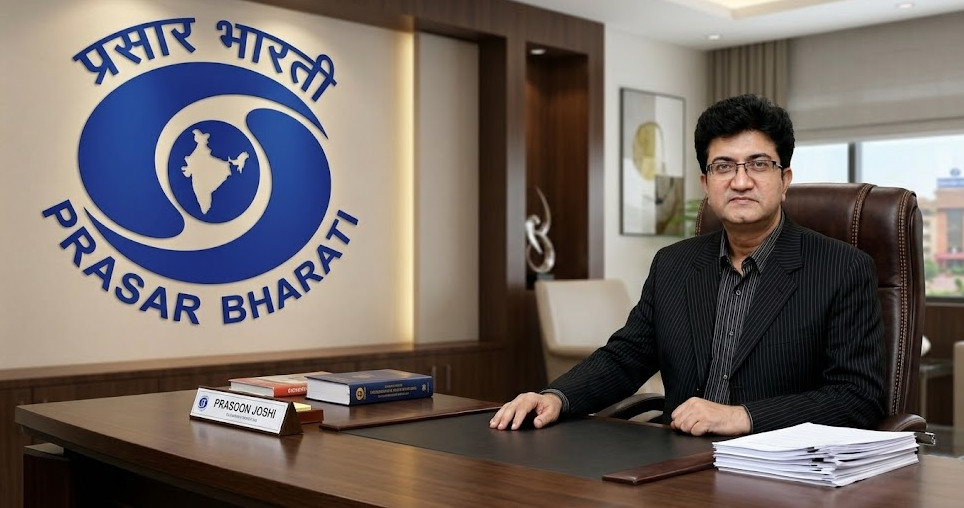
On May 2, 2026, the Ministry of Information and Broadcasting (I&B) appointed renowned lyricist, writer, and advertising veteran Prasoon Joshi as the Chairman of Prasar Bharati. The position had been vacant since December 2025, following the resignation of retired IAS officer Navneet Kumar Sehgal.
Key Points of the Appointment
- Creative Stewardship: Union Minister Ashwini Vaishnaw highlighted Mr. Joshi’s “rare creative spirit” and his ability to reflect the “timeless essence of Indian culture,” signaling a shift toward a more creative and narrative-driven leadership for India’s public broadcaster.
- Previous Tenure: Prasoon Joshi has served as the Chairperson of the Central Board of Film Certification (CBFC) since August 2017. He is also a trustee of the Indira Gandhi National Centre for the Arts (IGNCA).
- Succession: He succeeds Navneet Kumar Sehgal, who resigned halfway through his three-year term in December 2025 citing personal reasons.
- Timing: The appointment comes at a crucial juncture as Prasar Bharati (incorporating Doordarshan and Akashvani) navigates the challenge of digital transformation and OTT competition.
UPSC Perspective: Institutional Framework of Prasar Bharati
Prasar Bharati is an autonomous statutory body established under the Prasar Bharati (Broadcasting Corporation of India) Act, 1990. It came into existence on November 23, 1997. It is the public service broadcaster of India, comprising Akashvani (All India Radio) and Doordarshan.
The Prasar Bharati Board
The general management of the corporation vests in the Prasar Bharati Board.
- Composition:
- Chairman: A part-time member (must be a person of eminence in public life).
- One Executive Member: Acts as the Chief Executive Officer (CEO).
- One Member (Finance) and One Member (Personnel) (Whole-time members).
- Six Part-time Members.
- Ex-officio Members: Director Generals of Akashvani and Doordarshan.
- Nominee: A representative from the Ministry of I&B.
The Appointment Process (Critical for PT)
The Chairman and other members (except ex-officio) are appointed by the President of India on the recommendation of a three-member committee consisting of:
- The Vice President of India (as Chairman of the Committee).
- The Chairman of the Press Council of India.
- A nominee of the President of India.
Tenure and Eligibility
- Chairman: Holds office for a term of three years or until the age of 70 years, whichever is earlier.
- CEO: Holds office for a term of five years or until the age of 65 years.
Significance of the Role
- Public Service Mandate: Unlike private broadcasters, Prasar Bharati is mandated to inform, educate, and entertain while upholding the unity and integrity of the country and the values enshrined in the Constitution.
- Soft Power: As the voice of the nation, the Chairman plays a vital role in projecting India’s “soft power” through cultural and developmental content.
- Technological Shift: The new leadership is expected to oversee the integration of AI and 5G-led broadcasting (D2M – Direct-to-Mobile) to keep the state broadcaster relevant in the age of streaming.
UPSC Practice Questions
Prelims (PT) Question
Q. With reference to the Prasar Bharati Board, consider the following statements:
- It is a constitutional body established under Article 324 of the Constitution.
- The Chairman is appointed by a committee headed by the Prime Minister of India.
- The Chairman holds office for a term of three years or until the age of 70.
Which of the statements given above is/are correct?
A) 3 only
B) 1 and 3 only
C) 2 and 3 only
D) 1, 2, and 3
Answer: A) 3 only
Explanation: It is a statutory (not constitutional) body. The appointment committee is headed by the Vice President, not the Prime Minister.
Mains Question
Q. “In an era dominated by private media houses and OTT platforms, the role of a public service broadcaster like Prasar Bharati remains indispensable for a diverse democracy like India.” Critically analyze. (250 words)